Russian poetry doesn’t begin with Pushkin, just as Russian music doesn’t begin with his contemporary Glinka, but it is hardly an exaggeration to see both of them as the source of all the fine things that Russian music and literature have produced since the early nineteenth century.
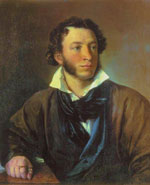
Aleksandr Pushkin (1799–1837) was far from being some impossible Sacred Monster to be treated with distant respect, but a very real human being, full of passions and contradictions, sudden enthusiasms and hesitations, a great lover and a clear-eyed observer, a man who springs vividly to life in everything he wrote or did. Few writers in any language can match Pushkin for the variety of his styles and subjects. His re-tellings of the old Russian folk tales he heard in his childhood are full of wonder, humour and mystery. His education at the Imperial Lycée gave him a grounding in the Classics which is reflected in his sculpted metres and rhythmic virtuosity. With a worldly life in St Petersburg there began the series of lyrics which explore every aspect of love. There followed some years spent in Southern Russia, where he encountered the exotic, Asiatic part of his country; then, with his return to the North, he embarked on a series of large-scale works in verse and prose which delve into Russia’s past and its evolution towards his own times, giving a precise literary reflection of every level of Russian society, with its particular traditions, customs and ways of speech.
At the time when Soviet Russia was marking the centenary of Pushkin’s death, a double standard prevailed. Pushkin’s hatred of tyranny was all very well as long as it applied to the bad old Tsarist days, but any application to contemporary reality was out of the question. The 1937 celebrations tended to focus on his less controversial works, musicians choosing lyric verses that avoided confronting the sort of oppression Pushkin knew well from personal experience. In 1825 he had found himself on the fringes of the Decembrist revolt, which attempted to provide some sort of constitution for Russia. He spent the rest of his life either under virtual house-arrest at his small country estate, or under the watchful eyes of officialdom in St Petersburg, where Tsar Nikolai I appointed himself the personal censor of the writer he is supposed to have described as ‘the wisest man in Russia’.
Few Russian composers could resist setting verses by this compelling figure, and his influence on the development of Russian music was indirectly as great as his influence on literature. For one thing, Pushkin’s poetry encouraged musicians who set his words to be clear, concise and direct. The Russian language itself, with its rich clusters of consonants and dark, liquid vowels, has a unique fascination, and the general practice among Russian composers of setting one note per syllable results in a close bond between words and music, with vocal lines intimately shaped by poetic stresses and phrasing.
from notes by Andrew Huth © 2009
La poésie russe ne commence pas avec Pouchkine, pas plus que la musique russe ne commence avec son contemporain Glinka, mais on exagère à peine en disant qu’ils sont à l’origine de tout ce que la musique et la littérature russes ont produit de beau depuis le début du XIXe siècle.
Loin d’être un monstre sacré impossible, à traiter avec un respect distant, Aleksandr Pouchkine (1799–1837) fut un être humain tout ce qu’il y a de plus vrai, plein de passions et de contradictions, de brusques enthousiasmes et d’hésitations, un grand amoureux et un observateur lucide, un homme qui s’anima intensément dans tout ce qu’il écrivit ou fit. Peu d’auteurs, russophones ou non, peuvent égaler sa variété stylistique et thématique. Ses refaçons des vieux contes populaires russes entendus dans son enfance sont pétris de merveilleux, d’humour et de mystère. Son éducation au Lycée impérial lui donna des bases classiques, que reflètent ses mètres ciselés et sa virtuosité rythmique. Avec l’expérience de la vie pétersbourgeoise vint une série de poèmes explorant toutes les facettes de l’amour. S’ensuivirent quelques années en Russie méridionale, où Pouchkine découvrit la partie exotique, asiatique de son pays; puis, de retour dans le nord, il se lança dans une série d’œuvres à grande échelle, en vers et en prose qui, fouillant le passé de la Russie, la manière dont elle évolua vers son époque à lui, brossent un tableau littéraire précis de toutes les couches de la société russe, avec leurs traditions, leurs coutumes et leurs parlers.
Quand elle fêta le centenaire de la mort de Pouchkine, la Russie soviétique eut deux poids, deux mesures. La haine du poète pour la tyrannie était parfaite tant qu’elle se cantonnait au bon vieux temps tsariste, mais il était hors de question de l’étendre à la réalité du moment. Les célébrations de 1937 tendirent donc à se focaliser sur ses œuvres les moins controversées: le choix des musiciens se porta sur des poèmes lyriques qui évitaient de se confronter au type d’oppression que Pouchkine avait bien connu, par expérience personnelle. Quelque cent vingt ans auparavant, il s’était retrouvé en marge de la révolte décembriste de 1825, qui tenta d’apporter une manière de constitution à la Russie. Dès lors, il vécut soit en quasi-résidence surveillée dans son petit domaine, soit sous le regard vigilant de la bureaucratie, à Saint-Pétersbourg; où le tsar Nicolas Ier se nomma le censeur de l’écrivain qu’il est supposé avoir décrit comme «l’homme le plus sage de Russie».
Peu de compositeurs russes purent résister à l’envie d’exprimer en musique des poèmes de cette figure envoûtante, qui influença autant la musique, fût-ce indirectement, que la littérature russes. Pour commencer, sa poésie encouragea une mise en musique claire, concise et directe. La langue russe elle-même, avec ses riches agglomérats de consonnes et de voyelles très fermées, liquides, exerce une fascination unique et la pratique des compositeurs russes consistant à allouer une note à chaque syllabe induit un lien étroit entre le texte et la musique, avec des lignes vocales intimement façonnées par les accents et le phrasé poétiques.
extrait des notes rédigées par Andrew Huth © 2009
Français: Hypérion
Russische Dichtung beginnt ebenso wenig mit Puschkin wie russische Musik mit seinem Zeitgenossen Glinka beginnt, doch ist es nicht übertrieben, die beiden als Quelle aller guten Dinge zu betrachten, die die russische Musik und Literatur seit dem frühen 19. Jahrhundert hervorgebracht haben.
Alexander Puschkin (1799–1837) war keineswegs ein schwieriges, unnahbares Wesen, das mit distanzierter Hochachtung behandelt werden musste, sondern ein vollblütiger Mensch voller Leidenschaften und Widersprüche, der sich plötzlich begeistern oder aber zögerlich sein konnte und der auch ein großer Liebhaber und guter Beobachter war; ein Mann, der sich mit allem, was er schrieb oder tat, lebhaft auseinandersetzte. Nur wenige Schriftsteller, ganz gleich in welcher Sprache, erreichen Puschkins Vielfalt von Stilen und Themen. Seine Nacherzählungen der russischen Volksmärchen, die ihm in seiner Kindheit erzählt worden waren, sind geheimnisvoll, voller Staunen und Humor. Am Lyzeum in Zarskoje Selo erhielt er eine humanistische Grundausbildung, die sich in seinen wohlgeformten Metren und seiner rhythmischen Virtuosität widerspiegelt. Als er dann am Gesellschaftsleben in Sankt Petersburg teilnahm, entstanden eine Reihe von Dichtungen, in denen die Liebe von allen Seiten beleuchtet wird. Darauf folgten einige Jahre in Südrussland, wo er den exotischen asiatischen Teil seines Heimatlandes kennenlernte. Als er danach in den Norden zurückkehrte, begann er mit der Arbeit an einer Reihe von großangelegten Werken, sowohl in Versen als auch in Prosa, die sich mit der Geschichte Russlands und der Entwicklung des Landes bis in seine eigene Zeit hinein auseinandersetzen. Damit schuf er ein genaues literarisches Abbild aller Schichten der russischen Gesellschaft, der jeweiligen Traditionen, Bräuche und sprachlichen Eigenheiten.
Puschkins 100. Todestag wurde vom sowjetischen Russland mit einer gewissen Doppelmoral begangen. Seine Verachtung für Tyrannei war schön und gut, wenn sie mit der bösen alten Zarenzeit in Verbindung gebracht wurde, doch ein Vergleich mit der Zeitgeschichte stand außer Frage. Die Jubiläumsfeiern von 1937 konzentrierten sich zumeist auf seine weniger kontroversen Werke und die Musiker wählten lyrische Verse, in denen die Unterdrückung, die Puschkin aus eigener Erfahrung wohlbekannt gewesen war, nicht thematisiert wurde. Etwa 120 Jahre zuvor hatte er am Rande der Dekabristen-Revolution von 1825 mitgewirkt, deren Ziel es war, eine Art Konstitution für Russland zu entwerfen. Den Rest seines Lebens verbrachte er entweder mehr oder minder unter Hausarrest auf seinem kleinen Landsitz, oder unter den wachsamen Augen der Bürokratie in Sankt Petersburg, wo sich der Zar, Nikolaus I., zum persönlichen Zensor des Schriftstellers ernannt hatte, den er angeblich als den „weisesten Mann Russlands“ beschrieben hatte.
Nur wenige russische Komponisten konnten der Verlockung widerstehen, die Verse dieses bezwingenden Dichters zu vertonen, wodurch sein Einfluss auf die Entwicklung der russischen Musik indirekt genauso groß ist wie sein Einfluss auf die Literatur. Um nur einen Aspekt zu nennen, animierten Puschkins Dichtungen die Komponisten dazu, ihre Vertonungen deutlich, präzise und direkt zu gestalten. Die russische Sprache mit ihren Anhäufungen von klangvollen Konsonantenkombinationen und dunklen, fließenden Vokalen hat selbst eine besondere Anziehungskraft und das übliche Verfahren unter russischen Komponisten bestand darin, jeweils eine Silbe mit einer Note zu vertonen, was zu einer starken Bindung zwischen Musik und Wort führte, wobei die Vokallinien von den dichterischen Betonungen und Phrasierungen deutlich vorbestimmt sind.
aus dem Begleittext von Andrew Huth © 2009
Deutsch: Viola Scheffel