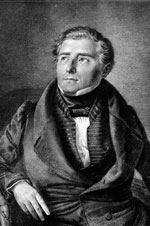
Born in the village of Löbejün, near Halle, just two months before Schubert, Carl Loewe has been aptly described as a medieval strolling minstrel transplanted to the Romantic age. As the star chorister in Köthen he had won the admiration, and the financial support, of Jérôme Bonaparte, King of Westphalia. He composed two of his most famous ballads, ‘Edward’ and ‘Erlkönig’, in 1817/18, while still a student in Halle. In 1820 his performances of ‘Erlkönig’ and other songs greatly impressed Goethe and his musical guru Carl Zelter in Weimar. Appointed music director in Stettin (present-day Szczecin) the same year, Loewe composed prolifically in all the main genres of the day: opera, oratorio, symphony, sonata, chamber music. But it was as a singer of his own songs that he became celebrated, first in the provincial capitals of Germany, and then on a wider international stage. In 1847 he visited London and sang at court, with Prince Albert turning the pages. The Viennese, who especially admired his ‘Erlkönig’, dubbed him ‘the north German Schubert’; and wherever he performed—sometimes sharing a recital with his second wife Auguste, a gifted soprano—he was acclaimed both for his imposing dramatic presence and his fine voice: a tenorish baritone of wide range, with a special facility in florid figuration and soft, high-lying music, whether playful or eerie.
from notes by Richard Wigmore © 2011
Né dans le village de Löbejün, près de Halle, juste deux mois avant Schubert, Carl Loewe a été judicieusement décrit comme un ménestrel médiéval transplanté à l’ère romantique. Choriste vedette à Cöthen, il avait suscité l’admiration et le soutien financier de Jérôme Bonaparte, roi de Westphalie. Il a composé deux de ses plus célèbres ballades,
Edward et
Erlkönig, en 1817/18, alors qu’il était encore étudiant à Halle. En 1820, ses interprétations d’
Erlkönig et d’autres lieder ont beaucoup impressionné Goethe et son gourou musical Carl Zelter à Weimar. Nommé directeur de la musique à Stettin (aujourd’hui Szczecin) la même année, Loewe a composé de manière prolifique dans tous les principaux genres de l’époque: opéra, oratorio, symphonie, sonate, musique de chambre. Mais c’est en chantant ses propres lieder qu’il est devenu célèbre, tout d’abord dans les capitales provinciales d’Allemagne, puis sur un plan international plus élargi. En 1847, il s’est rendu à Londres et a chanté à la cour, le prince Albert tournant les pages. Le Viennois, qui admirait particulièrement son
Erlkönig («Le Roi des aulnes»), l’a surnommé «le Schubert d’Allemagne du Nord»; et, partout où il se produisait—partageant parfois un récital avec sa seconde femme, Auguste, une soprano de talent—il remportait un grand succès grâce à sa présence dramatique imposante et à sa belle voix de baryton ténorisant à la tessiture étendue, avec une facilité particulière pour la figuration fleurie et la musique douce dans l’aigu, gaie ou sinistre.
extrait des notes rédigées par Richard Wigmore © 2011
Français: Marie-Stella Pâris
Carl Loewe wurde nur zwei Monate vor Schubert geboren und treffend als der fahrende, mittelalterliche Musikant der Romantik beschrieben. Er stammte aus Löbejün bei Halle und sang als Schuljunge im Köthener Knabenchor. Dort tat er sich besonders hervor, was ihm die Anerkennung und finanzielle Unterstützung von Jérôme Bonaparte, dem König von Westphalen, einbrachte. Zwei seiner berühmtesten Balladen,
Edward und
Erlkönig, entstanden 1817/18, während seiner Studienzeit in Halle. Im Jahr 1820 zeigten sich Goethe und dessen musikalischer Berater Carl Zelter in Weimar sehr beeindruckt von seinen Aufführungen des
Erlkönigs und anderen Liedern. Im selben Jahr wurde Loewe in Stettin zum Musikdirektor ernannt und komponierte reichlich in allen wichtigen Genres der Zeit: Oper, Oratorium, Symphonie, Sonate, Kammermusik. Besonders gefeiert wurde er jedoch als Sänger seiner eigenen Lieder, zunächst in den deutschen Provinzhauptstädten und dann auch in verschiedenen internationalen Musikzentren. 1847 reiste er nach London und sang bei Hofe, wobei Prinz Albert ihm umblätterte. Die Wiener, die besonders seinen
Erlkönig bewunderten, nannten ihn den „norddeutschen Schubert“; und wo er auch auftrat—manchmal zusammen mit seiner zweiten Ehefrau Auguste, einer begabten Sopranistin—wurde sowohl sein imposantes dramatisches Auftreten als auch seine schöne Stimme gelobt: ein tenoriger Bariton mit einem großen Stimmumfang und einer besonderen Gabe für Figurationen und sanfte Musik in hoher Lage, sowohl spielerischer als auch schauriger Art.
aus dem Begleittext von Richard Wigmore © 2011
Deutsch: Viola Scheffel