Welcome to Hyperion Records, a British classical label devoted to presenting high-quality recordings of music of all styles and from all periods from the twelfth century to the twenty-first.
Hyperion offers both CDs, and downloads in a number of formats. The site is also available in several languages.
Please use the dropdown buttons to set your preferred options, or use the checkbox to accept the defaults.
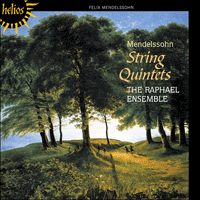

Mendelssohn's two String Quintets were composed at opposite ends of his short career. No 1 was written in 1826, soon after the completion of the Octet and E major Piano Sonata and before the Overture to 'A Midsummer Night's Dream', when Mendelssohn was still only seventeen. He later substituted a slow movement in memory of his friend the violinist Eduard Rietz, and it was this revised version of the Quintet that was published in Bonn the same year and is recorded here.
Quintet No 2 dates from 1845 (when Mendelssohn was still only thirty-six), a year before his triumphant success with Elijah in Birmingham and just two years prior to his premature death.

Although Mendelssohn possessed a talent which was almost inexhaustible in terms of its promise and potential, he nevertheless lacked the inner determination to develop his powers to their fullest extent. He was a sensitive man who was ultimately destroyed by his constant and caring attempts to counterbalance his extraordinary gifts with the need for a small number of intimate relationships away from the exhausting demands of being an idolized musical celebrity. As he once put it: ‘The thoughts which are expressed to me by music that I love are not too indefinite to be put into words, but on the contrary, too definite.’
Of the musical generation which succeeded Beethoven and Schubert, Mendelssohn was the only major composer to adopt an openly neo-Classical style. This has led to certain misunderstandings about Mendelssohn being in some ways a backward-looking composer, one who in his early years faced up to the implications of middle-period Beethoven (again the only one of his contemporaries to do so) but who subsequently back-pedalled into anachronistic regurgitation of earlier triumphs. What this point of view fails to take into account is the actual timing of Mendelssohn’s instigation of entirely novel procedures. Indeed, at the same time as Beethoven was working on his late-period masterpieces in the early-to-mid 1820s, Mendelssohn the teenage prodigy was already developing a style based upon the Classical virtues of formal and textural clarity, but which in its tendency towards lyricism rather than pure thematicism clearly looked forward to the Romantic era. Indeed, he encapsulated at a stroke the nineteenth-century problem of integrating lyrical material into logical sonata structures—and triumphantly succeeded.
It is also traditional in some musical circles to consider that in order for a composer to achieve true greatness he (like some Masonic test) must have peered over into the abyss and faced man’s ‘dark’ side; this might be in the form of a religious quest, for example, or some brooding spiritual introspection. Mendelssohn, however, was (until his final years) a predominantly sunny personality, whose intellectual grasp of philosophical ideas per se was way beyond the comprehension of most great composers. Put simply, he felt he knew most of the answers and was perfectly happy to leave it at that. Where some artists declare their unquenchable spirit with shows of macho indomitability, Mendelssohn deftly and self-effacingly moves us on with another miraculous sleight of hand.
Mendelssohn had an intimate understanding of string music and knew exactly how to extract the maximum amount of brilliance with the minimum amount of required technique. He was himself a gifted player, as Ferdinand Hiller once recalled: ‘He never touched a string instrument the whole year round, but if he wanted to he could do it, as he could most other things.’ The string quartets, quintets and octet were therefore written as much for the performers’ pleasure as that of the audience, with an unusual balance of interest among the various parts despite the seemingly inevitable first violin domination. Although there are some who still consider Mendelssohn to have essentially been too lightweight a composer to succeed totally in this most exacting of mediums, as regards string quintet writing itself there can be no doubt that in terms of formal structure, internal balance, clarity, textural variety and interest Mendelssohn achieves something very close to perfection.
The two string quintets were composed at opposite ends of Mendelssohn’s short career. String Quintet No 1 in A major, Op 18, was written in 1826, shortly after the completion of the String Octet and E major Piano Sonata and before the overture to A Midsummer Night’s Dream, when Mendelssohn was incredibly just seventeen years old. Dissatisfied with the original minuet second movement, in 1832 he substituted a slow movement composed in memory of his friend the violinist Eduard Rietz, and it is this revised version of the Quintet which was published in Bonn the same year and is recorded here.
In comparison with the fire and drive of the String Octet’s outer movements in particular, the A major String Quintet appears positively relaxed, taking the relatively genial Mozart and Schubert as its main stylistic cues rather than Beethovenian intensity and momentum. Once again the stylistic and structural assurance and maturity border on the staggering, for not only is the tone quite unlike anything else that was being composed at the time (Beethoven and Schubert were simultaneously pouring out their late masterpieces), but it also embraces a quite unique form of lyrical monothematicism. Indeed the only ‘new’ material which emerges after the initial statement of the glorious opening melody is nothing more than a counterpoint to the original. Even the dancing figuration which first appears in the cello at bar 35 is derived from it, and the much-delayed second subject which eventually arrives in the orthodox dominant key of E still has this same theme as its background. The final coda, a Mendelssohn speciality which invariably finds his musical imagination working at full stretch, is a stroke of genius as a twice-repeated rising scale from the first violin melts away into the equivalent of a musical sigh, setting up a quiet end to this radiantly beautiful movement.
The F major ABA Intermezzo which Mendelssohn composed for the 1832 version is one of those elusive, emotionally subtly understated pieces which, despite a more ominous-sounding D minor middle section, creates a tantalizingly unresolved ambivalence so that even at the end the listener is not quite sure whether Mendelssohn’s sincere expression of personal grief has been entirely resolved.
There are many who claim—with some justification—that Mendelssohn’s most lasting contribution to Western music was the creation of an entirely novel form of gossamer-textured Scherzo, replete with darting, half-illuminated, interweaving ideas. For the remarkably similar equivalent of the Octet, Mendelssohn had taken some lines from the ‘Walpurgis Night’ episode from Part I of Goethe’s Faust as his inspiration:
Wolkenflug und Nebelflor
Erhellen sich von oben,
Luft im Laub und Wind im Rohr
Und Alles ist zerstoben.
Train of clouds and flowering mist
Illuminate the sky,
Reeds and leaves by wind are kissed
Then all must quickly fly.The same could apply equally well here.
It is not until the driving triplet rhythms of the finale that the influence of Beethoven is keenly felt, in particular the rhythmically prototypical finales of the latter’s String Quartet, Op 18 No 1, and String Trio, Op 9 No 3. However, whereas Beethoven is all physical indomitability and muscular propulsion, Mendelssohn is on his toes, as light as air. Subtleties abound, including a relatively early arrival of the second subject to counterbalance the first movement’s delay, although it is the all-pervading triplets that dominate the movement as a whole. Also nicely judged is the appearance of a new idea in the development section in duplets, which has the effect of temporarily stabilizing the self-propelling fluidity of the rhythms elsewhere.
String Quintet No 2 in B flat major, Op 87, dates from 1845 (Mendelssohn was still only thirty-six years old at the time), a year before his triumphant success with Elijah in Birmingham and just two years prior to his premature death. His fifth and last child, Lili, was born that year, and he maintained close contacts teaching at the Leipzig Conservatory where his by now somewhat irascible mood swings were causing some concern. The pupils adored him, however, if only for his prodigious talent. Even Mendelssohn was proved fallible on one occasion, when a student could not work out which note to place next in a contrapuntal exercise. Mendelssohn took a long studied look and, confirming the student’s problem, remarked: ‘Neither can I!’
One of Mendelssohn’s trademarks is a predilection for the concertante style of quartet/quintet writing as most spectacularly deployed in the first and third of his Opus 44 Quartets. The opening of the B flat Quintet’s first movement encapsulates this to stunning effect with the first violin launching ahead with an exhilarating theme while the rest of the ensemble accompanies with excited chordal semiquavers. This allows for a far greater range of textural contrast than many other composers (even Beethoven is hardly blameless in this respect) whose contrapuntal obsessions can lead to a certain textural two-dimensionalism. It also allows for differentiation of presentation so that when the theme returns, the increase in contrapuntal activity allows him to move straight into the second subject as though it were the most natural thing in the world. As always with Mendelssohn even the most apparently carefree of musical materials is deployed with exceptional skill and inventiveness. If a certain déjà vu as regards the Octet is almost inevitable (the thrilling ending to the movement, for example), the charge that Mendelssohn spent the latter part of his all-too-short career reliving old triumphs is an unfair generalization.
The all too brief Andante scherzando is reminiscent of the half-lit world of the Scherzo from A Midsummer Night’s Dream (1842), with its gentle hints of nocturnal spookiness (the pizzicato ending is a particularly delightful touch). In comparison, the Adagio e lento creates tensions between a predominately chamber style and pseudo-orchestral outbursts, the heavenly coda transforming the whole movement with a magical harmonic side-step into D major. If the breathless finale occasionally appears obsessively fleet-footed and manically busy—even Mendelssohn admitted to not having a very high opinion of it—the composer’s extraordinary skill in generating interest from material which might at first sight appear less than promising nevertheless triumphantly affirms his place as one of the great masters of his craft.
Julian Haylock © 1998
Malgré un talent aux promesses et au potentiel quasi inépuisables, Mendelssohn ne possédait pas la détermination intérieure nécessaire au plein développement de ses facultés. Homme sensible, il fut finalement détruit par ses constantes et méticuleuses tentatives pour contrebalancer ses dons extraordinaires par un petit nombre de relations intimes, loin des impératifs épuisants du statut de célébrité musicale adulée. Il déclara un jour: «Les pensées qui me sont transmises par la musique que j’aime ne sont pas trop indéfinies pour être mises en mots mais, au contraire, trop définies.»
De tous les compositeurs majeurs issus de la génération post-beethovénienne et post-schubertienne, Mendelssohn fut le seul à adopter un style ouvertement néoclassique; ce qui conduisit à certaines méprises quant à un Mendelssohn en quelque sorte tourné vers le passé, un musicien qui affronta, dans ses premières années, les implications du Beethoven de la deuxième manière (à nouveau, le seul de ses contemporains à agir de la sorte), mais qui fit ensuite marche arrière dans une régurgitation anachronique de triomphes antérieurs. Ce point de vue néglige cependant le moment réel à partir duquel Mendelssohn incita à des procédures entièrement nouvelles. Car, au moment où Beethoven travaillait aux chefs-d’œuvre de sa troisième manière (1820/5), Mendelssohn l’adolescent prodige développait déjà un style fondé sur les vertus classiques de la clarté de forme et de texture, mais dont la tendance au lyrisme, plutôt qu’au thématisme pur, regardait manifestement vers l’ère romantique. De fait, il résuma d’un coup le problème du XIXe siècle, en l’occurrence intégrer le matériau lyrique dans des structures de sonate logiques—ce qu’il réussit triomphalement.
Il est également de tradition, dans certains cercles musicaux, de considérer qu’un compositeur ne saurait avoir atteint à la vraie grandeur sans avoir (à l’instar de quelque épreuve maçonnique) scruté les abîmes et affronté le côté sombre de l’homme, à travers quelque quête religieuse ou introspection spirituelle méditative, par exemple. Mais Mendelssohn demeura, jusque dans les dernières années de sa vie, une personnalité fondamentalement radieuse, dont l’appréhension d’idées philosophiques en tant que telle outrepassa largement la compréhension de la plupart des grands compositeurs. Il sentit tout simplement qu’il connaissait l’essentiel des réponses, et fut parfaitement heureux de ne pas chercher plus loin. Là où certains artistes déclarent leur esprit insatiable—non sans une certaine irréductibilité macho—, Mendelssohn nous émeut adroitement et modestement par un nouveau tour de passe-passe miraculeux.
Mendelssohn avait une profonde connaissance de la musique pour cordes et savait exactement comment en extraire le maximum d’éclat avec le minimum de technique. Comme le rappela Ferdinand Hiller, il était lui-même un instrumentiste talentueux: «Il ne touchait jamais un instrument à cordes de l’année, mais s’il le voulait, il le pouvait, comme il pouvait presque toutes les autres choses.» Les quatuors, les quintettes et l’octuor à cordes furent donc écrits autant pour le plaisir de l’interprète que pour celui de l’auditoire, avec un inhabituel équilibre d’intérêt entre les différentes parties, nonobstant la domination, apparemment inévitable, du premier violon. Quoique d’aucuns considèrent que Mendelssohn s’est montré fondamentalement trop léger pour pleinement réussir dans ce moyen d’expression exigeant entre tous, l’écriture même des quintettes à cordes ne laisse aucun doute quant au fait que le compositeur frôle la perfection en termes de structure formelle, d’équilibre interne, de clarté, de diversité de texture et d’intérêt.
Mendelssohn composa les deux quintettes à cordes au début et à la fin de sa courte carrière. Il écrivit ainsi le Quintette à cordes nº 1 en la majeur, op. 18 en 1826—à l’âge incroyable de dix-sept ans—, peu après l’achèvement de l’Octuor à cordes et de la Sonate pour piano en mi majeur, et avant l’ouverture du Songe d’une nuit d’été. Mécontent du deuxième mouvement de menuet original, il lui substitua, en 1832, un mouvement lent composé en mémoire de son ami, le violoniste Eduard Rietz, et c’est cette version révisée, publiée à Bonn en 1832, qui est enregistrée ici.
Comparé au feu et au dynamisme des mouvements extrêmes de l’Octuor à cordes, notamment, le Quintette en la majeur paraît totalement détendu, prenant pour principaux modèles stylistiques les assez affables Mozart et Schubert, plutôt que l’intensité et l’élan beethovéniens. À nouveau, l’assurance stylistico-structurale et la maturité de Mendelssohn frôlent l’ahurissant: totalement différente, dans le ton, des compositions contemporaines (Beethoven et Schubert produisaient alors leurs derniers chefs-d’œuvre), l’œuvre embrasse aussi une forme de monothématisme lyrique absolument unique. Car le seul matériau «nouveau» qui émerge après l’énonciation initiale de la glorieuse mélodie d’ouverture n’est rien d’autre qu’un contrepoint de l’original. Même la figuration dansante qui apparaît d’abord au violoncelle, à la mesure 35, en dérive, à l’instar du second sujet, fort retardé, qui arrive finalement dans la tonalité dominante orthodoxe de mi. La coda finale—une spécialité qui voit invariablement l’imagination de Mendelssohn fonctionner à plein régime—est un coup de génie: une gamme ascendante du premier violon, répétée deux fois, s’évanouit dans l’équivalent d’un soupir, clôturant avec paix ce mouvement d’une beauté radieuse.
L’Intermezzo ABA, en fa majeur, composé pour la version de 1832, est une de ces pièces discrètes, insaisissables, émotionnellement subtiles qui, malgré une section centrale plus menaçante (en ré mineur), créent une ambivalence d’une incertitude désespérante, de sorte que, même à la fin, l’auditeur n’est pas vraiment sûr que la sincère expression de douleur mendelssohnienne ait été tout à fait résolue.
Beaucoup affirment—non sans raison—que la contribution la plus durable de Mendelssohn à la musique occidentale fut la création d’une forme de Scherzo entièrement nouvelle, à la texture arachnéenne, toute d’idées entrelacées dardantes, à demi-lumineuses. Pour le passage équivalent, remarquablement similaire, de l’Octuor, Mendelssohn s’inspira de ces quelques vers de la «Nuit de Walpurgis», extraits de la Partie I du Faust de Goethe:
Wolkenflug und Nebelflor
Erhellen sich von oben,
Luft im Laub und Wind im Rohr
Und Alles ist zerstoben.
L’envol des nuages et la floraison de la brume
s’éclaircissent là-haut,
l’air dans la frondaison, le vent dans le roseau,
et tout devient poussière.
Cette inspiration pourrait tout aussi bien valoir ici.
L’influence de Beethoven—en particulier les finales rythmiquement archétypiques du Quatuor à cordes op. 18 nº 1 et du Trio à cordes op. 9 nº 3—ne se fait profondément ressentir que dans les rythmes de triolets énergiques du finale. Mais, alors que Beethoven est physiquement imposant et tout de propulsion musculaire, Mendelssohn se dresse sur la pointe des pieds, aussi léger que l’air. Les subtilités abondent, dont une arrivée, relativement précoce, du deuxième sujet pour contrebalancer le retard du premier mouvement, même si ce sont les omniprésents triolets qui dominent le mouvement dans son ensemble. Autre élément bien vu: l’apparition d’une nouvelle idée dans la section de développement, en duolets, qui engendre une stabilisation temporaire de la fluidité autopropulsée des rythmes.
Le Quintette à cordes nº 2 en si bémol majeur, op. 87 remonte à 1845—Mendelssohn n’avait encore que trente-six ans—, soit un an avant son triomphal Elijah, à Birmingham, et deux ans avant sa mort prématurée. Son cinquième et dernier enfant, Lili, naquit cette année-là, et il garda d’étroits contacts avec le Conservatoire de Leipzig, où ses sautes d’humeur, liées à une certaine irascibilité, provoquaient quelques troubles. Les élèves, cependant, l’adoraient, ne fût-ce que pour son talent prodigieux. Mais même lui se révéla faillible, une fois, devant un élève incapable de trouver quelle note placer ensuite, dans un exercice contrapuntique. Passé un long regard étudié, Mendelssohn confirma le problème de l’étudiant et remarqua: «Je ne peux pas non plus!»
L’un des sceaux de Mendelssohn est sa prédilection pour le style concertant de l’écriture pour quatuor/quintette, surtout spectaculaire dans les premier et troisième de ses Quatuors, op. 44. L’ouverture du premier mouvement du Quintette en si bémol résume également cette écriture, de manière stupéfiante, le premier violon se lançant avec un thème exaltant, pendant que le reste de l’ensemble l’accompagne d’enthousiastes doubles croches en accords. Ce procédé autorise un éventail de contrastes de texture bien plus ample que chez nombre d’autres compositeurs (même Beethoven n’est guère irréprochable à cet égard), dont les obsessions contrapuntiques aboutissent parfois à une texture bidimensionnelle. Il rend aussi possible une différenciation de la présentation, de sorte que, au retour du thème, l’accroissement de l’activité contrapuntique permet d’aller directement au second sujet, le plus naturellement du monde. Comme toujours chez Mendelssohn, même le matériel musical apparemment le plus léger est déployé avec une maîtrise et une inventivité exceptionnelles. Si un certain sentiment de déjà vu est quasiment inévitable en ce qui concerne l’Octuor (la fin trillée du mouvement, par exemple), accuser Mendelssohn d’avoir passé la seconde moitié de sa trop courte carrière à ressusciter de vieux succès est une généralisation injuste.
Le trop bref Andante scherzando rappelle l’univers en clair obscur du Scherzo du Songe d’une nuit d’été (1842), avec ses douces allusions à la frayeur nocturne (la fin en pizzicato est une touche particulièrement délicieuse). En comparaison, l’Adagio e lento crée des tensions entre un style essentiellement de chambre et des accès pseudo-orchestraux, la coda céleste transformant tout le mouvement d’un magique crochet harmonique jusqu’au ré majeur. Si le final époustouflant semble parfois obsessionnellement véloce et frénétiquement animé—même Mendelssohn admettait ne pas en avoir une très haute opinion—, l’extraordinaire talent du compositeur à faire ressortir l’intérêt d’un matériau qui pourrait, de prime abord, paraître moins que prometteur confirme triomphalement Mendelssohn comme l’un des grands maîtres de la musique.
Julian Haylock © 1998
Français: Hypérion
Mendelssohn verfügte zwar über Begabungen, die so vielversprechend und ausbaufähig waren, daß sie geradezu unerschöpflich erschienen, ihm fehlte es aber an der inneren Entschlossenheit, seine Möglichkeiten voll auszubauen. Er war ein empfindsamer Mensch, der letztendlich zerstört wurde durch seine unentwegten und einfühlsamen Versuche, seine außergewöhnlichen Fähigkeiten mit dem Bedürfnis nach ein paar wenigen intimen Beziehungen auszugleichen, fern der zehrenden Ansprüche, die man an ihn als vergötterten Star der Musikwelt stellte. Er sagte einmal, daß die Gedanken, die ihm die Musik darbringe, die er so liebe, nicht so unendlich wären, daß man sie nicht in Worte fassen könne; im Gegenteil, sie seien zu begrenzt.
Von der Musikergeneration, die Beethoven und Schubert folgte, war Mendelssohn der einzig bedeutende Komponist, der einen offen klassischen Stil verfolgte. Dadurch entstanden gewisse Fehlinterpretationen zu Mendelssohn: daß er irgendwie ein zur Vergangenheit hin orientierter Komponist war, der in seiner frühen Jugend zur Bedeutung eines in der Mitte seines Lebens stehenden Beethoven aufblickte (wiederum der einzige Zeitgenosse, von dem man das behaupten kann), der aber schließlich in ein anachronistisches Hochlebenlassen früherer Erfolge zurückverfiel. Was aus diesem Standpunkt allerdings nicht hervorgeht, ist der tatsächliche Zeitpunkt, der Mendelssohn zur Verwendung völlig neuartiger Techniken veranlaßte. Während der selben Zeit als Beethoven um 1820–25 an seinen späten Meisterwerken arbeitete, entwickelte das Wunderkind Mendelssohn einen auf Werten der Klassik basierenden Stil, wie Klarheit der Form und des Textes, der allerdings mit seinem Hang zur Lyrik anstelle reiner Thematik eindeutig in Richtung Romantik ging. Er vermochte es tatsächlich, die Schwierigkeit, die man im neunzehnten Jahrhundert mit der Eingliederung lyrischen Materials in eine logische Sonatenstruktur hatte, auf einen Schlag in den Griff zu bekommen—und genoß dabei einen triumphalen Erfolg.
In einigen Kreisen der Musikwelt ist man traditionell der Ansicht, ein Komponist könne erst dann zu wahrer Größe aufsteigen, wenn er einmal am Abgrund gestanden und die Schattenseite der Menschen kennengelernt hat; dies könne zum Beispiel—ähnlich wie bei den Freimaurern—in Form einer religiösen Suche geschehen, oder indem man spirituelle Selbstbeobachtung unternimmt. Mendelssohn hatte allerdings bis zum Ende seiner Tage einen vornehmlich lebensfrohen Charakter, dessen intellektuelles Verständnis der Philosophie per se weit über das Begriffsvermögen der meisten anderen großen Komponisten hinausging. Schlichtweg glaubte er, die meisten Antworten bereits zu kennen und war vollends zufrieden, es dabei zu belassen. Während sich bei manch anderem Künstler der unstillbare Geist mit einem Wink chauvinistischer Unbezwingbarkeit erklärt, so begleitet uns Mendelssohn zurückhaltend und flink mit einer zauberhaften Fingerfertigkeit.
Mendelssohn war mit der Musik der Streichinstrumente äußerst gründlich vertraut, und er wußte genau, wie man mit minimalster Technik ein Maximum der Brillanz erzeugen konnte. Und wie Ferdinand Hiller einmal erwähnte, war er selbst ein begabter Spieler: „Das ganze Jahr über rührte er kein Streichinstrument an, aber wenn er einmal spielen wollte, so beherrschte er es auch, wie eben die meisten Dinge.“ Somit bereiteten ihm seine Quartette, Quintette und das Oktett wohl selbst ebenso viel Vergnügen wie seinem Publikum. Sie alle verfügen, trotz der scheinbar unvermeidlichen Dominanz der ersten Geige, über eine ungewöhnlich ausgeglichene Interessenverteilung der verschiedenen Partien. Es mag zwar den einen oder anderen geben, der Mendelssohn als zu leichtgewichtig betrachtet, um sich in dieser anspruchsvollsten Kunstform völlig beweisen zu können; was allerdings das Komponieren von Streichquintetten angeht, so kommt Mendelssohn der Perfektion hinsichtlich formaler Anlage, innerer Ausgeglichenheit, Klarheit sowie einer interessanten struktureller Vielfalt ohne Zweifel ziemlich nahe.
Die beiden Streichquintette entstanden zu Zeitpunkten, die Mendelssohns kurzes Künstlerleben quasi einrahmen. Das Streichquintett Nr. 1 in A-Dur, Op. 18, komponierte Mendelssohn im Jahre 1826 kurz nach der Fertigstellung des Streichoktetts und der Klaviersonate in E-Dur und noch vor der Ouvertüre zu Ein Sommernachtstraum, als er gerade mal siebzehn Jahre alt war. Da er mit dem zweiten Menuettsatz unzufrieden war, 1832 tauschte er diesen gegen einen langsameren Satz aus, welchen er zum Gedenken an seinen Freund, den Violinisten Eduard Rietz, komponierte. Und eben diese nachbearbeitete Fassung des Quintetts wurde noch im selben Jahr in Bonn veröffentlicht und ist in dieser Aufnahme zu hören.
Im Vergleich zu den feurigen und schwungvollen Anfangs- und Schlußsätzen des Streichoktetts erscheint das A-Dur-Streichquintett völlig entspannt, und wurde wohl eher vom relativ wohltuenden Stil Mozarts und Schuberts inspiriert und nicht von der Wucht und Intensität eines Beethovens. Und wieder einmal hören wir diese fast schon umwerfende Zuversicht und Reife. Denn nicht nur der Klang ist völlig anders als der anderer Kompositionen jener Zeit (zur selben Zeit vollbrachten Beethoven und Schubert ihre späten Meisterwerke), dieses Stück verkörpert zudem lyrische Monothematik auf einzigartige Weise. Das einzig wirklich „neue“ Material, das nach dem Eintritt der Eröffnungsmelodie zu hören ist, stellt lediglich einen Kontrapunkt zum Original dar. Selbst die Tanzfiguration, die zum ersten Mal beim Cello im 35. Takt erscheint, stammt daraus; und auch das weit hinausgezögerte zweite Thema, welches schließlich in der konventionell dominanten Tonart E endet, verfügt noch über dasselbe Thema wie sein Vorgänger. Bei der abschließenden Koda—einer Mendelssohn’sche Spezialität, bei der man stets in den vollen Genuß seiner musikalischen Vorstellungskraft kommt—handelt es sich um einen Geniestreich, bei dem eine zweimal wiederholte aufsteigende Tonleiter der ersten Geige in einen musikalischen Seufzer dahinschmelzt und somit diesem strahlend schönen Satz ein ruhiges Ende bereitet.
Das F-Dur-ABA-Intermezzo, das Mendelssohn für die Fassung von 1832 komponierte, ist eines dieser unerreichten, emotionell feinen und subtilen Stücke, welches trotz eines bedrohlich klingenden Mittelabschnitts in d-Moll, eine auf verführerische Weise ungelöste Ambivalenz erzeugt, so daß der Zuhörer sich selbst zum Schluß hin nicht sicher ist, ob sich Mendelssohns ernster Ausdruck der Trauer tatsächlich völlig gelöst hat.
Es gibt nicht wenige, die der Ansicht sind (und das nicht ganz zu unrecht), daß Mendelssohns wesentlichster Beitrag zur abendländischen Musik die Kreation einer vollkommen neuartigen Form eines hauchdünn-strukturierten Scherzos gewesen ist, reichlich versehen mit plötzlichen, undurchsichtigen und miteinander verstrickten Ideen. Für das merklich ähnliche Äquivalent zum Oktett ließ sich Mendelssohn durch einige Zeilen von der „Walpurgisnacht“ aus Goethes Faust, Teil I, inspirieren:
Wolkenflug und Nebelflor
Erhellen sich von oben,
Luft im Laub und Wind im Rohr
Und Alles ist zerstoben.
Dasselbe trifft hier ebensogut zu.
Erst bei den treibenden Rhythmen der Triolen im Finale spürt man den Einfluß Beethovens so richtig, insbesondere bei den rhythmisch vorbildlichen Schlußstücken des Streichquartetts Nr. 1, Op. 18, und dem Streichtrio Nr. 3, Op. 9. Während aber Beethoven physisch imposant wirkt und voller Kraft steckt, schwebt Mendelssohn auf den Zehenspitzen daher, als ob er auf einer Wolke wandeln würde. Subtilitäten, wohin man nur sieht, darunter ein relativ früher Einsatz des zweiten Themas, womit die Hinauszögerung des ersten Satzes ausgeglichen wird; allerdings erst die alles durchdringenden Triolen beherrschen den Satz als Ganzes. Ebenso hervorragend abgepaßt ist die Verwendung einer neuen Idee im Durchführungsteil in Form von Duolen, womit an anderen Stellen eine zeitweilige Stabilisierung des eigendynamischen Flusses der Rhythmen erzeugt wird.
Das Streichquintett Nr. 2 in B-Dur, Op. 87, entstand im Jahre 1845 (Mendelssohn war zu diesem Zeitpunkt erst sechsunddreißig Jahre alt), ein Jahr vor seinem triumphalen Erfolg mit Elias in Birmingham und nur zwei Jahre vor seinem frühen Tod. In jenem Jahr wurde auch Lili, sein fünftes und letztes Kind, geboren. Dem Leipziger Konservatorium blieb er durch seine Lehrtätigkeit eng verbunden, man betrachtete aber dort seine mittlerweile aufbrausenden Gemütsschwankungen mit Sorge. Von den Schülern wurde er sehr bewundert, allerdings nur aufgrund seines erstaunlichen Könnens. Und daß selbst Mendelssohn nicht unfehlbar war, zeigte sich, als einmal ein Schüler im Rahmen einer Übung zur Kontrapunktierung nicht weiter wußte und ihn fragte, welche Note denn als nächstes käme. Mendelssohn sah sich das Problem des Studenten mit kritischem Blick an und bemerkte bestätigend: „Das weiß ich auch nicht!“
Eines der Markenzeichen Mendelssohns war seine Vorliebe für den konzertierenden Stil bei Quartett- und Quintettkompositionen, was sich am spektakulärsten im ersten und dritten seiner Opus 44-Quartette zeigt. Auch die Eröffnung des ersten Satzes im B-Dur-Quintett bringt dies mit einem erstaunlichen Effekt voll zur Geltung, als die erste Geige nämlich mit einem berauschenden Thema voranschreitet und vom restlichen Ensemble mit angeregten akkordischen Sechzehntelnoten begleitet wird. Dadurch wird eine weit größere Bandbreite struktureller Kontraste ermöglicht, als es bei vielen anderen Komponisten der Fall ist, deren kontrapunktierte Besessenheit zu einer gewissen strukturellen Zweidimensionalität führen kann (selbst Beethoven kann diesbezüglich nicht ganz ausgenommen werden). Ebenso wird damit eine Differenzierung der Präsentation gewährt, so daß ihm der Anstieg kontrapunktischer Aktivität beim Wiedererscheinen des Themas ermöglicht, direkt zum zweiten Thema überzugehen, als wäre dies die natürlichste Sache der Welt. Und wie stets bei Mendelssohn, wird selbst der scheinbar unbekümmertste musikalische Stoff mit außerordentlichem Geschick und Einfallsreichtum eingesetzt. Beim Oktett läßt sich zwar ein gewisses déjà vu-Erlebnis fast nicht vermeiden (zum Beispiel beim mitreißenden Schluß des Satzes), allerdings zu behaupten, Mendelssohn verbrachte die letztere Hälfte seiner allzu kurzen Karriere damit, im Triumph vergangener Tage zu schwelgen, wäre eine unfaire Pauschalisierung.
Das viel zu kurze Andante scherzando erinnert mit seinen sanften Andeutungen des nächtlichen Grusels (der Pizzicato-Schluß ist besonders reizvoll) an das verschleierte Wesen das Scherzos aus Ein Sommernachtstraum (1842). Im Vergleich dazu erzeugt das Adagio e lento Spannungen zwischen dem vorherrschenden Kammerstil und pseudo-orchestralen Ausbrüchen; die himmlische Koda verwandelt den gesamten Satz mit einem zauberhaften harmonischen Seitschritt in D-Dur. Selbst wenn das atemlose Finale gelegentlich leichtfüßig und übermotiviert erscheint—und wenn auch Mendelssohn zugab, daß er nicht besonders viel davon hielt—so bringt ihm doch die außergewöhnliche Fähigkeit, aus zunächst nicht gerade vielversprechend erscheinenden musikalischen Mitteln etwas Interessantes herauszuholen, einen Platz unter den großen Meistern seiner Zunft ein.
Julian Haylock © 1998
Deutsch: Michael Stoffl