
Welcome to Hyperion Records, a British classical label devoted to presenting high-quality recordings of music of all styles and from all periods from the twelfth century to the twenty-first.
Hyperion offers both CDs, and downloads in a number of formats. The site is also available in several languages.
Please use the dropdown buttons to set your preferred options, or use the checkbox to accept the defaults.
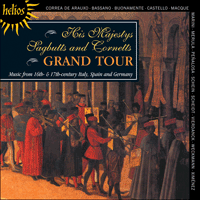



This is the first record in a projected series on Hyperion by His Majestys Sagbutts and Cornetts. The works featured comprehensively survey the remarkable repertoire composed over two hundred years in Italy, Germany and Spain and reveal an astonishing breadth of atmosphere. The musical pomp and splendour of bygone royal ceremony can be answered by the most tender and delicate of chamber music: all legitimate repertoire for what was in the past recognized as the most versatile of all instrumental ensembles.

Since its formation in 1982, His Majestys Sagbutts and Cornetts has explored and revived this richly varied vein of music, and the present recording offers a cross-section of its repertoire in a musical Grand Tour of three of the countries in which cornetts and sackbuts flourished.
Italy
Our tour starts in Italy where, in the decades around 1600, virtuosi developed the special qualities of the cornett to a peak of sophistication and flexibility. A hybrid of woodwind and brass, the cornett combines the fingering technique of the recorder with a trumpet-like mouthpiece. Its exceptional technical demands would later contribute to its decline—Bach, for example, did use the instrument, but only to give support to his choir. Yet in its heyday it was the undisputed king of wind instruments, admired for its range, agility and voice-like tone quality. Marin Mersenne (1636) compared it to ‘a ray of sunshine piercing the shadows, when heard with the choir voices in the cathedrals or chapels’.
The agility of the cornett gave rise to a highly florid style of playing, the art of diminution, the breaking up of a composed musical line with fast figures (divisions) and ornaments, was largely an improvised art, but fortunately some of the best players wrote down examples of their style. One such virtuoso was Giovanni Bassano who, in 1576, became a member of the instrumental ensemble at St Mark’s and who, in 1585, published Ricercate, passaggi et cadentie. This collection includes divisions on Palestrina’s popular madrigal Vestiva i colli, recorded here as a cornett solo with the accompanying voices played on the organ. Note that Bassano avoids obscuring the structure of the original by leaving the contrapuntal entries largely undecorated.
The sackbut, direct forerunner of the modern trombone (the Italians already called it ‘trombone’, or ‘large trumpet’) could match the vocal timbre of the cornett thanks to its relatively narrow bore and shallow mouthpiece. Despite the technical demands imposed by its slide mechanism, it too was often played in a florid manner, a style that can be heard in the bold and adventurous Sonata duodecima published in 1621 by another wind player at St Mark’s, Dario Castello.
Composers also used the sackbut’s majestic sonority to contrast with the agile treble instruments, as in Biagio Marini’s Sonata a 6. Marini was a much-travelled violinist—his position at St Mark’s under Monteverdi (from 1615) was only one of many appointments in Italy and Germany—and the top two parts in this Sonata are specified as for violins. But violin music was habitually considered as also suitable for the cornett; indeed, apart from special effects such as double-stopping, there was little difference in style between the two instruments’ repertoire, and some magpie-like stealing of gems is perfectly in order. Marini’s Affetti musicali, Op 1, of 1617, source of the eloquent little Sinfonia grave: La Zorzi, is specified as for violins or cornetts. On the other hand, his muscular Sonate a quattro tromboni is hardly imaginable played in any alternative scoring.
Monteverdi’s influence is clear in the music of the Cremonese organist Tarquinio Merula. His Chiacona for two treble instruments and continuo may well have been inspired by Monteverdi’s madrigal for two tenors, Zefiro torna.
Giovanni Battista Buonamente was another well-travelled violinist from northern Italy who, in his native Mantua, may have worked with Monteverdi. He published a good deal of instrumental music in seven books, of which the first three are now lost. By the time his sixth book of Sonate et Canzoni was printed in 1636 he was established in Assisi as maestro de capella at the Basilica of St Francis. His six-part Sonata and Canzona represent the splendid Venetian instrumental style of the Renaissance—established above all by Giovanni Gabrieli—in a late phase of development. There are vestiges of counterpoint, but the predominant effect is imposingly chordal and architectural, enhanced in the Sonata by the wide spacing of the outer parts. Both pieces have a contrasting triple-time section followed, in the Canzona, by a passage of tremolo, a popular effect at that time. Both close with a section making effective re-use of music heard at the opening. (It is hard, by this time, to perceive any significant difference between works entitled ‘sonata’ and ‘canzona’.)
Spain
Instrumental music survives plentifully from seventeenth-century Italy thanks to the flourishing of the publishing trade. Crossing the Mediterranean to Spain, we find a very different situation: we know that wind instruments were played in the churches and cathedrals, and that there was a vigorous tradition of florid wind playing, but little actual instrumental ensemble or solo music survives. For much of the time wind instruments were used to accompany voices, but a recently discovered sixteenth-century minstrels’ manuscript from Lerma also reveals a repertoire of vocal pieces—motets, madrigals and the like—which, like the sonatas and canzonas of Italy, were played instrumentally as part of the liturgy. To give a flavour of this style, we perform here a polyphonic Marian motet, O Domina sanctissima, on four sackbuts. Its composer is Francisco de Peñalosa, associated both with Seville Cathedral and the Spanish royal chapel, and praised by a contemporary as a ‘prince of musicians’.
For Spanish styles of ornamentation we must turn to music for other instruments, such as the viol divisions of Diego Ortíz, or the music of keyboard players such as the great organist of the church of San Salvador in Seville, Francisco Correa de Arauxo. The tientos (polyphonic fantasias) printed in Correa’s Facultad organica of 1626 preserve a special Andalucian type of ornamentation that marries the international style of the day with local traditions, still strongly influenced by Arab music. Often conceived for an organ mixture stop called ‘corneta’ that runs from middle G sharp up to treble A, Correa’s soloistic keyboard divisions prove ideal, if technically demanding, for the real cornett. Here David Staff and Jeremy West make a convincing case for such transcription in the flamboyant duetting of the Tiento de segundo tono, No 53 in Facultad organica.
Another feature of Spanish keyboard music that invites transcription is the fact that up to the end of the seventeenth century it was normally written strictly in four parts notated in open score. There was a similar tradition in Italy where some works, such as canzonas by Merulo and Gabrieli, exist in both keyboard and ensemble versions. Thus a work like the Batalla by José Ximénez, in four-part open score, becomes an attractive candidate for ensemble peformance. However, the ranges oblige the transcriber to increase the number of parts to six; this allows each player some well-deserved rest, as well as giving a fuller texture at climactic moments. Ximénez was organist of La Seo, Saragossa, in the mid-seventeenth century, and descriptive battle pieces like this, often featuring motifs derived from the battle chansons of Clément Janequin, are typical of the Spanish repertoire and were probably associated with the Feast of St Michael. Here the intended tempo relationships of the alternate duple- and triple-time sections are unclear: we have opted for a scheme that creates the impression of each section being faster than the last, while returning to the original tempo at the end.
Moving on to the later seventeenth century, our rather free version of the Canciones de clarines was suggested by Edward Tarr’s transcription for trumpet and organ of an anonymous organ piece that is itself based, at least in part, on orchestral movements by Lully (the second movement is a minuet from Atys, and the closing gigue comes from Bellérophon). The suite of four fanfare-like Canciones, aptly symbolizing the end of Spain’s musical isolation through much of the seventeenth century, appears in a large, retrospective manuscript collection compiled between 1706 and 1709 by the priest Francisco Martín y Coll entitled Flores de música. The Canciones exploit the new trumpet stops typical of Spanish organs, and our transcription contrasts a natural trumpet in D with an ensemble of cornett, four sackbuts and organ.
Germany
No such arrangement is necessary for the wind music of seventeenth-century Germany, for many printed collections of dances, canzonas and sonatas are extant, some of them specifying the instrumentation, others leaving this to the discretion of the user. The first book of Samuel Scheidt’s Ludi musici, which appeared in 1621 when he was Kapellmeister at the Saxon court of Halle, was intended primarily for string instruments, but includes at least one piece written for cornetts and sackbuts: a dazzling Galliarda ‘La Battaglia’ that was dedicated to the court cornettist. Scheidt’s fine canzonas are based on existing tunes, developed with both wit and a thoroughness that some may see as typically Teutonic. The Cantionem Gallicam is a popular song, ‘Est-ce Mars?’, which was also treated in keyboard variations by Scheidt and by his Dutch master, Sweelinck.
Johann Schein, like Scheidt, was associated with the greatest German composer of the time, Heinrich Schütz, and was a predecessor of Bach in the post of Cantor at the Thomaskirche in Leipzig. Schein’s Banchetto musicale of 1617 is an outstanding collection of dance and entertainment music. It is the source of the highly original A minor Padoana, a piece that is surely too complex for actual dancing. Each section is based on long pedal notes, over which Schein builds short motifs into expressive, unexpected harmonies.
The young organist, violinist and cornettist Johann Vierdanck started his career in Dresden, where his master Schütz declared that he was ‘a fine, modest person and making a very good, solid beginning in composition’. He spent his later years, from 1635, as organist of the Marienkirche in Stralsund on the Baltic coast. The two sonatas recorded here come from his second collection of instrumental music, the Capricci, Canzoni und Sonaten of 1641, and show that, despite his geographical isolation, Vierdanck was in touch with up-to-date musical styles. Sonata 28 sets a concertante solo cornett part against a trio of sackbuts, skilfully scored to sound as a full ‘tutti’, while Sonata 31 is based on the song ‘Als ich einmal Lust bekam’ by Gabriel Voigtländer, and makes remarkable use of unison passages and vigorous chordal writing—a far cry from the canzona’s polyphonic origins in Italy.
The keyboard solos
As in His Majestys Sagbutts and Cornetts’ concerts, the two keyboard solos, both improvisatory in character, serve to cleanse the listeners’ palettes as well as rest the wind-players’ lips. Giovanni de Macque was a Flemish keyboard player and harpist who found employment in Naples. The strange, chromatic beauty of his Seconde Stravaganze was mentioned by Stravinsky in his converstaions with Robert Craft.
Harmonic boldness characterizes the E minor Toccata III of Matthias Weckmann, a composer from Thuringia who, like his colleagues Schütz and Froberger, played an important role in disseminating Italian styles through Lutheran Germany.
The organ and harpsichord have been tuned by Malcolm Greenhalgh in a meantone temperament which gives the special colour to such adventurous solo music, as well as distinctive resonance (the result of the low thirds, sixths and leading notes) to the wind ensemble accompanied by organ continuo.
Timothy Roberts © 1996
Depuis sa formation en 1982, His Majestys Sagbutts and Cornetts a exploré et ressuscité cette veine musicale somptueusement variée; le présent enregistrement offre un échantillon de leur répertoire, via une Grande Visite musicale dans trois des pays qui virent fleurir les cornets et les saqueboutes.
Italie
Notre voyage débute en Italie où des virtuoses développèrent, dans les décennies aux environs de l’an 1600, les qualités spécifiques au cornet pour atteindre à un apogée de sophistication et de souplesse. Hybride des bois et des cuivres, le cornet combine doigté de la flûte à bec et embouchure de type trompette. D’où d’exceptionnelles exigences techniques qui devaient, plus tard, contribuer à son déclin—ainsi Bach ne l’utilisa-t-il que pour soutenir son chœur. Cet instrument fut pourtant, à son heure de gloire, le roi incontesté des vents, admiré tant pour sa tessiture et pour son agilité que pour sa qualité tonale, presque vocale. Marin Mersenne (1636) le compara à «un rayon de Soleil, qui paroist dans l’ombre ou dans les tenebres, lors qu’on l’entend parmy les voix dans les Église Cathedrales, ou dans les Chapelles».
L’agilité du cornet suscita un style d’interprétation extrêmement fiorituré. L’art de la diminution—savoir l’insertion de figures rapides (divisions) et d’ornements pour interrompre une ligne musicale composée—était en grande partie improvisé mais, par bonheur, certains des meilleurs joueurs consignèrent des exemples de leur style. Un de ces virtuoses, Giovanni Bassano, qui fut un des membres du ensemble instrumental de la basilique Saint-Marc, publia en 1585 Ricercate, passaggi et cadentie. Ce recueil inclut des divisions sur le madrigal populaire de Palestrina Vestiva i colli, enregistre ici sous forme d’un solo de cornet avec les voix d’accompagnement jouées à l’orgue. Observez à propos comment Bassano évite d’obscurcir la structure originelle en laissant les entrées contrapuntiques extrêmement dépouillées.
Dotée d’un cylindre relativement étroit et d’une embouchure peu profonde, la saqueboute, précurseur direct du trombone moderne (les Italiens l’appelaient déjà «trombone» ou «grande trompette») pouvait égaler le timbre vocal du cornet. Les exigences techniques imposées car son mécanisme à coulisse ne l’empêchait pas d’être également jouée dans un style fioriture, illustré par l’audacieuse et aventureuse Sonata duodecima publiée en 1621 par un autre joueur de vent de la basilique Saint-Marc: Dario Castello.
Les compositeurs usèrent aussi de la sonorité majestueuse de la saqueboute pour contraster avec les agiles instruments soprano, comme dans la Sonata a 6 de Biagio Marini. Ce dernier fut un violoniste qui voyagea énormément—son emploi à la basilique Saint-Marc, sous la direction de Monteverdi (à partir de 1615) ne fut qu’un des nombreux postes qu’il occupa en Italie et en Allemagne. Les deux parties aiguës de sa Sonate sont d’ailleurs spécifiées pour violon. Mais la musique pour violon était généralement considérée comme adaptable au cornet, tant le répertoire des deux instruments présentait peu de différences stylistiques, excepté des effets spécifiques comme la double-corde. Il est d’ailleurs temps de nous faire pie pour dérober quelques joyaux, telle l’éloquente petite Sinfonia grave: La Zorzi, spécifiée pour violons ou cornets et tirée des Affetti musicale, Op 1, de Marini (1617). Sa Sonata a quattro tromboni, musclée, est par contre difficilement imaginable dans une autre orchestration.
Giovanni Battista Buonamente fut un autre violoniste-voyageur, qui quitta l’Italie du Nord et son Mantoue natal, où il aurait aussi pu travailler avec Monteverdi. Il publia beaucoup de musique instrumentale, répartie en sept livres—dont les trois premiers sont aujourd’hui perdus. La parution (1636) de son sixième livre de Sonate et Canzoni le trouva établi maestro de capella à la basilique de Saint-François, à Assise. Sa Sonata en six partie et sa Canzona illustrent une phase tardive du développement du splendide style instrumental vénitien de la Renaissance, avant tout établi par Giovanni Gabrieli. Ces œuvres présentent des vestiges de contrepoint mais l’effet prédominant est, de manière imposante, vertical et architectural—rehaussé dans la Sonate par le large espacement des parties extérieures. Chacun des morceaux possède une section contrastante, à trois temps, suivie, dans la Canzone, d’un passage de trémolo (un effet alors populaire). Puis les deux œuvres s’achèvent sur une section qui ré-emploie efficacement la musique d’ouverture. (Il est difficile de percevoir, à cette époque, une différence importante entre les pièces intitulées «sonata» et «canzona».)
Espagne
A partir du XVIIe siècle, le fleurissement de l’édition permit une abondante survie de la musique instrumentale italienne. Mais traversons la Méditerrannée et partons en Espagne, à la découverte d’une toute autre situation: nous savons que les vents étaient joués dans les églises et dans les cathédrales et qu’ils possédaient une vigoureuse tradition d’interprétation fioriturée. Par contre, nous connaissons peu de véritable musique solo ou pour ensemble instrumental. Durant fort longtemps, les vents furent employés pour accompagner les voix mais un manuscrit de ménestrels du XVIe siècle (récemment découvert) du monastère de Lerma révéla également un répertoire de pièces vocales—motets, madrigaux, etc.—jouées comme partie intégrante de la liturgie, à l’instar des sonates et canzones d’Italie. O Domina sanctissima, un motet polyphonique marial interprété ici sur quatre saqueboutes, permet à l’auditeur de goûter la saveur de ce style. Son compositeur, Francisco de Peñalosa—loué par un de ses contemporains comme le «prince des musiciens»—était associé à la cathédrale de Séville et à la chapelle royale espagnole.
Pour ce qui est des styles espagnols d’ornementation, nous devons nous tourner vers une musique écrite pour d’autres instruments, comme les divisions pour viole de Diego Ortíz ou la musique de joueurs de claviers comme Francisco Correa de Arauxo, le grand organiste de l’église de San Salvador, à Séville. Les tientos (fantaisies polyphoniques) imprimés dans son Facultad organica (1626) préservent un style d’ornementation propre à l’Andalousie, qui marie le style international de l’époque aux traditions locales encore fortement influencées par la musique arabe. Souvent conçues pour une mixture d’orgue appelée «corneta»—qui s’étend du do dièse du milieu de clavier au la aigu—, les divisions pour clavier soliste de Correa se révèlent, malgré leurs exigences techniques, idéales pour le cornet. David Staff et Jeremy West nous offrent une exécution convaincante de ce type de transcription dans le flamboyant duetto Tiento de segundo tono, no 53, extrait du Facultad organica.
Une autre caractéristique de la musique pour clavier espagnole est une véritable invite à la transcription: jusqu’à la fin du XVIIe siècle, cette musique était normalement strictement composée de quatre parties notées sur une partition en parties séparées. La même tradition était de mise en Italie, où certaines œuvres, comme les canzones de Merulo et de Gabrieli, existaient en deux versions: pour clavier et pour ensemble. Ainsi une œuvre comme la Batalla pour orgue de José Ximénez, sur une partition en quatre parties séparées, devient-elle une séduisante candidate à une interprétation pour ensemble. Les gammes obligent cependant le transcripteur à porter à six le nombre des parties—ce qui autorise, outre quelque repos bien mérité pour chaque interprète, une texture plus pleine lors des apogées. Ximénez (milieu du XVIIe siècle) était organiste de La Seo, à Saragosse, et de telles pièces de bataille descriptives, qui mettaient souvent en scène des motifs dérivés des chansons de bataille de Clément Janequin et étaient probablement associées à la fête de saint Michel, sont typiques du répertoire espagnol. Dans le cas présent, les relations de tempo des sections alternées binaires et ternaires voulues par l’auteur sont floues. Aussi avons-nous opté pour un schéma qui donne l’impression que chaque section est plus rapide que la précédente, tout en retrouvant le tempo initial à la fin.
Gagnons la fin du XVIIe siècle pour retrouver les Canciones de clarines. La version, plutôt libre, que nous en présentons nous fut suggérée par une transcription pour trompette et orgue (signée Edward Tarr) d’une pièce anonyme pour orgue—elle-même fondée, du moins en partie, sur des mouvements orchestraux de Lully (le second mouvement est ainsi un menuet extrait d’Atys tandis que la gigue finale provient de Bellérophon). La suite de quatre Canciones, aux sonorités de type fanfare, symbolise convenablement la fin de l’isolement musical dans lequel l’Espagne se trouva plongée durant une grande partie du XVIIe siècle. Tirées d’un vaste manuscrit rétrospectif (compilé entre 1706 et 1709 par le prêtre Francisco Martín y Coll) intitulé Flores de música, ces Canciones exploitent les trompettes, les nouveaux jeux typiques des orgues espagnoles. Notre transcription met en contraste une trompette naturelle en ré avec un ensemble cornet, quatre saqueboutes et orgue.
Allemagne
De tels arrangements ne sont pas nécessaires dans la musique pour vents de l’Allemagne du XVIIe siècle, car quantité de recueils imprimés de danses, canzones et sonates subsistent, certains spécifiant l’instrumentation, d’autres la laissant à la discrétion de l’utilisateur. Publié en 1621 alors que son auteur était Kapellmeister à la cour saxonne de Halle, le premier livre des Ludi musici de Samuel Scheidt fut essentiellement écrit pour cordes, à l’exception d’au moins une pièce pour cornets et saqueboutes: une éblouissante Galliarda «La Battaglia», dédiée au cornettiste de la cour. Les belles canzones de Scheidt sont fondées sur des mélodies déjà existantes, mais développées avec une intelligence et une profondeur que d’aucuns qualifieront peut-être de typiquement teutonnes. Le Cantionem Gallicam, chant populaire intitulé «Est-ce Mars?», est également traité dans des variations pour clavier par Scheidt et par son maître hollandais, Sweelinck.
A l’instar de Scheidt, Johann Schein fut associé au plus grand compositeur allemand de son temps, Heinrich Schütz, et fut un des prédécesseurs de Bach au poste de cantor à la Thomaskirche de Leipzig. Son Banchetto musicale (1617), remarquable recueil de musique pour danse et divertissement, est à la source de la Padoana en la mineur, une pièce extrêmement originale et assurément bien trop complexe pour être véritablement dansée. Chaque section repose sur de longues notes de pédale, sur lesquelles Schein construit de courts motifs en d’expressives harmonies inattendues.
Le jeune organiste, violoniste et cornettiste Johann Vierdanck commença sa carrière à Dresde, où son maître Schütz dit de lui qu’il était «une personne bien et modeste, qui fait un très bon et solide début dans la composition». A partir de 1635, il passa les dernières années de sa vie comme organiste à la Marienkirche de Stralsund, sur la côte baltique. Les deux sonates enregistrées ici, extraites de son second recueil de musique instrumentale intitulé Capricci, Canzoni und Sonaten (1641), prouvent cependant que son isolement géographique ne l’empêcha pas de demeurer en contact avec les styles musicaux les plus récents. La Sonata 28 met en musique une partie concertante de cornet solo, qui contraste avec un trio de saqueboutes, habilement écrit pour sonner comme un «tutti» plein. La Sonate 31, fondée sur le chant «Als ich einmal Lust bekam» de Gabriel Voigtländer, use pour sa part remarquablement des passages d’unisson et d’une vigoureuse écriture d’accords—lointain écho aux origines polyphoniques italiennes de la canzone.
Les solos de clavier
Comme dans les concerts de His Majestys Sagbutts and Cornetts, les solos de claviers servent autant à nettoyer les palettes des auditeurs qu’à reposer les lèvres des joueurs de vents. Giovanni de Macque, joueur de clavier et harpiste flamand, trouva un emploi à Naples. L’étrange beauté chromatique de sa Seconde Stravaganze fut mentionnée par Stravinski dans ses conversations avec Robert Craft.
L’audace harmonique caractérise la Toccata III en mi mineur de Matthias Weckmann, compositeur aventureux de Thuringe qui joua, à l’instar de ses collègues Schütz et Froberger, un rôle important dans la diffusion des styles italiens à travers l’Allemagne luthérienne.
Malcolm Greenhalgh a accordé l’orgue et le clavecin dans un tempérament mésotonique qui teinte cette musique solo aventureuse d’une couleur particulière et procure à l’ensemble des vents, accompagné par le continuo d’orgue, une résonance distinctive, fruit des tierces, des sixtes graves et des notes conductrices.
Timothy Roberts © 1996
Français: Hypérion
Seit ihrer Gründung 1982 haben „His Majestys Sagbutts and Cornetts“ dieses überaus variierte Reich der Musik erforscht und wiederbelebt, und die gegenwärtige Aufnahme stellt in einer musikalischen Grand Tour durch diese drei Länder, in denen Kornette und Sackbuts ihre Blütezeit erlebten, einen Querschnitt ihres Repertoires dar.
Italien
Unsere Reise beginnt in Italien in den Jahrzehnten um 1600, als die Virtuosen die besonderen Qualitäten des Kornetts mit höchster Eleganz und Flexibilität ausschöpften. Als eine Mischung aus Holz- und Blechblasinstrumenten kombiniert das Kornett die Fingertechnik der Blockflöte mit einem trompetenähnlichen Mundstück. Seine außergewöhnlich technischen Anforderungen sollten später zu seinem Verblassen beitragen—Bach zum Beispiel wendete das Instrument lediglich zur Unterstützung seiner Chorpassagen an. Trotzdem war es zu seiner Blütezeit der unbestrittene König der Blasinstrumente, verehrt wegen seines Stimmbereichs, seiner Agilität und seiner stimmenähnlichen Tonqualität; Marin Mersenne (1636) verglich es mit „einem Sonnenstrahl, der durch die Schatten dringt, wenn es mit den Chorstimmen in Kathedralen oder Kapellen erschallt“.
Die Agilität des Kornetts bewirkte einen höchst schwülstigen Musikstil. Die Kunst der Verkleinerung oder das Brechen komponierter musikalischer Reihen mit schnellen Figuren (Teilungen) und Ornamenten waren im großen und ganzen Improvisationskünste, glücklicherweise jedoch schrieben einige der besten Spieler Beispiele ihrer Spielart nieder. Einer dieser Virtuosen war Giovanni Bassano, der 1576 ein Mitglied des instrumentalen Ensembles der Markuskirche war und 1585 Ricercate, passaggi et cadentie veröffentlichte. Diese Sammlung enthält Verkleinerungen von Palestrinas berühmtem Madrigal Vestiva i colli, hier in einer Aufnahme der Soloversion für Kornett mit den begleitenden Stimmen der Orgel. Es ist bemerkenswert, daß Bassano ein Verdunkeln der ursprünglichen Struktur meidet, indem er die kontrapunktischen Einsätze im großen und ganzen unverziert läßt.
Das Sackbutt, direkter Vorläufer der modernen Posaune (die Italiener nannten es bereits „Trombone“ oder „große Trompete“) paßte dank seiner relativ engen Mensur und seinem flachen Mundstück zur vokalen Klangfarbe des Kornetts. Trotz der technischen Anforderungen, die durch seinen Zug-Mechanismus hervorgerufen wurden, wurde auch das Sackbutt oft auf schwülstige Art und Weise gespielt, ein Stil, der in der kühnen und abenteuerlustigen Sonata duodecima zu hören ist, die 1621 von einem weiteren Bläser von St. Mark, Dario Castello veröffentlicht wurde.
Komponisten benutzen den majestätischen Wohlklang des Sackbutts zudem als Kontrast zu den agilen Sopraninstrumenten, wie in Biagio Marinis Sonata a 6. Marini war ein weit umherreisender Violinist—seine Stellung an der Markuskirche unter der Leitung Monteverdis (ab 1615) war nur eine von vielen Beschäftigungen in Italien und Deutschland—und die beiden ersten Passagen dieser Sonate sind für Violinen instrumentiert. Violinmusik wurde jedoch gewöhnlich auch als dem Kornett angemessen betrachtet; tatsächlich gab es von einigen Sondereffekten wie dem Doppelgriff abgesehen nur geringe Unterschiede im Repertoire dieser beiden Instrumente, und ein der diebischen Elster ähnliches Stehlen einzelner Prachtstücke ist in keiner Weise unangebracht. Marinis 1617 entstandenen Affetti musicali, Op. 1 bilden die Quelle der ausdrucksvollen kleinen Sinfonia grave: La Zorzi und sind für die Violinen oder Kornetts instrumentiert. Seine kraftvolle Sonata a quattro tromboni erscheint mit einer alternativen Partitur recht unvorstellbar.
Giovanni Battista Buonamente war ein weiterer weitgereister Violinist aus dem Norden Italiens, der in seiner Geburtsstadt Mantua auch mit Monteverdi zusammen-gearbeitet haben mag. Er veröffentlichte eine große Anzahl instrumentaler Musik in sieben Büchern, von denen die drei ersten verlorengegangen sind. Zur Zeit, als sein sechstes Buch Sonate et Canzoni 1636 gedruckt wurde, hatte er sich in Assisi als Maestro de Capella an der Sankt Franziskus-Basilika niedergelassen. Seine sechsstimmigen Sonata und Canzona stellen den ausgezeichneten venezianischen instrumentalen Stil der Renaissance in einer späten Entwicklungsphase dar, die vor allem von Giovanni Gabrieli bestimmt wurde. Es gibt Spuren des Kontrapunkts, der überwiegende Effekt ist beeindruckend akkordisch und architektonisch und wird in der Sonate durch den weiten Raumgriff der äußeren Teile noch verstärkt. Beide Stücke beinhalten einen Abschnitt kontrastierender Tripeltakte, dem in der Canzona eine Tremolo-Passage folgt, ein zu jener Zeit recht beliebter Effekt. Beide Stücke schließen mit einem Abschnitt effektvollen wiederholten Spielens der Musik, die in den eröffnenden Passagen zu hören war, ab. (Es ist schwierig, zu diesem Zeitpunkt bemerkens-werte Unterschiede zwischen den Stücken „Sonata“ und „Canzona“ wahrzunehmen.)
Spanien
Instrumentale Musik aus dem siebzehnten Jahrhundert Italiens verdankt ihr heutiges Bestehen dem blühenden Markt des Verlagswesens. Überqueren wir jedoch das Mittelmeer und betrachten Spanien, so ergibt sich ein ganz anderes Bild: Wir wissen, daß Blasinstrumente in Kirchen und Kathedralen gespielt wurden, und daß es eine leidenschaftliche Tradition reich verzierter Bläsermusik gab, jedoch ist uns heute nur wenig der wirklichen instrumentalen Ensemble- oder Solomusik erhalten geblieben. Lange Zeit wurden Blasinstrumente ausschließlich zur Stimmenbegleitung angewendet, ein kürzlich entdecktes Manuskript eines Spielmanns aus dem sechzehnten Jahrhundert aus Lerma entlarvt außerdem ein Repertoire vokaler Stücke—Motetten, Madrigale usw.—die, wie die Sonaten und Canzonen Italiens, instrumental als Teil der Liturgie gespielt wurden. Um einen Eindruck dieses Stils geben zu können, haben wir hier eine polyphonische Marien-Motette O Domina sanctissima, gespielt von vier Sackbutts, gewählt. Ihr Komponist ist Francisco de Peñalosa, der sowohl mit der Kathedrale von Sevilla als auch mit der königlichen spanischen Kapelle verbunden war und von einem Zeitgenossen als „Prinz der Musiker“ gepriesen wurde.
Im Hinblick auf den spanischen Stil der Ornamentik müssen wir uns der Musik für andere Instrumente, wie der Verkleinerung für Viole von Diego Ortíz oder der Musik der Tastenspieler, wie jene des berühmten Organisten der San Salvador-Kirche in Sevilla, Francisco Correa de Arauxo zuwenden. Die Tientos (polyphonische Fantasien), die in Correas Facultad organica aus dem Jahr 1626 abgedruckt sind, enthalten einen besonders andalusischen Stil der Ornamentik, der den jeweiligen internationalen Stil mit lokalen Traditionen verbindet, die immer noch stark von arabischer Musik beeinflußt sind. Oft für ein Orgel-Mischregister „Corneta“, das vom mittleren Cis bis zum hohen A reicht, komponiert, erweisen sich Correas solistische Tastatur-Teilungen, wenn auch technisch herausfordernd, als ideal für das echte Kornett. David Staff und Jeremy West liefern hier in dem prächtigen Duett des Tiento de segundo tono, Nr. 53 der Facultad organica überzeugende Argumente für eine solche Transkription.
Ein weiteres Merkmal spanischer Tastenmusik, das zur Transkription einlädt, ist die Tatsache, daß sie gegen Ende des siebzehnten Jahrhunderts gewöhnlich in genau vier Stimmen mit offener Partitur geschrieben wurde. Eine ähnliche Tradition gab es auch in Italien, wo einige Werke wie die Canzonen von Merulo und Gabrieli in Tasten- wie auch Ensembleversionen vorliegen. Somit stellt ein Stück wie das vierteilige Werk für Orgel mit offener Partitur Batalla von José Ximénez einen attraktiven Kandidaten für das Ensemblerepertoire dar. Der Tonumfang wird voll ausgeschöpft, indem er umgeschrieben wird, um die Zahl der Passagen auf sechs zu erhöhen: dieses ermöglicht jedem Spieler eine wohlverdiente Pause und verleiht den Höhepunkten eine kräftigere Struktur. Ximénes war in der Mitte des siebzehnten Jahrhunderts Organist an der La Seo in Saragossa, und deskriptive Kampfstücke wie dieses, die oft Motive beinhalten, die von den Kampf-Chansons Clément Janequins herrühren, sind für das spanische Repertoire typisch und waren wahrscheinlich mit den Feierlichkeiten von St. Michael verbunden. Hier sind die beabsichtigten Tempobeziehungen zwischen den wechselnden Passagen der Zweier- und Dreiertakte unklar. Wir haben uns für ein Werk entschieden, das den Eindruck erweckt, jede Passage sei schneller als die vorherige, während es letztendlich zum ursprünglichen Tempo zurückkehrt.
Wenden wir uns dem späten siebzehnten Jahrhundert zu, so finden wir unsere eher freie Version des Canciones de clarines, ein Stück, das sich in der von Edward Tarr für Trompete und Orgel vorgenommenen Transkription eines anonymen Orgelstücks anbietet, das zumindest teilweise auf den orchestralen Sätzen von Lully basiert (der zweite Satz ist ein Minuett von Atys, die abschließende Gigue stammt von Bellérophon). Die Folge von vier der fanfaren-ähnlichen Canciones, die passend das Ende der musikalischen Isolation Spaniens während langer Perioden des siebzehnten Jahrhunderts symbolisieren, erscheint in einer vom Priester Francisco Martín y Coll zusammengestellten großen, retrospektiven Manuskriptsammlung von Werken aus den Jahren zwischen 1706 und 1709 unter dem Titel Flores de música. Die Canciones erforschen die neuen für die spanischen Orgeln so typischen Trompetenregister, und unsere Transkription setzt ein Kornett-Ensemble, vier Sackbutts und einer Orgel, in Kontrast zum natürlichen Trompetenton in D ein.
Deutschland
Solche Arrangements sind für die Bläsermusik Deutschlands des siebzehnten Jahrhunderts nicht nötig, denn viele gedruckte Sammlungen von Tänzen, Canzonen und Sonaten sind heute noch vorhanden, einige von ihnen mit spezifischer Instrumentierung, andere überlassen diese wiederum dem Ermessen des Künstlers. Das erste Buch von Samuel Scheidts Ludi Musici das 1621 erschien, als er die Stellung als Kapellmeister am sächsischen Hof in Halle inne hatte, war in erster Linie für Streichinstrumente komponiert worden, es enthält aber auch mindestens ein Stück für Kornetts und Sackbutts: eine blendende Galliarda „La Battaglia“, die dem Hofkornettisten gewidmet war. Scheidts feine Canzonen sind von existierenden Melodien abgeleitet und mit Witz wie auch einer Sorgfalt entwickelt, die manch einem typisch teutonisch erscheinen mag. Das Cantionem Gallicam ist ein berühmtes Lied, „Est-ce Mars?“, das auch als Tastenvariationen von Scheidt und seinem niederländischen Lehrer Sweelinck überarbeitet wurde.
Johann Schein war wie Scheidt mit dem größten Komponisten der damaligen Zeit, Heinrich Schütz, verbunden und aufgrund seiner Stellung als Kantor an der Thomaskirche in Leipzig ein Vorgänger Bachs. Scheins Banchetto musicale aus dem Jahr 1617 stellt eine außerordentliche Sammlung von Tänzen und Unterhaltungsmusik dar. Es ist zudem die Quelle der höchst origenellen Padoana in a-Moll, eines Stücks, das als eigentliche Tanzmusik mit Sicherheit zu komplex ist. Jede Passage basiert auf langen Pedaltönen, aus denen Schein kurze Motive entwickelt, die in ausdrucksvolle, unerwartete Harmonien übergleiten.
Der junge Organist, Violinist und Kornettist Johann Vierdanck begann seine Karriere in Dresden, wo sein Lehrer Schütz ihn als „eine feine, bescheidene Person, die einen sehr guten, soliden Ansatz des Komponierens gemacht hat“, bezeichnete. Er verbrachte seine späten Jahre, ab 1635, als Organist der Marienkirche in Stralsund an der Ostseeküste. Die zwei hier aufgenommenen Sonaten stammen aus seiner zweiten Sammlung instrumentaler Musik, der Capricci, Canzoni und Sonaten von 1641 und zeigen, daß Vierdanck seiner geographischen Isolation zum Trotz die Verbindung zu den neuesten Musikstilen nie verlor. Sonata 28 stellt, in geschickter Partitur wie ein vollständiges Tutti klingend, ein konzertierendes Solostück für Kornett einem Sackbutt-Trio gegenüber. Sonata 31 basiert dagegen auf dem Lied „Als ich einmal Lust bekam“ von Gabriel Voigtländer und wendet auf bemerkenswerte Weise einstimmige Passagen und dynamische akkordische Komposition an—ein völliger Kontrast zum polyphonischen Ursprung der Canzona in Italien.
Die Tastensoli
Wie in den Konzerten der „His Majestys Sagbutts and Cornetts“ dienen die zwei jeweils von improvisatorischem Charakter angefüllten Tastensoli dazu, den Geist des Hörers zu reinigen und den Lippen der Bläser eine Pause zu gönnen. Giovanni de Macque war ein flämischer Tastenspieler und Harfenist, der in Neapel eine Stellung fand. Die sonderbare, chromatische Schönheit seiner Seconde Stravaganze wurde von Strawinski in seinen Gesprächen mit Robert Craft erwähnt.
Harmonische Kühnheit kennzeichnet die Toccata III in e-Moll von Matthias Weckmann, einem abenteuerlustigen Komponisten aus Thüringen, der wie seine Kollegen Schütz und Froberger in der Verbreitung italienischer Stilarten im lutherischen Deutschland eine nicht unwichtige Rolle spielte.
Die Orgel und das Cembalo sind von Malcolm Greenhalgh im mitteltönigen Temperament angestimmt worden, das solch einer abenteuerlustigen Solomusik eine besondere Färbung und dem Bläserensemble mit ununterbrochener Orgelbegleitung eine bestimmte Resonanz verleiht—das Ergebnis der tiefen Terzen, Sexten und Leittöne.
Timothy Roberts © 1996