
Welcome to Hyperion Records, a British classical label devoted to presenting high-quality recordings of music of all styles and from all periods from the twelfth century to the twenty-first.
Hyperion offers both CDs, and downloads in a number of formats. The site is also available in several languages.
Please use the dropdown buttons to set your preferred options, or use the checkbox to accept the defaults.
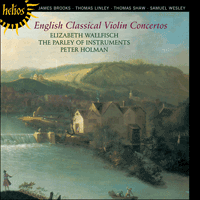



These four delightful concertos are the work of young men: Linley and Wesley were still in their mid teens when they wrote them, Shaw and Brooks probably not much older. It reminds us that artistic talent tended to be fostered and developed early at a time when lives were shorter and more uncertain than today. The work by Linley is the only survivor of his twenty violin concertos and strongly shows the influence of his Italian travels. The Wesley is similarly bold in the juxtaposition of apparently contrasting styles, here the Classical and the Baroque.
While Shaw and Brooks remain in rather greater obscurity (the latter not even earning a mention in Grove), their concertos are equally attractive and assured.

The Linleys were the most important and influential family of musicians in eighteenth-century Bath. Thomas Linley the elder was the son of a builder and carpenter who moved to the city in the late 1740s to take advantage of the building boom. He became a harpsichordist, singing teacher and composer, and started to direct concerts there in the mid-1750s, gradually involving his talented children in them: Elizabeth, Mary and Maria were precociously gifted singers, while Thomas junior played a violin concerto in Bristol at the age of eight, and began to compose soon after. Thomas went to study with Nardini in Florence for three years in 1768, where he met and befriended Mozart, his exact contemporary. On his return in 1771 he became Bath’s leading violinist, a position he retained until 1776 when his father became one of the managers of the Drury Lane Theatre and the family moved to London. He died two years later at the age of twenty-two in a boating accident at Grimsthorpe Castle in Lincolnshire.
Thomas Linley is said to have composed at least twenty violin concertos, but only one survives complete. The score was included in one of the memorial volumes compiled for George III after the composer’s death and it is still in the Royal Music Collection of the British Library. It was probably written after his return to Bath from Italy, for it displays a mature grasp of the galant idiom of his teacher Nardini and other Italians, and, of course, immigrants resident in London, such as J C Bach and C F Abel. In particular, the solo part in the first movement is much more varied than in the English concertos he would have known before he left home. It does not consist just of rapid scales and arpeggios, but also includes themes borrowed from the ritornelli, often presented in the highest register of the violin, as well as fearsome passages in thirds, sixths and octaves—some of which imitate hunting horns. The orchestral writing, too, is unusually varied and imaginative, with haunting piano cadences coloured by antique suspensions and the rich colours of horns and bassoons doubling the strings. The brief but impassioned slow movement is in the ‘Scotch’ style fashionable at the time, while the finale is a delicious Rondeau in gavotte rhythm with hints of distant bagpipes.
Samuel Wesley also mixes elements of the Baroque and Classical styles in an effective way in his D major Concerto of 1781. It is the second of seven violin concertos he wrote between 1779 and 1785 for the concerts he organized with his brother Charles in the family house in Chesterfield Street, Marylebone; Wesley was just fifteen at the time. It contains some extremely taxing solo writing, with high positions and elaborate double stops, while the first movement is an assured example of mature Classical concerto form—though, at more than 350 bars, it also shows that he had not yet learned when to stop! The slow movement has some attractive ethereal passages for three solo violins, while the helter-skelter finale is delightfully sure-footed. From time to time Wesley throws in a cheeky quotation from the march in Gluck’s La rencontre imprévue (1764), known in German as Die Pilgrimme von Mecca, which Mozart used as the basis of a set of piano variations. It is not clear how he came across the theme, for Gluck’s opera does not seem to have been produced or published in London.
Thomas Shaw and James Brooks are much more obscure figures than Linley or Wesley though their concertos are equally attractive and assured. Shaw was probably born in Bath in the early 1750s. His father was a double bass player in Bath for many years, and he was active as a violinist there from about 1770 to 1776 or 1777, when he went to London. His career seems to have been shaped by his rivalry with Thomas Linley junior. Indeed, he was a leading member of the breakaway group of musicians led by William Herschel that in 1772 began to challenge the hold Thomas Linley senior exercised over concert life in Bath and Bristol. Herschel and Shaw gave a number of concerts together in the spring of 1772, with Herschel playing ‘the Changeable Harpsichord’ (a fortepiano) on one occasion, while on another Shaw played one of his own violin concertos ‘in a very masterly Manner and with much Taste’. Shaw was eventually reconciled to Thomas Linley senior, for he became leader of the Drury Lane band in 1786 and worked there for more than a decade. Not much is known about his later life, though Fanny Kemble came across him in the 1820s teaching music in Paris.
James Brooks’s career followed a similar pattern to Shaw’s. He was born in Bath in 1760, the son of the violinist John Brooks, and was playing with his father in Linley’s band at the New Assembly Rooms at the age of eleven. He is known to have played a violin concerto (perhaps the one recorded here) in Bath on 23 April 1783, though he moved to London soon after, and played in the orchestra for the 1784 Handel Commemoration in Westminster Abbey. He returned to Somerset at some point, for he is mentioned in Bristol concert announcements in the 1790s. In 1800 he became leader of the band at Vauxhall Gardens, and subsequently published some Vauxhall songs; he died in London in December 1809.
Brooks and Shaw were probably close friends. Their violin concertos are similar in style and form, and they were both issued in parts by the London publisher Longman & Broderip, probably at the same time; the title-page of the Brooks states it is ‘No 1’, but no sequel is known. Although they were published in London, they were probably written in Bath for the concerts there. They use the same pattern of movements, with an opening Allegro in a Mozartian march rhythm, a brief slow movement setting an apparently invented tune in the ‘Scotch’ style, and a rondo in the 6/8 hunting idiom, with prominent horn passages. Their solo parts are demanding but idiomatically conceived for the violin and they are thoroughly up-to-date, with a profusion of elegant, tuneful ideas in the manner of J C Bach. Not all English composers of the period, it seems, remained wedded to the past.
Two features of this recording need some explanation. The first is the use of a concertino of two violins, cello and continuo to accompany the soloist. This practice was derived from the concerto grosso, and seems to have been universal among English concerto composers of the late eighteenth century; it is still found in James Hook’s Clarinet Concerto of 1812 (recorded on CDH55261). It is indicated by the consistent omission of the viola and the wind instruments in the solo passages, and by the occasional solo and tutti mark. Further research needs to be done in this area, but it seems that the practice was also common on the Continent. It has been argued, for instance, that Mozart used a concertino to accompany the solo sections of his piano concertos. In the 1770s and ’80s English orchestras were still directed by the leader and the continuo player, and a keyboard is certainly needed in many places in these concertos, not least at the end of cadenzas where a dominant chord is required under the soloist’s trill. Doubtless a harpsichord would still have been in use in many places, but I was encouraged to choose a fortepiano by the reference to Herschel playing a ‘changeable harpsichord’ in Bath as early as 1772, and by the up-to-date style of most of the music, which demands carefully graded dynamics.
Peter Holman © 1996
Thomas Linley fils aurait composé au moins vingt concertos pour violon, mais un seul nous est parvenu en entier. La partition de ce morceau, incluse dans un des mémoriaux compilés pour George III après la mort du compositeur, fait toujours partie de la Royal Music Collection de la British Library. Ce concerto est probablement postérieur à son séjour en Italie, comme l’atteste une compréhension mûre du style galant tant de son maître Nardini que d’autres Italiens et, bien sûr, d’immigrés établis à Londres—tels J C Bach et C F Abel. La partie soliste du premier mouvement est, notamment, beaucoup plus variée que dans les concertos anglais dont il a pu avoir connaissance avant son départ pour l’Italie. Loin de se limiter à des passages rapides et à des arpèges, elle comprend des thèmes empruntés aux ritornelli, souvent présentés dans le plus haut registre du violon, mais également de redoutables passages en tierces, en sixtes et en octaves—certains imitant des cors de chasse. L’écriture orchestrale est, elle aussi, inhabituellement variée et imaginative: d’entêtantes cadences piano colorées de retards antiques voisinent avec les riches couleurs des cordes doublées par des paires de cors et de bassons. Le mouvement lent, bref mais passionné, est de style «écossais», alors en vogue, tandis que le finale est un délicieux Rondeau, sis dans un rythme de gavotte nué de lointaines cornemuses.
Dans son Concerto en ré majeur de 1781, Samuel Wesley reprend ce même mélange efficace d’éléments issus des styles baroque et classique. Entre 1779 et 1785, Wesley composa sept concertos pour violon, certainement destinés aux concerts que son frère Charles et lui organisaient dans la demeure familiale de Chesterfield Street, à Marylebone; Wesley avait alors tout juste quinze ans. Le présent concerto, le deuxième de la série, recèle une écriture soliste extrêmement ardue, avec des positions hautes et des doubles cordes élaborées, lors même que le premier mouvement est un exemple de concerto classique plein d’assurance—bien que, fort de plus de trois cent cinquante mesures, il nous montre aussi que Wesley n’avait pas encore appris à s’arrêter! Le mouvement lent présente quelques attrayants passages éthérés pour trois violons solo, et le finale désordonné est délicieusement sûr. De temps en temps, Wesley insère une impertinente citation de la marche de La rencontre imprévue (1764) de Gluck, que Mozart utilisa comme base d’un ensemble de variations pour piano. Nous ignorons d’ailleurs comment il découvrit ce thème, l’opéra de Gluck n’ayant apparemment jamais été produit ou publié à Londres.
Thomas Shaw et James Brooks demeurèrent bien plus obscurs que Linley ou Wesley mais leurs concertos sont tout aussi charmants et assurés. Shaw, le plus âgé des deux, naquit certainement au début des années 1750 à Bath, où son père fut longtemps contrebassiste. Violoniste dans sa ville natale de 1770 environ à 1776 ou 1777, il partit ensuite pour Londres, où sa carrière semble avoir été forgée par sa rivalité avec Thomas Linley fils. Il fut en effet un des chefs de file du groupe dissident de musiciens conduit par William Herschel, qui commença à ébranler, en 1772, l’emprise de Thomas Linley père sur la vie musicale de Bath et de Bristol. Herschel et Shaw donnèrent ensemble un certain nombre de concerts au printemps 1772 avec, selon les circonstances, Herschel jouant du «clavecin changeable» (pianoforte) ou Shaw interprétant un de ses propres concertos pour violon «avec une immense maestria et beaucoup de goût». Shaw finit par se réconcilier avec Thomas Linley père et devint directeur de l’orchestre du Drury Lane, où il travailla plus de dix ans. Le reste de sa vie demeure mystérieux, à un détail près puisque Fanny Kemble le trouva professeur de musique dans le Paris des années 1820.
La carrière de James Brooks fut, de par son schéma, identique à celle de Shaw. Né à Bath en 1760 et fils du violoniste John Brooks, James avait onze ans lorsqu’il joua avec son père dans l’orchestre de Linley aux New Assembly Rooms. Il aurait interprété un concerto pour violon (peut-être celui enregistré ici) à Bath, le 23 avril 1783, bien que nous sachions par ailleurs qu’il déménagea à Londres peu après et joua dans l’orchestre qui se produisit pour la commémoration de Haendel (1784), en l’abbaye de Westminster. Dans les années 1790, des annonces de concerts à Bristol attestent son retour dans le Somerset. En 1800, il devint chef de l’orchestre des Vauxhall Gardens et publia quelques chants de Vauxhall; il mourut à Londres en décembre 1809.
Brooks et Shaw étaient certainement des amis intimes. Leurs concertos pour violon, qui présentent un style et une forme similaires, furent publiés en partie, et probablement en même temps, par l’éditeur londonien Longman & Broderip. La page de titre de Brooks porte la mention «no 1», mais aucune suite n’est connue. Bien que toutes deux parues à Londres, ces œuvres furent, selon toute probabilité, composées à Bath, pour les concerts de la ville. Elles usent en outre du même schéma de mouvements: une ouverture Allegro sise dans un rythme mozartien alla marcia; un bref mouvement lent mettant en musique, dans le style «écossais», une mélodie apparemment inventée; et un Rondo dans une mesure de chasse à 6/8, avec de proéminents passages de cors. Les parties solo sont exigeantes mais stylistiquement conçues pour le violon et profondément «modernes», emplies de concepts mélodiques élégants, à la manière de J C Bach. Manifestement, tous les compositeurs anglais de l’époque ne restèrent pas liés au passé.
Deux traits du présent enregistrement requièrent quelque explication, a commencer par l’utilisation d’un concertino de deux violons, violoncelle et continuo pour accompagner le soliste. Cette pratique, dérivée du concerto grosso, paraît avoir été générale chez les compositeurs anglais de concertos de la fin du XVIIIe siècle et nous la retrouvons dans le concerto pour clarinette de James Hook (1812). Elle est indiquée tant par l’omission constante de l’alto et des instruments à vent dans les passages solo que par les occasionnelles mentions solo et tutti. Des recherches doivent encore être menées dans ce domaine mais il semble que cette pratique était également courante en Europe continentale. D’aucuns ont ainsi récemment avancé que Mozart accompagnait avec un concertino les sections solo de ses concertos pour piano. Dans les années 1770 et 1780, les orchestres anglais étaient toujours dirigés par le chef et l’interprète du continuo, et maints passages de ces concertos nécessitent sûrement un clavier, surtout à la fin des cadences, lorsqu’un accord dominant est requis sous le trille du soliste. Le clavecin était encore, sans aucun doute, largement répandu. Mais la référence à Herschel jouant sur un «clavecin changeable» dès 1772 et le style «moderne» de l’essentiel de ces musiques, qui exigent des dynamiques à la gradation soignée, m’incitèrent à lui préférer un pianoforte.
Peter Holman © 1996
Français: Hypérion
Es heißt, daß Thomas Linley mindestens zwanzig Violinkonzerte komponierte, jedoch ist uns heute nur ein einziges erhalten geblieben. Die Partitur war in einer der Gedenkausgaben, die für George III nach dem Tod des Komponisten gesammelt wurden, enthalten und befindet sich noch heute in der Royal Music Collection der British Library. Es war wahrscheinlich nach seiner Rückkehr aus Italien in Bath komponiert worden, denn es kommt hier ein reifes Verständnis für das galante Idiom seines Lehrers Nardini sowie anderer Italiener zum Ausdruck, und natürlich ist der Einfluß von in London wohnenden Ausländern wie J. C. Bach und C. F. Abel nicht zu vergessen. Im besonderen die Solostimme des ersten Satzes ist weitaus variierter als in den englischen Konzerten, die er gekannt haben muß, ehe er England verließ. Sie enthält nicht nur schnelle Skalen und Arpeggios, sondern auch Themen, die den Ritornelli entnommen wurden und oft im höchsten Register der Violine angesetzt sind, sowie furchterregende Passagen in Terzen, Sexten und Oktaven—von denen einige Jagdhörner imitieren. Auch die orchestrale Komposition ist von ungewöhnlicher Variation und Vorstellungskraft, mit schwermütigen piano-Kadenzen, die mit antiken Verzierungen und der reichen Klangwelt der Streicher von Hörner- und Fagottpaaren noch verdoppelt werden. Der kurze, dennoch leidenschaftliche langsame Satz ist im „schottischen“ Stil gehalten, der zu jener Zeit modern war, während das Finale ein herrliches Rondo ist, das rhythmisch wie eine Gavotte gestaltet ist und fern erklingende Dudelsäcke andeutet.
Auch Samuel Wesley mischt in seinem Konzert in D-Dur aus dem Jahr 1781 barocke und klassische Stilelemente recht wirkungsvoll. Es ist das zweite von sieben Violinkonzerten, die er zwischen 1779 und 1785 für Aufführungen schrieb, die er zusammen mit seinem Bruder Charles im Haus der Familie in der Chesterfield Street, Marylebone organisierte. Wesley war zu jener Zeit nur fünfzehn Jahre alt. Das Werk enthält Passagen äußerst anspruchsvoller Solokomposition, mit hoher Tonfolge und kunstvollen Doppelgriffen, während der erste Satz ein anerkanntes Beispiel der reifen, klassischen Konzertform darstellt—obgleich mit seinen mehr als 350 Takten von einer Länge, die andeutet, daß er noch nicht gelernt hatte, einen Schlußstrich zu ziehen! Der langsame Satz enthält einige ansprechend himmlische Passagen für drei Solo-Violinen, während das wilde Finale wunderbar sicher ist.
Thomas Shaw und James Brooks sind Persönlichkeiten, die noch mehr in Vergessenheit geraten sind als Linley oder Wesley, obwohl ihre Konzerte im gleichen Maße Interesse und Anerkennung verdienen. Shaw war der ältere der beiden und wurde wahrscheinlich in den frühen 1750ern in Bath geboren. Sein Vater spielte viele Jahre lang den Kontrabaß in Bath und war dort von ungefähr 1770 bis 1776 oder 1777 ein aktiver Violinist, bis er nach London zog. Seine Karriere scheint von seiner Rivalität mit Thomas Linley junior geformt worden zu sein. Shaw söhnte sich letztendlich mit Thomas Linley senior aus, denn er wurde 1786 Leiter des Drury Lane Orchesters und arbeitete über ein Jahrzehnt dort. Über sein späteres Dasein ist nur wenig bekannt, doch kreuzte Fanny Kemble in den 1820ern seinen Weg, als er Musik in Paris lehrte.
James Brooks’ Karriere folgte einem ähnlichen Muster wie jene Shaws. Er wurde 1760 als Sohn des Violinisten John Brooks in Bath geboren und spielte als Elfjähriger mit seinem Vater in den New Assembly Rooms. Er soll am 23. April 1783 ein Violinkonzert (vielleicht das Konzert, das hier aufgenommen ist) in Bath gegeben haben und kurze Zeit darauf nach London gezogen sein, wo er 1784 in der Westminster Abbey im Orchester der Händel-Gedenkfeier spielte. Er kehrte irgendwann nach Somerset zurück, denn er wird in den 1790ern in Konzertankündigungen erwähnt. 1800 wurde er Leiter des Instrumentalensembles von Vauxhall Gardens und veröffentlichte folglich einige Vauxhall-Lieder; er starb im Dezember 1809 in London.
Brooks und Shaw waren wahrscheinlich eng befreundet. Ihre Violinkonzerte sind von ihrem Stil und ihrer Form her ähnlich und beide wurden vom Londoner Herausgeber Longman & Broderip wahrscheinlich zur selben Zeit in Auszügen veröffentlicht; das Titelblatt des Brook’schen gibt es als „Nr. 1“ an, ohne daß jedoch auf eine Fortsetzung hingewiesen wird. Obwohl in London veröffentlicht, waren sie vermutlich in Bath für dortige Konzerte komponiert worden. Das Anwenden der gleichen Satzmuster, mit einer Einführung im Allegro eines Mozart’schen Marschrhythmus, einem kurzen langsamen Satz, der eine scheinbar erfundene Melodie im „schottischen“ Stil erschallen läßt und eines Rondos im 6/8 Idiom der Jagdmusik, mit bemerkenswerten Hornpassagen, ist bemerkenswert. Ihre Solostimmen sind anspruchsvoll, werden idiomatisch jedoch von der Violine gehalten und sind durch und durch auf dem neuesten Stand, mit einer Fülle an eleganten, melodischen Ideen in der Art eines J. C. Bach. Nicht alle englische Komponisten dieser Zeit, so scheint es, blieben von der Vergangenheit gefesselt.
Zwei Aspekte dieser Aufnahmen bedürfen näherer Erläuterungen. Zuerst ist da der Gebrauch eines Concertinos, das aus zwei Violinen, Cello und Continuo als Begleitung des Solisten zusammengesetzt ist. Diese Besetzung stammt vom Concerto grosso und scheint unter den englischen Konzertkomponisten des späten achtzehnten Jahrhunderts allgemein verbreitet gewesen zu sein; es ist weiter in James Hooks Konzert für Klarinette von 1812 zu finden. Dies wird durch das konsequente Auslassen der Bratsche und der Blasinstrumente in den Solopassagen angezeigt und durch die gelegentliche Bezeichnung Solo und Tutti weiter gestützt. Dieser Bereich bedarf noch weiterer Erforschungen, es scheint jedoch, daß diese Art der Besetzung auch auf dem europäischen Festland nicht unbekannt war. In den 1770ern und 1780ern wurden englische Orchester immer noch von ihren Konzertmeistern und dem Continuospieler geleitet, und eine Klaviatur wird mit Sicherheit häufig in vielen Abschnitten dieser Konzerte benötigt, nicht zuletzt am Ende der Kadenzen, wenn der dominierende Akkord unter dem Triller des Solisten gehalten wird. Zweifellos wurde vielerorts auch ein Cembalo gespielt. Ich sah mich jedoch sowohl von der Bemerkung über Herschel, der so früh wie 1772 eben ein „veränderbares Cembalo“ in Bath spielte, als auch vom modernen Stil des größten Teils der Musik, der sorgfältig abgestufter Dynamik bedarf, ermutigt, ein Klavier zu wählen.
Peter Holman © 1996
Deutsch: Ute Mansfeldt