Welcome to Hyperion Records, a British classical label devoted to presenting high-quality recordings of music of all styles and from all periods from the twelfth century to the twenty-first.
Hyperion offers both CDs, and downloads in a number of formats. The site is also available in several languages.
Please use the dropdown buttons to set your preferred options, or use the checkbox to accept the defaults.
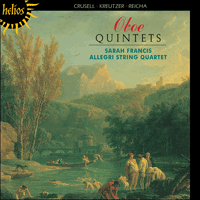


The marriage of solo wind instrument to string trio or quartet has generally been a felicitous one. If, by the end of the eighteenth century, the string quartet had evolved into a medium into which a composer could pour his deepest thoughts, the addition of flute, oboe or clarinet generally brought reminders of the old-fashioned serenade or divertimento; music primarily intended to entertain (though the best-known example of the genre, Mozart’s Clarinet Quintet, undoubtedly ranks with his finest music). Crusell’s Oboe Quintet, Op 9, is indeed called a ‘Divertimento’.
Bernhard Henrik Crusell: Divertimento in C major Op 9
Born into a family of Finnish bookbinders on 15 October 1775 in Nystad, Bernhard Henrik Crusell’s musical ability was quick to manifest itself, though it was not encouraged by his parents. Nevertheless, he became apprenticed to a military band at the age of thirteen (he had taken up the clarinet at the age of four) at Sveaborg, which transferred to Stockholm in 1791. It was as a clarinettist that Crusell was to make his name, studying with Franz Tausch in Berlin and later with Jean Xavier Lefèvre in Paris.
Whilst in Stockholm Crusell studied music theory with Abbé Georg Joseph Vogler (one of the more colourful and controversial of the many theorists working at the end of the eighteenth century), Kapellmeister and tutor to Gustav III since 1786, but it was only at the turn of the century that he himself began composing seriously. As a measure of his success, many of his works were published by Peters in Leipzig; he was the first Finnish composer whose music appeared in print. Vogler, who had been enjoined to found a national music school in Stockholm, must have been pleased.
On paper the overall plan of the C major Divertimento is conventional enough, but the structure is in fact entirely novel. As a wind player himself, Crusell treats the oboe very much as a soloist and many of the gestures derive from the concerto and operatic aria. The first Allegro proceeds very much as a normal sonata-form movement would (the very flexible approach to modulation may well have been learned from Vogler), but the spirited codetta, which gives the oboist the opportunity to show off some high notes, leads not into the expected development section but into a cadenza for the oboe which in turns leads directly into the slow movement. (This practice of truncating the first movement found some favour in the nineteenth century, the best known example being Max Bruch’s G minor Violin Concerto.) The C minor Andante poco adagio is a movement whose gravity is tempered by some smiling turns towards the major mode. Towards its close the mood becomes more fervent, but this is dispelled by the ensuing Allegro, which again follows without a break and is itself little more than a fairly extended introduction to the Allegro vivace finale proper.
Rodolphe Kreutzer: Grand Quintet in C major
Rodolph Kreutzer was born in Versailles in 1766 and became one of the most famous and influential violinists of his day. Like most contemporary musicians he was equally active as a composer, producing no fewer than nineteen violin concertos as well as a good deal of music for the stage – ballets, operas and opéras-comiques. Most of his chamber music dates from the 1790s. The exact date of the Oboe Quintet – the solo wind part may also be taken by the clarinet – is not known, but the work is presumed to have been written between 1790 and 1799. It is a relatively short piece, despite being labelled ‘Grand Quintet’. As in the Crusell there is a surprise in the first movement: in place of the development is an Andantino section, prefaced by a hymn-like passage for the strings. The slow movement itself, in F major, is long-lined, very vocal in style, with a recurring dotted rhythm (redolent of the first movement of Beethoven’s ‘Moonlight’ Sonata) and an affecting use of the Neapolitan. The music’s vocal quality is furthered by a recitative section, an operatic dialogue between oboe and first violin, before the short finale, a perky Presto non troppo.
Antoine Reicha: Quintet in F major Op 107
Compared with these, Antoine Reicha’s F major Quintet is conventional, though his craftsmanship is not to be gainsaid. Antoine Reicha (as he became; he was born Antonín, or Anton, Rejcha in Prague on 26 February 1770) was one of the leading pedagogues of the late-eighteenth and early-nineteenth centuries. Among his more illustrious pupils were Berlioz, Liszt, and, briefly in the last year of his life, César Franck. In his youth he knew Beethoven and C G Neefe (his adoptive family moved to Bonn in 1785 where Anton played flute and violin in the Hofkapelle) and also Haydn. After a few unsuccessful years in Paris, 1801 found him in Vienna where he took lessons from Albrechtsberger (from whom, like Beethoven, he probably gained his mastery of contrapuntal techniques) and Salieri. In 1808 he returned to Paris, dreaming of operatic success. Though this was not forthcoming, as a composer of chamber music his fame continued to grow: he produced no fewer than four sets of wind quintets. Such was his reputation that he was appointed professor of counterpoint and fugue at the Conservatoire in 1818 and it was around this time that his Cours de composition musicale was published. The famous Traité de haute composition musicale, his most important treatise, followed between 1824 and 1826. This work provoked much controversy and within a few years had been translated into English, Italian and Spanish.
The F major Quintet, Op 107, dates from the Paris years, being written probably between 1821 and 1826 and published in Paris in 1829 in a version for clarinet and strings in G major. Reicha had said of his six quartets for flute and strings, Op 98, that they were true quartets rather than sonatas or solos for flute with string accompaniment, and the same holds good for the Quintet. The first movement demonstrates Reicha’s mastery of sonata form; the delaying of any extensive reference to the minor mode until the development section is reached is particularly effective. The B flat major Andante has a definite archaic feel to its with its dotted Sicilian rhythms, and the melting coda sounds as though the composer had the equivalent point in the Larghetto of Mozart’s Clarinet Quintet in mind; but Reicha’s originality is manifest in the Minuet and finale which both show his propensity for asymmetric phrases (something Berlioz was to imitate). The lightweight nature of the finale is agreeably offset by an elaborate fugato section in the middle, and the return of the main theme is delayed as long as possible finally reappearing after a mock cadenza.
Andrew Mikolajski © 1999
Le mariage d’un instrument à vent soliste au trio ou au quatuor à cordes a habituellement été heureux. Si, à la fin du XVIIIe siècle, le quatuor à cordes était devenu un moyen d’expression dans lequel le compositeur pouvait déverser ses pensées les plus profondes, l’ajout d’une flûte, d’un hautbois ou d’une clarinette fut généralement vecteur de réminiscences des surannés sérénade ou divertimento: la musique visait essentiellement au divertissement (même si le plus fameux exemple du genre, le Quintette avec clarinette de Mozart, figure indubitablement au rang des plus belles pages du compositeur). Le Quintette avec hautbois, Op 9 de Crusell est, d’ailleurs, appelé «Divertimento».
Bernhard Henrik Crusell: Divertimento en ut majeur Op 9
Né dans une famille de relieurs finlandais, le 15 octobre 1775, à Nystad, Bernhard Henrik Crusell manifesta des dons musicaux précoces, en dépit de l’absence de soutien de ses parents. Il entra malgré tout comme apprenti dans une fanfare militaire, à l’âge de treize ans (il avait commencé la clarinette à quatre ans), à Sveaborg, avant d’être transféré à Stockholm en 1791. Ce fut en tant que clarinettiste qu’il devait se faire un nom, étudiant avec Franz Tausch, à Berlin, puis avec Jean Xavier Lefèvre, à Paris.
À Stockholm, Crusell étudia la théorie musicale auprès de l’abbé Georg Joseph Vogler (l’un des théoriciens les plus hauts en couleurs et controversés de la fin du XVIIIe siècle), Kapellmeister et précepteur de Gustav III depuis 1786, mais ce fut seulement au tournant du siècle qu’il se mit à composer sérieusement. Preuve de son succès, quantité de ses œuvres furent publiées par Peters, à Leipzig – il fut le premier compositeur finlandais dont la musique fut imprimée. Vogler, qui avait reçu l’ordre de fonder une école de musique nationale à Stockholm, dut en être ravi.
Sur le papier, le schéma global du Divertimento en ut majeur est assez conventionnel, mais sa structure est, en fait, totalement neuve. Lui-même joueur d’instrument à vent, Crusell traite le hautbois presque en soliste, et nombre des gestes dérivent du concerto et de l’aria d’opéra. Le premier Allegro se déroule comme un mouvement normal de forme sonate (l’approche très flexible de la modulation est peut-être un enseignement de Vogler), mais la codetta animée – occasion, pour le soliste, de faire la démonstration de quelques notes aiguës – conduit non à la section de développement attendue, mais à une cadence pour le hautbois qui mène, à son tour, directement au mouvement lent. (Cette pratique de troncage du premier mouvement trouva grâce au XIXe siècle, l’exemple le plus connu étant le Concerto pour violon en sol mineur de Max Bruch.) L’Andante poco adagio en ut mineur est un mouvement dont la gravité est tempérée par quelques souriants revirements vers le mode majeur. Vers la fin de ce mouvement, l’atmosphère se fait plus fervente, mais cette ferveur est chassée par l‘Allegro suivant qui, de nouveau, survient directement et n’est guère plus qu’une introduction, assez prolongée, au finale Allegro vivace proprement dit.
Rodolphe Kreutzer: Grand Quintette en ut majeur
Né à Versailles en 1766, Rodolphe Kreutzer devint l’un des violonistes les plus célèbres et influents de son temps. À l’instar de la plupart de ses contemporains, il se montra aussi actif dans la composition, produisant pas moins de dix-neuf concertos pour violon et quantité de musiques de scène – ballets, opéras et opéras-comiques. La majorité de ses pièces de chambre remontent aux années 1790. La date exacte du Quintette avec hautbois – la partie de vent solo a pu être tenue par une clarinette – est inconnue, mais l’on présume qu’il fut écrit entre 1790 et 1799. Il s’agit d’une pièce relativement brève, nonobstant son appellation de «Grand Quintette». Comme chez Crusell, le premier mouvement recèle une surprise: le développement est remplacé par une section Andantino, préfacée par un passage hymnique dévolu aux cordes. Le mouvement lent en tant que tel, en fa majeur, est longiligne, de style très vocal, avec un rythme pointé récurrent (évocateur du premier mouvement de la Sonate «Clair de lune» de Beethoven) et un touchant usage de la sixte napolitaine. La vocalité de la musique est servie par une section de récitatif, un dialogue opératique entre le hautbois et le premier violon, avant le court finale, un vif Presto non troppo.
Antoine Reicha: Quintette en fa majeur Op 107
Comparé à ces œuvres, le Quintette en fa majeur d’Antoine Reicha est conventionnel, en dépit d’une indéniable maîtrise. Antoine Reicha (né Antonín, ou Anton, Rejcha, à Prague, le 26 février 1770) fut l’un des grands pédagogues de la fin du XVIIIe siècle et du début du XIXe. Parmi ses élèves les plus illustres, citons Berlioz, Liszt et, brièvement, à la fin de sa vie, César Franck. Dans sa jeunesse, Reicha connut Beethoven, C G Neefe (dont la famille adoptive déménagea en 1785 à Bonn, où Anton jouait de la flûte et du violon à la Hofkapelle) et Haydn. Passé quelques années infructueuses à Paris, l’année 1801 le trouva à Vienne, où il prit des leçons auprès d’Albrechtsberger (de qui, à l’instar de Beethoven, il tira probablement sa maîtrise des techniques contrapuntiques) et de Salieri. En 1808, il retourna à Paris, rêvant de succès opératiques. Ces derniers n’arrivèrent point, mais sa renommée de compositeur de musique de chambre continua de croître: il produisit pas moins de quatre corpus de quintettes à vent. Sa réputation fut telle qu’on le nomma professeur de contrepoint et de fugue au Conservatoire, en 1818, date aux environs de laquelle son Cours de composition musicale fut publié – suivi, entre 1824 et 1826, de son ouvrage majeur, le Traité de haute composition musicale, qui suscita maintes controverses et fut traduit, en quelques années, en anglais, en italien et en espagnol
Le Quintette en fa majeur, Op l07 date des années parisiennes; probablement écrit entre 1821 et 1826, il fut publié à Paris, en 1829, dans une version pour clarinette et cordes, en sol majeur. Reicha avait dit de ses six quatuors pour flûte et cordes, Op 98 qu’il s’agissait non de sonates ou de solos pour flûte avec accompagnement de cordes, mais de véritables quatuors. Ce qui vaut également pour le Quintette. Le premier mouvement démontre la maîtrise de Reicha quant à la forme sonate – la mise en retard de toute référence importante au mode mineur jusqu’à ce que la section de développement soit atteinte est particulièrement efficace. L’Andante en si bémol majeur est résolument archaïque, avec ses rythmes de sicilienne pointés, cependant que, pour l’attendrissante coda, le compositeur semble avoir eu à l’esprit la coda du Larghetto du Quintette avec clarinette de Mozart; mais l’originalité de Reicha est manifeste dans le Menuet et le finale, tous deux preuves de sa propension aux phrases asymétriques (que Berlioz devait imiter). La légèreté du finale est agréablement compensée par une élaborée section de fugato, au milieu, tandis que la reprise du thème principal est retardée aussi longtemps que possible, réapparaissant finalement après une fausse coda.
Andrew Mikolajski © 1999
Français: Hypérion
Die Verbindung zwischen solistischem Blasinstrument und Streichtrio oder –quartett ist im allgemeinen eine glückliche. Zwar hatte sich gegen Ende des achtzehnten Jahrhunderts das Streichquartett zu einem Medium gewandelt, in das der Komponist seine tiefsten Gedanken einbringen konnte, wenn jedoch Flöte, Oboe oder Klarinette hinzukamen, rief dies in der Regel Erinnerungen an die altmodische Serenade oder das Divertimento wach: an Musik, die vorwiegend dazu gedacht war, zu unterhalten (auch wenn das bekannteste Beispiel der Gattung, Mozarts Klarinettenquintett, zweifellos zu seinen schönsten Musikstücken zählt). Crusells Oboenquintett Op 9 trägt sogar die offizielle Bezeichnung ‘Divertimento’.
Bernhard Henrik Crusell: Divertimento in C-Dur Op 9
Nachdem er am 15. Oktober 1775 in eine finnische Buchbinderfamilie hineingeboren worden war, wurde Bernhard Henrik Crusells musikalische Begabung recht bald offenbar, obwohl sie von seinen Eltern nicht gefördert wurde. Dennoch trat er mit dreizehn Jahren (er hatte mit vier Jahren begonnen, Klarinette zu spielen) in Svaeborg eine Lehrstelle bei einer Militärkapelle an, die 1791 nach Stockholm verlegt wrude. Und als Klarinettist, der von Franz Tausch in Berlin und später von Jean Xavier Lefèvre in Paris ausgebildet wurde, sollte sich Crusell einen Namen machen.
Während er in Stockholm war, studierte Crusell Musiktheorie bei Abbé Georg Joseph Vogler (einem der eigenwilligeren und umstritteneren unter den Theoretikern, die am Ende des achtzehnten Jahrhunderts tätig waren), der seit 1786 Kapellmeister und Musiklehrer Gustavs III. war. Allerdings fing Crusell selbst erst um die Wende des Jahrhunderts ernsthaft zu komponieren an. Es ist ein Maßstab seines Erfolges, daß viele seiner Werke von Peters in Leipzig herausgegeben wurden; er war der erste finnische Komponist, dessen Musik im Druck erschien. Vogler, dem es auferlegt war, in Stockholm eine nationale Schule der Musik zu gründen, muß hocherfreut gewesen sein.
Auf dem Papier ist der Grundplan des Divertimento in C-Dur recht konventionell, doch tatsächlich ist seine Struktur völlig neuartig. Da er selbst Holzbläser war, behandelt Crusell die Oboe im wesentlichen als Soloinstrument, und viele ihrer Gesten gehen auf das Konzert und die Opernarie zurück. Das erste Allegro schreitet als ganz normaler Sonatensatz voran (den äußerst flexiblen Umgang mit Modulationen könnte Crusell von Vogler gelernt haben), doch die beschwingte Codetta, die dem Oboisten Gelegenheit gibt, einige sehr hohe Noten vorzuführen, geht nicht in die erwartete Durchführung über, sondern in eine Kadenz für die Oboe, die wiederum direkt in den langsamen Satz mündet. (Diese Praxis, den ersten Satz abzukürzen, fand im neunzehnten Jahrhundert einigen Anklang; das bekannteste Beispiel ist Max Bruchs Violinkonzert in g-Moll.) Das Andante poco adagio in c-Moll ist ein Satz, dessen Ernst durch einige freundliche Wendungen in die Durtonart gemildert wird. Gegen Ende wird die Stimmung hitziger, ehe sie vom folgenden Allegro verdrängt wird, das wieder ohne Unterbrechung anschließt und selbst wenig mehr als eine recht ausführliche Einführung zum Allegro vivace überschriebenen eigentlichen Finale ist.
Rodolphe Kreutzer: Großes Quintett in C-Dur
Rodolphe Kreutzer wurde 1766 in Versailles geboren und brachte es zu einem der bekanntesten und einflußreichsten Violinisten seiner Zeit. Wie die meisten Musiker der damaligen Zeit war er als Komponist ebenso aktiv und brachte nicht weniger als neunzehn Violinkonzerte sowie eine große Menge Musik für die Bühne hervor – Ballette, Opern und Opéras-comiques. Seine Kammermusik entstammt mehrheitlich den 1790er Jahren. Das genaue Entstehungsdatum des Oboenquintetts – die solistische Bläserstimme kann auch von der Klarinette gespielt werden – ist nicht bekannt, aber man geht davon aus, daß es zwischen 1790 und 1799 komponiert wurde. Es ist ein relativ kurzes Stück, obwohl es als ‘großes Quintett’ bezeichnet wird. Wie bei Crusell gibt es im ersten Satz eine Überraschung: Die Stelle der Durchführung nimmt ein Andantino ein, dem eine hymnische Streicherpassage vorausgeht. Der eigentliche langsame Satz in F-Dur ist von langen Linien gekennzeichnet und vom Stil her sehr sanglich, mit einem wiederkehrenden punktierten Rhythmus (der stark an den ersten Satz von Beethovens ‘Mondscheinsonate’ erinnert) und ergreifenden neapolitanischen Sexten. Der sangliche Charakter der Musik wird noch durch eine Rezitativpassage erhöht, einen opernhaften Dialog zwischen Oboe und erster Geige, ehe das kurze Finale einsetzt, ein lebhaftes Presto non troppo.
Antoine Reicha: Quintett in F-Dur Op 107
Verglichen damit ist das F-Dur-Quintett von Antoine Reicha ausgesprochen konventionell, auch wenn sein handwerkliches Können nicht zu leugnen ist. Antoine Reicha (der am 26. Februar 1770 als Antonín bzw. Anton Rejcha in Prag geboren wurde) war einer der führenden Pädagogen des späten achtzehnten und frühen neunzehnten Jahrhunderts. Zu seinen bekannteren Schülern zählten Berlioz, Liszt und im letzten Jahr seines Lebens noch kurz César Franck. In seiner Jugend war er mit Beethoven und C G Neefe bekannt (seine Adoptivfamilie zog 1785 nach Bonn, wo Anton in der Hofkapelle Flöte und Violine spielte), sowie mit Haydn. Nach einigen erfolglosen Jahren in Paris erschien er 1801 in Wien und nahm dort Unterricht bei Salieri und Albrechtsberger (bei dem er wahrscheinlich genau wie Beethoven den meisterhaften Umgang mit dem Kontrapunkt erlernte). 1808 kehrte er nach Paris zurück und träumte davon, als Opernkomponist erfolgreich zu sein. Auch wenn es dazu nicht kam, wuchs sein Ansehen als Komponist von Kammermusik: Er gab nicht weniger als vier Sammlungen von Bläserquintetten heraus. So gut war sein Ruf, daß er 1818 zum Professor für Kontrapunkt und Fuge am Conservatoire ernannt wurde, und um diese Zeit kam auch sein Cours de composition musicale heraus. Die berühmte Traité de haute composition musicale, seine bedeutendste Abhandlung, folgte zwischen 1824 und 1826. Dieses Werk löste erhebliche Kontroversen aus und wurde binnen weniger Jahre ins Englische, Italienische und Spanische übersetzt.
Das Quintett in F-Dur Op 107 stammt aus der Pariser Zeit, wurde vermutlich zwischen 1821 und 1826 komponiert und 1829 in Paris in einer Fassung für Klarinette und Streicher in G-Dur veröffentlicht. Reicha hatte über seine sechs Quartette für Flöte und Streicher Op 98 ausgesagt, sie seien echte Quartette, nicht Sonaten oder Soli für Flöte mit Streicherbegleitung, und das gleiche gilt für das Quintett. Der erste Satz beweist Reichas meisterhaften Umgang mit dem Sonatensatz; der Aufschub aller ausführlicheren Verweise auf die Durtonart bis zur Durchführung ist besonders wirkungsvoll. Das Andante in B-Dur hat mit seinem punktierten Siciliano-Rhythmus etwas eindeutig Archaisches an sich, und die schmelzende Coda klingt, als habe der Komponist die entsprechende Stelle im Larghetto von Mozarts Klarinettenquintett im Sinn gehabt. Andererseits macht sich Reichas Originalität im Menuett und im Finale bemerkbar, die beide seinen (später von Berlioz nachgeahmten) Hang zu asymmetrischen Phrasen verraten. Der leichte Charakter des Finales steht in angenehmem Kontrast zu einem kunstvollen Fugato in der Mitte, und die Rückkehr des Hauptthemas wird so lange wie möglich aufgeschoben, bis es schließlich nach einer Scheinkadenz wieder auftaucht.
Andrew Mikolajski © 1999
Deutsch: Anne Steeb/Bernd Müller