Welcome to Hyperion Records, a British classical label devoted to presenting high-quality recordings of music of all styles and from all periods from the twelfth century to the twenty-first.
Hyperion offers both CDs, and downloads in a number of formats. The site is also available in several languages.
Please use the dropdown buttons to set your preferred options, or use the checkbox to accept the defaults.
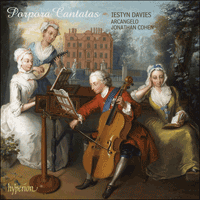




Young countertenor Iestyn Davies makes his much anticipated Hyperion solo debut with an enchanting disc of cantatas from the Italian composer Nicola Porpora. Davies’s luminous tone has a celestial purity and he performs with prodigious technical assurance. Unfazed by the composer’s intricate passagework and elaborate ornamentation, his astonishing breath control creates a seamless melodic line. Davies is accompanied by the ensemble Arcangelo in interpretations that go far beyond historical understanding.
In a productive career that spanned 70 years, Porpora wrote some 135 secular canatas, twelve of which were dedicated to His Royal Highness Frederick Prince of Wales, a great patron of the arts and an amateur musician. Porpora’s ability to set the Italian language to music was widely acknowledged during his lifetime and his music is full of imaginative word painting. Davies’s remarkable skill in characterization, and his innate ability to go straight to the heart of both text and music, make this the perfect affiliation.

After cricket, Frederick’s favourite pastime was music: he was not only the principal patron of the Opera of the Nobility in Lincoln’s Inn Fields in competition with the King’s Theatre in the Haymarket, which was under Handel’s thumb, but also a keen amateur performer. On 30 November 1734 the famous castrato Farinelli reported to the Bolognese count Sicinio Pepoli, his lifelong patron: ‘The royal prince of these parts […] does me countless favours of which I should never have dreamt, and from him I expect much of advantage to myself, since we are always together, he playing the cello and I singing.’
These music-making sessions involving the Prince and the castrato, who was able to accompany himself on the harpsichord, could last many hours. Farinelli wrote that he passed the whole of 1 July 1735 in this way with Frederick. It is tempting to imagine that their repertoire included the twelve cantatas by Nicola Porpora that were to appear in print that same year with a eulogistic dedication to Frederick as an ‘Amateur, Owner and most munificent PATRON’ of the fine arts; Porpora may even have composed the cantatas expressly for his former pupil Farinelli in order to gratify their common operatic patron in London. The title page actually speaks of ‘These newly composed vocal works’, even if such a well-worn claim cannot always be taken at face value.
The Neapolitan lawyer Saverio Mattei, a noted polymath and correspondent of Metastasio, wrote to Giuseppe Orlandi, an editor of the poet’s collected works, on 30 May 1784: ‘I am sending you twelve cantatas that I have had copied from the papers of Porpora, who set them to music at the same time as Metastasio wrote them.’ This description hints at close contact between the two men, which—previously to 1735—could have taken place only at three points in the course of their long careers: in Naples in 1719–22; in Rome in 1722–3 (or, less probably, in late 1729 to early 1730); and in Venice in early 1726.
The 1735 London print makes no mention of the author of the cantata texts. This is rather puzzling, since Metastasio’s prestigious post in Vienna as ‘Caesarian Poet’ and the excellent relations between the Habsburgs and the Court of St James would have made his naming appropriate and advantageous. Stranger still, until 1734 Metastasio affected to have little regard for his early cantatas, writing to his Venetian publisher Bettinelli: ‘The cantatas I have penned are not many, and I have never taken care to preserve them.’ Only in 1748, at the behest of the Dresden publisher Walther, did he volunteer to provide ‘a small number of cantatas which, written by me but not retained, are circulating in corrupt form among lovers of poetry; however, these number no more than twelve or fourteen’.
Despite their immaturity and scant acknowledgement by their author, these cantatas are poetically far superior to the average for such verse in the mid-eighteenth century. No editor of the time or modern scholar seriously disputes their authorship. Moreover, the 1735 London score offers a sung text that is substantially correct, matching the ‘literary’ versions of the poems published much later. So presumably their autograph texts had been in Porpora’s possession for a long time—since at least the mid-1720s—before the cantatas came out in print.
The musical setting of the cantatas for alto recorded here (numbered 7–12 in the collection) can be described as a reasonable compromise between the intimate requirements of the chamber cantata and the flamboyant vocal virtuosity of the new ‘Neapolitan’ opera, as popularized between 1733 and 1736 in Porpora’s most successful scores for the London public stage, such as Arianna in Nasso and Polifemo.
Although intricate passagework and elaborate ornamentation are present throughout, sheer acrobatics is not the main issue for the solo singer. With a range stretching from b to e'' flat (exceptionally to e'' natural and f'', thus comparable in modern terms to an average mezzo-soprano), and with intervallic leaps not exceeding one octave, the main emphasis is rather on rapid divisions, rhythmic flexibility and an accomplished breath control enabling the singer to produce long trills on sustained notes (as in the second aria of Cantata No 7), or to deliver those opening messe di voce (as in the second arias of Cantata No 9 and Cantata No 10) whose perfect realization was a sort of style-marker for Porpora’s pupils.
In the accompaniment, the energetic bass line is idiomatic for the cello and sets in relief the vocal part with concertato-like imitations, while notated chordal passages additional to the usual figures stipulate the presence of a harpsichord, probably with further continuo instruments. All manner of compositional devices are deployed in the recitative, from secco through obbligato to arioso, with accurate descriptive effects and hints at word-painting matching the sung text.
A climax for the whole collection occurs in Cantata No 9, which starts with a long obbligato recitative in the guise of a highly dramatic monologue redolent of opera seria. The accompaniment on two separate staves features mercurial tempo changes and a dense harmonic texture. Particularly here, and in the lovely siciliana that follows (‘Nei campi e nelle selve’), the addition of some kind of treble instrument seems unavoidable. However, in most cantatas the enrichment of the basic scoring with one or two violins, a flute or recorder, oboe and bassoon, would be consistent both with period practice and with the pastoral atmosphere gracefully depicted by Metastasio. In Cantata No 8, the future poeta cesareo resorted to the unusual pattern of an opening recitative framed by the repeats of a single quatrain to introduce a comparison between the narrating lover and the mythological character of the nymph Clytie turned into a sunflower (Ovid, Metamorphoses, Book IV, 190–270). If old-fashioned and a little obscure, this passage afforded Porpora the opportunity for a melancholy arioso (or ‘semi-aria’) of heart-rending effect.
Carlo Vitali © 2011
Après le cricket, la musique était le passe-temps favori de Frederick: principal mécène de l’Opera of the Nobility de Lincoln’s Inn Fields—le rival du King’s Theatre (Haymarket) placé sous la coupe de Haendel—, il était également un fin interprète amateur. Le 30 novembre 1734, le célèbre castrat Farinelli rapporta au comte de Bologne Sicinio Pepoli, son indéfectible mécène: «Le prince royal de cette région […] me fait d’innombrables faveurs dont jamais je n’aurai rêvé et je compte tirer grand profit de lui, car nous sommes toujours ensemble, lui au violoncelle et moi au chant.»
Ces séances de musique réunissant le prince et le castrat—par ailleurs capable de s’accompagner au clavecin—pouvaient durer des heures. Farinelli écrivit avoir passé ainsi tout le 1er juillet 1735 avec Frederick. Il est tentant d’imaginer que figuraient à leur répertoire les douze cantates de Nicola Porpora qui allaient être imprimées cette année-là, avec une louangeuse dédicace à Frederick, «Amateur, propriétaire et très munificent mécène» des Beaux-Arts; il se peut même que Porpora ait composé ces cantates expressément pour son ancien élève Farinelli, dans le seul but d’être agréable à leur mécène opératique commun, à Londres. Au vrai, la page de titre dit «These newly composed vocal works» [«Ces œuvres vocales nouvellement composées»], même si ce genre de banalités n’est pas toujours à prendre pour argent comptant.
Le juriste napolitain Saverio Mattei, célèbre esprit encyclopédique et correspondant de Métastase, écrivit à Giuseppe Orlandi, éditeur des œuvres complètes du poète, le 30 mai 1784: «Je vous envoie douze cantates que j’ai fait copier d’après les papiers de Porpora, qui les mit en musique en même temps que Métastase les écrivit.» Cette évocation insinue un contact étroit entre les deux hommes qui, avant 1735, ne put survenir qu’en trois moments de leurs longues carrières: en 1719–22, à Naples; en 1722–3 (ou, moins probablement, entre la fin de 1729 et le début de 1730), à Rome; et au début de 1726, à Venise.
L’édition londonienne de 1735 ne précise pas l’auteur des textes de cantates, ce qui est étonnant car le prestigieux poste de Métastase, à Vienne («poète césarien»), mais aussi l’excellence des relations entre les Habsbourgs et la cour de Saint James auraient rendu la mention de son nom opportune, bénéfique. Chose plus étrange encore, jusqu’en 1734, Métastase sembla peu se soucier de ses premières cantates: «Les cantates que j’ai rédigées ne sont pas nombreuses et je n’ai jamais pris soin de les conserver», écrivit-il à son éditeur vénitien Bettinelli. Ce fut seulement en 1748, à la demande de l’éditeur dresdois Walther, qu’il voulut bien fournir «quelques cantates qui, écrites par moi mais non retenues, circulent sous une forme corrompue parmi les amateurs de poésie; il n’y en a toutefois pas plus de douze ou quatorze».
Manquant de maturité, à peine reconnues par leur auteur, ces cantates sont pourtant poétiquement bien supérieures à ce que ce type de vers offrait, en général, au milieu du XVIIIe siècle. Aucun éditeur de l’époque, ni aucun spécialiste moderne n’en conteste sérieusement la paternité. Par ailleurs, la partition londonienne de 1735 présente un texte chanté en grande partie correct, conforme aux moutures «littéraires» des poèmes publiées bien après. Porpora en possédait donc une version autographe depuis les années 1725 au moins, c’est-à-dire bien avant que les cantates ne fussent imprimées.
La mise en musique des cantates pour alto enregistrées ici (nos 7–12 du recueil) est, pourrait-on dire, un compromis raisonnable entre les exigences intimistes de la cantate da camera et la flamboyante virtuosité vocale du nouvel opéra «napolitain», tel que Porpora le popularisa, entre 1733 et 1736, dans ses partitions à très grand succès conçues pour la scène londonienne (Arianna in Nasso ou Polifemo, par exemple).
Même si les passages complexes et l’ornementation sophistiquée sont constants, la pure acrobatie n’est pas le principal problème du chanteur. Avec un ambitus s’étirant de si2 à mi4 bémol (exceptionnellement à mi4 naturel et fa4, ce qui équivaut à un mezzo-soprano moyen) et avec des sauts d’intervalle n’excédant pas l’octave, l’heure est plutôt aux divisions rapides, à la flexibilité rythmique et à un contrôle accompli du souffle, permettant à qui chante de produire de longs trilles sur des notes tenues (comme dans la seconde aria de la Cantate no 7) ou de délivrer ces messe di voce liminaires (comme dans les secondes arias des Cantates nos 9 et 10), dont la parfaite réalisation était une manière de griffe stylistique pour les élèves de Porpora.
Dans l’accompagnement, l’énergique ligne de basse, idiomatique pour le violoncelle, met en relief la partie vocale avec des imitations façon concertato, cependant que des passages en accords notés, ajoutés aux figures habituelles, stipulent la présence d’un clavecin, probablement associé à d’autres instruments de continuo. Quant au récitatif, il déploie tous les types de procédés compositionnels, du secco à l’arioso en passant par l’obbligato, avec un effet descriptif précis et des pointes de figuralisme dignes du texte chanté.
Le recueil atteint à un de ses summums dans la Cantate no 9, qui part sur un long récitatif obbligato, un monologue des plus remarquables rappelant l’opera seria. L’accompagnement sur deux portées séparées présente de vifs changements de tempo et une texture harmonique dense. Ici, tout particulièrement, comme dans la charmante sicilienne qui suit («Nei campi e nelle selve»), l’ajout d’un instrument de tessiture aiguë paraît inévitable. Toutefois, dans la plupart des cantates, enrichir l’écriture de base avec un ou deux violons, une flûte (à bec ou non), un hautbois et un basson serait cohérent avec la pratique de l’époque comme avec l’atmosphère pastorale élégamment dépeinte par Métastase. Dans la Cantate no 8, le futur poeta cesareo recourut au schéma inhabituel d’un récitatif inaugural flanqué des reprises d’un seul et même quatrain pour introduire une comparaison entre l’amant narrateur et le personnage mythologique de la nymphe Clytie changée en tournesol (Ovide, Métamorphoses, Livre IV, 190–270). Quoique à l’ancienne et un rien obscur, ce passage fut pour Porpora l’occasion de se livrer à un arioso (ou «semi-aria») mélancolique, à vous serrer le cœur.
Carlo Vitali © 2011
Français: Hypérion
Neben dem Cricket beschäftigte Frederick sich am liebsten mit der Musik: er war nicht nur der Hauptförderer der Opera of the Nobility in Lincoln’s Inn Fields, der Konkurrenz des von Händel geführten King’s Theatre in Haymarket, sondern auch ein leidenschaftlicher Laienmusiker. Am 30. November 1734 berichtete der berühmte Kastrat Farinelli dem Grafen Sicinio Pepoli aus Bologna, der ihn zeit seines Lebens förderte: „Der königliche Prinz hierzulande […] erweist mir zahllose Gefälligkeiten, die ich mir nie hätte träumen lassen und von ihm erwarte ich viel, was mich voran bringen wird, da wir immer zusammen sind; er spielt Cello und ich singe.“
Dieses gemeinsame Musizieren des Prinzen und des Kastraten, der sich selbst am Cembalo begleiten konnte, konnte viele Stunden lang andauern. Farinelli schrieb, dass er den ganzen 1. Juli 1735 auf diese Weise mit Frederick zugebracht hatte. Vielleicht führten sie sogar die zwölf Kantaten von Nicola Porpora, die später in demselben Jahr im Druck erschienen, in ihrem Repertoire. Diese Ausgabe war jedenfalls mit einer Widmung versehen, die Frederick als „Amateur, Besitzer und äußerst großzügigen PATRON“ der schönen Künste rühmte; es ist durchaus denkbar, dass Porpora diese Kantaten ausdrücklich für seinen ehemaligen Schüler Farinelli komponierte, um ihren gemeinsamen Opernförderer in London zufrieden zu stellen. Auf der Titelseite ist sogar von „Diese[n] neukomponierten Vokalwerke[n]“ die Rede, doch war dies eine viel benutzte Wendung und kann nicht immer wörtlich genommen werden.
Der neapolitanische Rechtsanwalt Saverio Mattei, ein anerkannter Universalgebildeter, der mit Metastasio korrespondierte, schrieb am 30. Mai 1784 an Giuseppe Orlandi, einem Herausgeber der gesammelten Werke des Dichters: „Ich übersende Ihnen zwölf Kantaten, die ich von den Papieren Porporas kopiert habe, der sie komponiert hat, als Metastasio sie schrieb.“ Diese Beschreibung deutet den engen Kontakt zwischen den beiden Männern an, der (bis 1735) nur zu drei Zeitpunkten im Laufe ihrer langen Karrieren stattgefunden haben kann: 1719–22 in Neapel, 1722–23 in Rom (oder, was weniger wahrscheinlich ist, zwischen Ende des Jahres 1729 und Anfang des Jahres 1730) oder zu Beginn des Jahres 1726 in Venedig.
In der Londoner Druckausgabe von 1735 findet sich kein Hinweis auf den Autoren der Kantatentexte. Es ist dies etwas verwirrend, da Metastasio als „kaiserlicher Hofpoet“ der Habsburger großes Ansehen genoss und angesichts der exzellenten Verbindungen zwischen Wien und dem Hof zu St James die Nennung seines Namens sicherlich angebracht und von Vorteil gewesen wäre. Noch eigenartiger ist, dass Metastasio bis 1734 seine frühen Kantatentexte offenbar selbst geringschätzte, was aus einem Brief an seinen venezianischen Verleger Bettinelli hervorgeht: „Die Kantaten, die ich zu Papier gebracht habe, sind nicht zahlreich und ich habe mich nie darum bemüht, sie zu erhalten.“ Erst im Jahre 1748, auf die Initiative des Dresdener Verlegers Walther hin, bot er „eine kleine Anzahl von Kantaten“ an, „die ich geschrieben, jedoch nicht behalten habe und die in korrupter Form unter Liebhabern von Poesie zirkulieren; jedoch handelt es sich dabei um nicht mehr als zwölf oder vierzehn“.
Trotz ihrer mangelnden Reife und der geringen Würdigung ihres Autoren befinden sich diese Kantaten auf einem deutlich höheren dichterischen Niveau als die meisten anderen vergleichbaren Werke der Mitte des 18. Jahrhunderts. Kein zeitgenössischer Herausgeber und auch kein heutiger Forscher zweifelt ernsthaft ihre Urheberschaft an. Zudem ist in der Londoner Partitur von 1735 der Gesangstext im Wesentlichen korrekt wiedergegeben und stimmt mit den sehr viel später veröffentlichten „literarischen“ Versionen der Gedichte überein. So darf man wahrscheinlich davon ausgehen, dass die Manuskripte der Texte sich lange in Porporas Besitz befanden—mindestens seit der Mitte der 1720er Jahre—bevor die Kantaten im Druck erschienen.
Die hier eingespielte Vertonung der Kantaten für Altstimme (Nummern 7–12 in der Sammlung) kann als gelungener Kompromiss zwischen den intimen Erfordernissen einer Kammerkantate und der extravaganten stimmlichen Virtuosität der neuen „neapolitanischen“ Oper bezeichnet werden, die zwischen 1733 und 1736 mit Porporas erfolgreichsten Werken für die öffentliche Londoner Bühne, wie etwa Arianna in Nasso und Polifemo, populär wurde.
Obwohl komplexe virtuose Passagen und aufwändige Verzierungen stets gegenwärtig sind, ist reine Stimmakrobatik für den Sänger nicht das Hauptanliegen. Mit einem Tonumfang von h bis es'' (ausnahmsweise bis e'', beziehungsweise f'', und damit heutzutage mit einem durchschnittlichen Mezzosopran vergleichbar) und mit Intervallsprüngen, die eine Oktave nicht übersteigen, liegt der Hauptschwerpunkt eher auf schnellen Ornamenten, rhythmischer Flexibilität und einer guten Atemtechnik, die es dem Sänger oder der Sängerin ermöglicht, die langen Triller auszuhalten (wie etwa in der zweiten Arie der Kantate Nr. 7) oder die messe di voce (wie in der jeweils zweiten Arie der Kantaten Nr. 9 und Nr. 10) auszuführen, deren perfekte Darbietung eine Art Markenzeichen der Schüler Porporas war.
In der Begleitung ist die energische Basslinie für das Cello besonders idiomatisch und lässt die Singstimme mit concertato-artigen Imitationen hervortreten, während die zusätzlich zu den üblichen Figuren notierten Akkordpassagen ein Cembalo verlangen (und weitere Continuo-Instrumente sicherlich nicht fehl am Platze sind). Im Rezitativ treten alle Arten von kompositorischen Techniken auf, vom Secco über das Obligato bis zum Arioso, wobei akkurat-deskriptive Effekte und Anklänge an Wortmalerei den Gesangstext unterstreichen.
Ein Höhepunkt der gesamten Sammlung findet sich in der Kantate Nr. 9, die mit einem langen obligaten Rezitativ in der Gestalt eines hochdramatischen, an die Opera seria erinnernden Monologs beginnt. Die Begleitung ist auf zwei separaten Notensystemen notiert und zeichnet sich durch launische Tempowechsel und eine dichte harmonische Textur aus. Besonders hier und auch in dem wunderschönen, darauf folgenden Siciliano, „Nei campi e nelle selve“, scheint das Hinzufügen eines Melodieinstruments unbedingt nötig. Bei den meisten Kantaten jedoch würde die Anreicherung der Grundbesetzung durch eine oder zwei Geigen, eine Flöte oder Blockflöte, Oboe und Fagott nicht nur der zeitgenössischen Praxis, sondern auch der elegant von Metastasio dargestellten pastoralen Atmosphäre entsprechen. In der Kantate Nr. 8 bediente sich der zukünftige poeta cesareo der ungewöhnlichen Struktur eines einleitenden Rezitativs, das von den Wiederholungen eines einzelnen Vierzeilers umrahmt wird, um den Vergleich zwischen dem erzählenden Liebhaber und der mythologischen Figur der Nymphe Klytie, die in eine Sonnenblume verwandelt wird (Ovid: Metamorphosen, 4. Buch, 190–270), darzustellen. Auch wenn sie altmodisch und etwas obskur war, gab diese Passage Porpora doch Gelegenheit dazu, ein melancholisches Arioso (oder eine „Halbarie“) mit herzzerreißender Wirkung zu verarbeiten.
Carlo Vitali © 2011
Deutsch: Viola Scheffel