
Welcome to Hyperion Records, a British classical label devoted to presenting high-quality recordings of music of all styles and from all periods from the twelfth century to the twenty-first.
Hyperion offers both CDs, and downloads in a number of formats. The site is also available in several languages.
Please use the dropdown buttons to set your preferred options, or use the checkbox to accept the defaults.
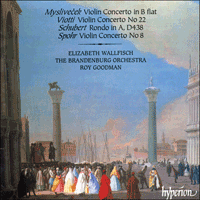



From the earliest years of the eighteenth century the violin has been a popular concerto instrument. Giuseppe Torelli was first, in about 1698, and the subsequent interest shown by Vivaldi, Locatelli, Geminiani and others saw the rapid development of the genre. By the middle of the century there was a dip in production but this was reversed by Myslivecek, who wrote eight such works between 1764 and 1772.
Myslivecek's vivacious personality endeared him to the Mozart family when they met in Bologna in 1770. 'He exudes fire, spirit and life', wrote Wolfgang, who was himself influenced significantly by the work of his lesser-known colleague. Viotti's famous Concerto No 22 dates from the last years of the eighteenth century and was highly praised by Brahms in a letter to Clara Schumann.
Both Schubert's Rondo and Spohr's Concerto No 8 date from 1816. Schubert wrote no violin concertos and yet the Rondo could almost be described as one, such is its level of development. Spohr's concertos far outstripped those of Beethoven in terms of their popularity at the time the two composers were writing, and the Eighth is fascinating in that it is more of an operatic aria, with the violin simply replacing the singer (hence its subtitle: in modo di scena cantate).

Myslivecek Violin Concerto No 4 in B flat major
Josef Myslivecek composed the earliest work in this collection. It dates from 1772 or earlier and thus predates Mozart’s by several years. The Bohemian Myslivecek was friendly with Mozart; each admired the other’s musicianship and it is possible that Myslivecek’s concerto-writing exerted an influence on Mozart.
Myslivecek was one of identical twin brothers born on 9 March 1737 in Prague. Reports of their receiving tuition from Felix Benda (c1700–1768) cannot be substantiated but both certainly entered the Charles University as philosophy students. Josef showed more interest in music than in anything else and, despite becoming a master miller (his father’s trade) in 1761, the violin bow prevailed over grain. That calling he left to his brother, Jáchym. Josef began composing in about 1760: a reported set of symphonies titled after months of the year is a myth (as are his reported nicknames, ‘The Divine Bohemian’ and ‘Venatorini’), but he did indeed become an important symphonist, producing eighty-five examples.
His vivacious personality endeared him to the Mozart family when they met in Bologna in 1770. ‘He exudes fire, spirit and life’, wrote Wolfgang. There is no doubt that Myslivecek’s Italianate style influenced Mozart a great deal in opera, symphonies, and violin concertos. Furthermore, Myslivecek wrote the earliest examples of string quintet (before 1767), a form Mozart made his own much later.
Myslivecek’s musical style reflects Mozart’s impression of the man himself. A beguiling melodic gift is evident in the first movement, and despite the introduction of virtuoso writing for the soloist he never forgets that he is writing for the listener who appreciates orderly forms, pleasing harmonies and graceful melody. The Larghetto celebrates the songful capabilities of the violin in a gentle aria-like piece to which the orchestra contributes a prelude and postlude, with short contrasting interludes. Myslivecek’s ‘fire’ is well displayed in the Presto finale.
Josef Myslivecek met an unfortunate end. After a brutal operation which removed his nose in an attempt to ‘cure’ his venereal disease, his earlier successes were forgotten and he died in poverty in Rome in 1781, aged forty-three.
Viotti Violin Concerto No 22 in A minor g97
Giovanni Battista Viotti (1755–1824) was foremost a violinist and composer for his instrument, but an opportunistic streak led him into other areas and away from his native Italy. His early violin teachers included Gaetano Pugnani, with whom he undertook an extensive concert tour to Switzerland, Germany, Poland and Russia (1780–81), such was his early brilliance. In Paris, he tired of the virtuoso way of life despite enthusiastic acclaim, and ‘escaped’ into the service of Marie-Antoinette at Versailles. His administrative skills soon surfaced. He created a new opera house and supported several younger composers by mounting their operas, but in 1792 the Revolution forced him to abandon everything and flee to London. There he resumed his virtuoso existence, becoming prominent in Haydn’s concert series. Trumped-up political charges drove him to Germany in 1798 but about two years later he was back in London, this time to sell wine! An unhappy period in Paris (1819–23) brought him close to despair and he died soon after returning to London.
For all his patchy career, his position as the leading violinist of his time is undisputed. He is regarded as the founder of modern violin playing. Following Tartini, his skill was unsurpassed until the appearance of Paganini, and his numerous compositions naturally concentrate upon his own instrument. He wrote twenty-nine violin concertos between about 1782 and 1805; they are important as ‘gap-fillers’ between Mozart’s and Beethoven’s but their quality puts them far above what that phrase implies. No 22 in Giazotto’s list is dated ‘c1792–7’.
A lengthy orchestral tutti creates an atmosphere of sombre expectation which is only marginally dispelled by the soloist’s contemplative entry. Here Viotti, the master violinist-composer, shows his paces in a well-constructed movement of contrasting moods in which display is neatly juxtaposed with thematic strength. The Adagio is a placid and beautiful interlude, the Agitato assai finale possesses an intriguing subdued urgency, and the whole work provides a valuable insight into the influences to which Spohr was exposed early on. Even Brahms came to admire this Viotti Concerto.
Schubert Rondo in A major D438
Lacking any full-scale attempt at a violin concerto by Schubert—and how rewarding such an attempt might have been!—we must content ourselves with a Concertstück, a Polonaise, and this Rondo which, but for the differences in key (D, B flat and A respectively) might yet have been assembled by an arranger as a concerto of sorts. Dating from June 1816, the Rondo, D438, for violin and four-part string orchestra boasts an extended Adagio introduction. The Rondo proper is then launched, Allegro giusto, its recurring theme the soul of happiness. A contrasting theme, heard almost immediately, is of a more pensive nature. The latter returns towards the close before the final statement of the Rondo theme and an exciting coda. In this beautifully crafted movement the modest-sized orchestra supports discreetly, but it is really the soloist’s show all the way. Primarily a pianist, Schubert learnt the violin when young, so his short violin works may have been written for himself. Like much of Schubert’s music, it gathered much dust, achieving publication only eighty-one years after its composition.
Spohr Violin Concerto No 8 in A minor
The year 1816 also saw the production of Spohr’s Eighth Violin Concerto. After Beethoven’s lone entry into the field of the violin concerto ten years earlier, composers seemed to recognise the wisdom of not trying to compete unless with something stylistically totally different. Schubert’s Rondo is a fragment by comparison, while Spohr adopts a less assuming tone in his concertos. He wrote fifteen between 1802 and 1844. In No 8 he departs radically from standard concerto format by putting the soloist into the role of a singer in a dramatic scene.
Born on Monday 5 April 1784 in Brunswick, Louis Spohr was encouraged in his musical inclinations by his father, a doctor, who sent the boy for lessons to, among others, Charles Dufour. He arranged further intensive instruction. This proved so fruitful that Spohr was engaged as chamber musician at the Brunswick court of Duke Karl Wilhelm Ferdinand at the age of fifteen. At nineteen he attended a violin concert by Pierre Rode which might have set him upon the career of a violin virtuoso, but circumstances led him to wider pastures.
Conducting had been practised for centuries by choral leaders wielding a stock or some other object, but Spohr, about 1810, was one of the first to use a slender stick. This gave greater precision and resulted in increased respect for the young man as conductor as well as composer and violinist. His career took him, and his harpist wife Dorette, on many successful concert-giving trips throughout Europe, notably to London and Paris. There were short appointments with a number of posts in Vienna and Frankfurt before they eventually settled in Kassel in 1822. His innate charm saw him through a number of personal, professional and organisational difficulties, and his fame became widespread as he resumed his concert tours. He ended his days as chief director of music at Kassel and died in 1859, aged seventy-five.
He left a large number of compositions. Operas, concertos for various instruments, symphonies, choral and vocal pieces, and a prodigious amount of chamber music make up his work-list, and the violin concertos hold a special place for their unassuming freshness, vigour and variety.
Concerto No 8 opens in an ominous mood that seems to suggest an operatic event of high drama, and the soloist enters with a recitative as if to describe the scene. This is carried through at some length, the orchestra providing suitable punctuation. As the Andante second movement enters without a pause, the violin maintains its operatic stance with an aria-like interlude of grave beauty. An agitated central section further intensifies the elegiac mood before the soloist peacefully concludes the movement. But the finale renews the drama, with the soloist again offering an explanatory recitative. This movement is, for Spohr, unusually passionate but does not neglect the composer’s standard trademark of melodic elegance, nor his obligation to provide the soloist with rewarding opportunities for display.
Robert Dearling © 1996
Myslivecek Concerto pour violon en si bémol
La plus ancienne œuvre du présent recueil, une composition de Josef Myslivecek, date de 1772, voire d’avant, précédant ainsi Mozart de plusieurs années. Le Bohémien Myslivecek était précisément un ami de Mozart; chacun admirait la musicalité de l’autre et il est possible que l’écriture de concerto de Myslivecek influençât Mozart.
Myslivecek et son vrai jumeau naquirent le 9 mars 1737 à Prague. Les récits selon lesquels ils suivirent des cours auprès de Felix Benda (circa 1700–68) ne peuvent être confirmés. Il est par contre certain que les deux frères entrèrent à la Charles University comme étudiants en philosophie. Josef manifesta davantage d’intérêt pour la musique que pour tout autre chose et, bien que devenu maître meunier (la profession de son père) en 1761, l’archet du violon prévalut sur le grain. Il laissa ce métier à son frère Jàchym et commença à composer aux alentours de 1760. A ce propos, le corpus de symphonies censées être intitulées d’après les mois de l’année est un mythe (à l’instar de ses soi-disants surnoms «le divin Bohémien» et «Venatorini»), mais il est vrai qu’il devint un important symphoniste, auteur de quatre-vingt-cinq œuvres.
Sa personnalité enjouée lui gagna les faveurs de la famille Mozart, qu’il rencontra à Bologne en 1770. «Il exsude le feu, l’esprit et la vie», écrivit Wolfgang. Il ne fait aucun doute que le style italianisant de Myslivecek influença énormément Mozart dans ses opéras, ses symphonies et ses concertos pour violon. Myslivecek composa également les tout premiers quintettes à cordes (avant 1767), forme que Mozart fit sienne bien des années plus tard.
Le style musical de Myslivecek reflète l’impression que Mozart eut de l’homme. Un charmant don mélodique est manifeste dans le premier mouvement et, malgré l’introduction d’une écriture virtuose pour le soliste, Myslivecek n’oublie jamais qu’il compose pour l’auditeur amateur de formes ordonnées, d’harmonies agréables et de mélodies gracieuses. L’Adagio glorifie les capacités chantantes du violon dans un doux morceau de type aria, auquel l’orchestre contribue par un prélude et un postlude, avec de brefs interludes contrastants. Le «feu» de Myslivecek transparaît bien dans le final Presto.
Josef Myslivecek connut une fin malheureuse. Victime d’une brutale opération qui l’amputa du nez dans une tentative de «traitement» de sa maladie vénérienne, il vit ses succès antérieurs sombrer dans l’oubli et mourut pauvre, à Rome, en 1781, à l’âge de quarante-trois ans.
Viotti Concerto pour violon no 22 en la mineur G97
Giovanni Battista Viotti (1755–1824) fut un instrumentiste-compositeur majeur pour le violon, même si une période opportuniste le conduisit vers d’autres sphères et l’éloigna de son Italie natale. Parmi ses premiers maîtres de violon figura Gaetano Pugnani, avec lequel il entreprit une vaste tournée de concerts en Suisse, Allemagne, Pologne et Russie (1780–81), tant sa brillance était précoce. A Paris, fatigué de la vie de virtuose, et ignorant les acclamations enthousiastes, il «s’échappa» pour se mettre au service de Marie-Antoinette à Versailles. Ses compétences administratives s’affirmèrent bientôt et il fonda un nouveau théâtre de l’opéra, dans lequel il soutint plusieurs jeunes compositeurs en montant leurs opéras. Mais en 1792, la Révolution le contraignit à tout abandonner pour s’enfuir à Londres.
Là, il reprit son existence de virtuose et accéda à la célébrité dans une série de concerts de Haydn. En 1798, des charges politiques montées de toutes pièces contre lui l’entraînèrent en Allemagne mais, deux ans plus tard, il regagna Londres, cette fois pour vendre du vin! Un séjour parisien malheureux (1819–23) l’amena au bord du désespoir et il mourut peu après son retour à Londres.
Durant toute sa carrière inégale, Viotti conserva son statut de violoniste majeur de son temps, considéré comme le fondateur du jeu moderne. Suivant Tartini, sa maîtrise demeura insurpassée jusqu’à Paganini. Et ce fut tout naturellement qu’il consacra ses nombreuses compositions à son propre instrument. Importants en tant que «bouche-trous» entre les concertos de Mozart et ceux de Beethoven, les vingt-neuf concertos pour violon qu’il composa de 1782 à 1805 (dates approximatives) possèdent une qualité qui les place bien au-delà de ce que le terme «bouche-trou» implique. Dans la liste de Giazotto, le no 22 est daté «environ 1792–7».
Un très long tutti orchestral crée cette atmosphère de sombre expectative, à peine dissipée par l’entrée contemplative du soliste. Maître violoniste-compositeur, Viotti prouve ce dont il est capable dans un mouvement bien construit de modes contrastants, où la démonstration est nettement juxtaposée à la force thématique. L’Adagio est un interlude paisible et magnifique, tandis que le final, Allegro assai, recèle une intrigante urgence réfrénée; l’œuvre tout entière offre un précieux aperçu des influences auxquelles Spohr allait être exposé. Brahms lui-même admira ce concerto de Viotti.
Schubert Rondo en la D438
A défaut d’une tentative schubertienne d’un concerto pour violon de grande envergure—et combien pareille œuvre eût pu être gratifiante!—, nous devons nous contenter d’un Concertstück, d’une Polonaise et de ce Rondo, que quelque arrangeur aurait fort bien pu, n’étaient les différences tonales (respectivement ré, si bémol et la), assembler en une espèce de concerto. Daté de juin 1816, le Rondo (D438), pour violon et orchestre à cordes à quatre parties, se targue d’une vaste introduction adagio. Le Rondo proprement dit est ensuite lancé, Allegro giusto, avec pour thème récurrent l’âme du bonheur. Un thème contrastant, de nature pensive, se fait entendre presque aussitôt, qui revient vers la fin, avant l’affirmation ultime du Rondo et une palpitante coda. Dans ce mouvement magnifiquement ciselé, l’orchestre, de taille modeste, est un soutien discret et, en réalité, la démonstration repose jusqu’au bout sur le soliste. Essentiellement pianiste, Schubert avait appris le violon dans ses jeunes années; aussi a-t-il pu se destiner ses courtes œuvres pour violon, comme une grande partie de sa musique. Mais le Rondo croupit sous la poussière et ne fut publié que quatre-vingt-un ans après avoir été composé.
Spohr Concerto pour violon no 8 en la mineur
L’année 1816 vit naître non seulement le Rondo en la de Schubert mais aussi le huitième concerto pour violon de Spohr. Dix ans après l’entrée solitaire de Beethoven dans le domaine du concerto pour violon, les compositeurs semblèrent reconnaître qu’il était sage de ne pas tenter de le concurrencer, sinon avec quelque chose de stylistiquement totalement différent. Comparativement, autant le Rondo de Schubert est comme un fragment de Beethoven, autant les concertos de Spohr (il en composa quinze entre 1802 et 1844) adoptent une tonalité moins présomptueuse. Dans le no 8, il se départit radicalement du format normal du concerto en plaçant le soliste dans un rôle équivalent à celui d’un chanteur dans une scène dramatique.
Né le lundi 5 avril 1784 à Brunswick, Louis Spohr fut encouragé dans ses inclinations musicales par son père, médecin, qui l’envoya, enfant, prendre des leçons auprès de Charles Dufour, entre autres, avant d’arranger une instruction plus intensive. L’ensemble se révéla si fructueux que Spohr n’avait que quinze ans lorsqu’il fut engagé comme chambriste à la cour du roi Karl Wilhelm Ferdinand, à Brunswick. A dix-neuf ans, il assista à un concert du violoniste Pierre Rode qui aurait pu le lancer dans la carrière de violoniste virtuose, mais les circonstances le conduisirent vers des horizons plus larges.
Durant des siècles, la direction avait été le fait de chefs de chœur brandissant un quelconque objet cylindrique, jusqu’à ce que Spohr fût, aux environs de 1810, un des tout premiers à utiliser un bâton mince. D’où une plus grande précision de la direction et un respect accru pour le jeune homme, qu’il fût chef, compositeur ou violoniste. Sa carrière l’entraîna, ainsi que Dorette, son épouse harpiste, dans de multiples voyages de concerts à travers l’Europe, surtout à Londres et à Paris. Ils connurent de brefs emplois sédentaires, occupant quelques postes à Vienne et à Francfort, avant de finalement s’installer à Kassel en 1822. Son charme inné lui fit traverser un certain nombre de difficultés personnelles, professionnelles et organisationnelles, et sa renommée grandit lorsqu’il reprit ses tournées de concerts. Il finit ses jours comme directeur de la musique à Kassel et mourut en 1859, à l’âge de soixante-quinze ans.
Il laissa un grand nombre de compositions, dont des opéras, des concertos pour divers instruments, des symphonies, des pièces chorales et vocales, et une prodigieuse quantité de musique de chambre; les concertos pour violon occupèrent une place particulière, liée à leur fraîcheur sans prétention, à leur vigueur et à leur variété. Le Concerto no 8 s’ouvre sur un mode inquiétant, qui semble suggérer un événement d’opéra extrêmement dramatique, et le soliste fait son entrée avec un récitatif, comme pour décrire la scène. Ce passage est conduit assez longuement, l’orchestre fournissant une ponctuation appropriée. Tandis que le second mouvement Andante surgit sans une pause, le violon maintient sa position lyrique par un interlude de type aria à la beauté grave. Puis, une section centrale agitée intensifie encore le mode élégiaque avant que le soliste achève paisiblement le mouvement. Mais le final renoue avec le drame, le soliste offrant un nouveau récitatif explicatif. Ce mouvement est inhabituellement passionné pour Spohr, sans pour autant négliger ni l’élégance mélodique, véritable sceau du compositeur, ni l’obligation de procurer au soliste de gratifiantes opportunités de montrer son jeu.
Robert Dearling © 1996
Français: Hypérion
Myslivecek Violinkonzert in B-Dur
Josef Myslivecek komponierte das früheste Werk in dieser Reihe. Es stammt aus dem Jahr 1772 oder früher und geht somit jenen von Mozart um mehrere Jahre voraus. Der Böhme Myslivecek war mit Mozart befreundet; beide bewunderten die musikalischen Fähigkeiten des anderen, und es ist möglich, daß Mysliveceks Konzertkompositionen Mozart beeinflußten.
Myslivecek, geboren am 9. März 1737 in Prag, war einer von zwei eineiigen Zwillingsbrüdern. Berichte, daß sie Unterricht von Felix Benda (ca. 1700–1768) erhielten, lassen sich nicht untermauern, sicher ist jedoch, daß beide als Studenten der Philosophie die Karls-Universität besuchten. Josef zeigte mehr Interesse an der Musik als an anderen Dingen, und obwohl er 1761 Müllermeister wurde (das Handwerk seines Vaters), siegte der Geigenbogen über das Korn. Diesen Beruf überließ er seinem Bruder Jáchym. Josef begann um 1760 mit dem Komponieren: Eine Anzahl von Sinfonien, die ihren Titel nach den Monaten des Jahres erhielten, ist eine Legende (ebenso wie seine angeblichen Spitznamen „Der göttliche Böhme“ und „Venatorini“). Er war jedoch tatsächlich ein wichtiger Sinfoniker, denn er komponierte fünfundachtzig Werke dieses Genres.
Sein lebhafter Charakter machte ihn bei der Familie Mozart beliebt, als er 1770 mit ihr in Bologna zusammentraf. „Er strahlt Feuer, Geist und Leben aus“ schrieb Wolfgang. Es besteht kein Zweifel daran, daß der italienische Stil Mysliveceks Mozarts Opern, Sinfonien und Violinkonzerte in großem Umfang beeinflußte. Außerdem schrieb Myslivecek die ersten Streichquintette (vor 1767), eine Form, der Mozart sich später annahm.
Der Eindruck Mozarts von dem Mann selbst spiegelt sich im musikalischen Stil Mysliveceks wieder. Eine betörende melodische Gabe wird im ersten Satz deutlich, und trotz der Einführung von virtuoser Komposition für den Solisten vergaß er nie, daß er auch für ein Publikum schrieb, das geordnete Formen, angenehme Harmonien und reizende Melodien zu schätzen weiß. Das Adagio feiert die kantablen Möglichkeiten der Violine in einem sanften, der Arie ähnlichen Stück, dem das Orchester mit kurzen kontrastierenden Zwischenspielen sowohl ein Präludium als auch ein Postludium hinzufügt. Das „Feuer“ Mysliveceks kommt im Allegro-Höhepunkt wunderschön zum Ausdruck.
Das Leben Josef Mysliveceks fand ein grausames Ende. Nach einer brutalen Operation, bei der man in dem Versuch, seine Geschlechtskrankheit zu „kurieren“, seine Nase entfernte, waren seine früheren Erfolge vergessen, und er starb verarmt 1781, im Alter von dreiundvierzig Jahren in Rom.
Viotti Violinkonzert Nr. 22 in a-Moll
Giovanni Battista Viotti (1755–1824) war in erster Linie Violinist und Komponist für sein Instrument, ein glücklicher Zufall führte ihn jedoch in andere Bereiche und fort von seinem Geburtsland Italien. Sein frühes Schaffen war von solcher Brillanz, daß er mit einem seiner ersten Violinlehrer, Gaetano Pugnani, weite Konzertreisen in die Schweiz, nach Deutschland, Polen und Rußland (1780–81) unternahm. Des Lebens eines Virtuosen trotz enthusiastischer Anerkennung müde, „floh“ er in die Dienste der Marie-Antoinette nach Versailles. Schnell bewies er seine administrativen Fähigkeiten. Er schuf ein neues Opernhaus und unterstützte zahlreiche jüngere Komponisten, indem er ihre Opern inszenierte. 1792 zwang die Revolution ihn jedoch dazu, alles zu verlassen und nach London zu fliehen.
Dort nahm er sein Leben als Virtuose wieder auf und wurde durch eine Reihe von Konzertserien von Haydn berühmt. Aus der Luft gegriffene politische Anschuldigungen trieben ihn 1798 nach Deutschland, ungefähr zwei Jahre später war er jedoch wieder in London, dieses Mal als Weinhändler! Eine unglückliche Periode in Paris (1819–1823) brachte ihn an den Rand der Verzweiflung, und er starb kurz nach seiner Rückkehr in London.
Während seiner gesamten, widersprüchlichen Karriere war seine Position als führender Violinist seiner Zeit unbestritten. Er wird als Gründer des modernen Violinspiels angesehen. Nach Tartini waren seine Fähigkeiten bis zum Erscheinen Paganinis unübertroffen, und seine zahlreichen Kompositionen konzentrieren sich natürlich auf sein eigenes Instrument. Zwischen 1782 und 1805 komponierte er neunundzwanzig Violinkonzerte; sie sind als „Lückenfüller“ zwischen den Kompositionen Mozarts und Beethovens von Bedeutung, ihre Qualität trägt sie jedoch weit über diese zweifelhafte Aussage hinaus. Nr. 22 ist in der Liste Giazottos als „ca. 1792–97“ datiert.
Ein ausführliches orchestrales Tutti schafft die Atmosphäre düsterer Erwartung, die lediglich geringfügig vom besinnlichen Einsatz des Solisten gelöst wird. Hier zeigt Viotti, Meister der Komposition von Violinmusik, seine Tempi in einem wohlstrukturierten Satz kontrastierender Stimmungen, in dem die Anlage der thematischen Stärke gegenübergestellt wird. Das Adagio ist ein beschauliches und wunderschönes Zwischenspiel, der Abschluß im Adagio assai ist von einer faszinierend gedämpften Eindringlichkeit, und das gesamte Werk erlaubt einen wertvollen Einblick in jene Einflüsse, denen Spohr früher ausgesetzt war. Selbst Brahms sollte später dieses Konzert Viottis bewundern.
Schubert Rondo in A-Dur D438
Da Schubert nie den Versuch eines umfangreichen Violinkonzerts wagte—und wie dankbar wäre ein solcher Versuch angenommen worden!—müssen wir uns mit einem Koncertstück, einer Polonaise und diesem Rondo zufrieden geben, das sehr wohl von irgendeinem Arrangeur als ein „Allerwelts“-Konzert zusammengestellt sein könnte, wären da nicht die unterschiedlichen Tonarten (jeweils D, B und A). Das Rondo D438 für Violine und vierstimmiges Streichorchester vom Juni 1816 beginnt prahlerisch mit einem erweiterten Adagio, wonach das eigentliche Rondo, allegro giusto, vorgestellt wird, mit seinem wiederkehrenden Thema die Seele der Freude darstellend. Eine kontrastierend fast ohne Umschweife zum Vorschein kommende Melodie ist von eher nachdenklicher Natur. Letztere kehrt zum Schluß, kurz vor der letzten Rondomelodie und einer interessanten Koda zurück. In diesem wunderschön geschaffenen Satz leistet das in bescheidener Besetzung spielende Orchester diskrete Unterstützung, es ist jedoch wirklich die Aufgabe des Solisten, die Richtung anzugeben. Schubert war hauptsächlich Pianist, lernte in seinen jungen Jahren jedoch auch Violine, und die kurzen Klavierstücke mag er für sich selbst geschrieben haben. Wie so oft in Schuberts Musik sammelte das Stück Staub an, ehe es einundachtzig Jahre nachdem es komponiert worden war, veröffentlicht wurde.
Spohr Violinkonzert Nr. 8 in a-Moll
Das Jahr 1816 erlebte nicht nur die Komposition von Spohrs Achtem Violinkonzert, sondern auch von Schuberts Rondo in a-Moll. Nach Beethovens einzigartigem Beitrag zum Violinkonzert zehn Jahre zuvor, schienen Komponisten einem Wettbewerb weise aus dem Weg zu gehen—es sei denn, sie schufen etwas stilistisch völlig neues. Schuberts Rondo ist im Vergleich hierzu ein bloßes Fragment, während Spohr in seinen Konzerten einen weniger anmaßenden Ton anstimmt. Zwischen 1802 und 1844 schrieb er fünfzehn dieser Art. In der Achten nimmt er auf radikale Weise Abstand von der Standardform des Konzerts, indem er dem Solisten die Rolle eines Sängers in einer dramatischen Szene verleiht.
Geboren am Montag, den 5. April 1784 in Brunswick, wurde das musikalische Talent Louis Spohrs von seinem Vater, einem Arzt, gefördert, der den Jungen zum Unterricht unter anderem zu Charles Dufour schickte. Er organisierte außerdem weitere intensive Lehrstunden. Dies erwies sich als so ergiebig, daß Spohr im Alter von 18 Jahren eine Stellung als Kammermusiker am Brunswicker Hof des Herzogs Karl Wilhelm Ferdinand erhielt. Als Neunzehnjähriger besuchte er ein Violinkonzert von Pierre Rode, der ihm womöglich den Weg zu einer Karriere als Violinvirtuose zeigte, die Umstände ließen ihn jedoch noch weitere Bereiche erforschen.
Das Dirigieren war über Jahrhunderte hinweg von Chorleitern ausgeübt worden, die ein Holzscheit oder einen anderen Gegenstand schwangen. Spohr war um 1810 der erste, der einen dünnen Stock benutzte. Dies ermöglichte eine größere Präzision und resultierte darin, daß man dem jungen Mann sowohl als Dirigenten als auch als Komponisten und Geiger mit mehr Respekt begegnete. Seine Karriere bescherte ihm und seiner Frau Dorette, der Harfenistin, viele erfolgreiche Konzertreisen durch ganz Europa, besonders nach London und Paris. Es gab kurze Anstellungen in zahlreichen Positionen in Wien und Frankfurt, ehe sie sich 1822 schließlich in Kassel niederließen. Sein natürlicher Charme lenkte ihn durch eine Reihe von persönlichen, beruflichen und organisatorischen Schwierigkeiten, und sein Ruhm wurde durch die Wiederaufnahme seiner Konzertreisen noch größer. Er starb 1859 im Alter von fünfundsiebzig Jahren als Generaldirektor in Kassel.
Er hinterließ eine Reihe von Kompositionen, Opern und Konzerten für verschiedene Instrumente, Sinfonien, Chor- und Gesangsstücken, und sein Werkverzeichnis, in dem die Violinkonzerte wegen ihrer bescheidenen Frische, Dynamik und Vielfalt einen besonderen Platz innehaben, umfaßt zudem eine erstaunliche Anzahl von Kammermusikstücken.
Konzert Nr. 8 beginnt in unheilsschwangerer Stimmung, die ein höchst dramatisches Operngeschehen anzudeuten scheint, und der Solist setzt mit einem Rezitativ ein, als wolle er die Szene beschreiben. Dies wird ziemlich lange gespielt, während das Orchester in angemessener Punktierung begleitet. Während der zweite Satz, ein Andante, ohne Pause einsetzt, führt die Violine ihre opernhafte Haltung mit einem arienähnlichen Zwischenspiel großer Schönheit fort. Ein bewegter mittlerer Abschnitt intensiviert die elegische Stimmung weiter, ehe der Solist den Satz friedvoll abschließt. Dieser Satz ist für Spohr von ungewöhnlicher Leidenschaft, er vernachlässigt jedoch weder das übliche Markenzeichen melodischer Eleganz des Komponisten noch seine Verpflichtung, den Solisten mit lohnenden Entfaltungsmöglichkeiten zu versorgen.
Robert Dearling © 1996
Deutsch: Ute Mansfeldt
The Schubert Rondo is more familiar territory (and available in a good modern Urtext) but surviving editions of the Myslivecek Concerto contain countless errors, and I have made substantial revisions in order to make a performable version. I have chosen to include a harpsichord continuo for the Myslivecvek Concerto and fortepiano continuo for the Viotti and Schubert.
Roy Goodman © 1996