1 March 2011
Classical CD Review, USA, Gavin Dixon
Vivaldi & Piazzolla: The Eight Seasons'The multiple performances have allowed the players to hone their ensemble skills, and they play with remarkable precision. That is not unusual in Vivaldi recordings, but by applying those baroque standards to the Piazzolla, the sharpness gives those dance rhythms a real kick' (Classical CD Review, USA)
» More1 February 2011
The Independent, Andy Gill
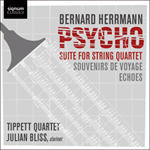
Herrmann: Psycho Suite & other works'Bernard Herrmann brought a distinctive, almost malicious relish to his work on Alfred Hitchcock’s thrillers, as exemplified in the 10-minute 'Psycho Suite', which features all the familiar dramatic flourishes and shrill chills. But when the two men fell out over his score for Tom Curtain, Hermann returned to concert work, composing the clarinet quartet 'Souvenirs De Voyage' and the string quartet 'Echoes', both of which display the melancholy tone that reflected the composer’s own prevailing mood. The brooding 'Echoes' is especially interesting: it features many of the same jolting musical strategies that marked his movie scores, conjuring the kind of dark images of which his greatest patron would have undoubtedly approved' (The Independent)
1 February 2011
Classics Today, Jed Distler
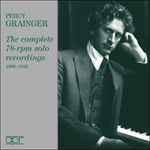
Percy Grainger - The complete 78-rpm solo recordings‘The best of Grainger’s shellac efforts retain their vividness and communicative immediacy. Even if Grainger had never met and befriended Grieg, his interpretations of the composer still would bear an 'authentic' imprimatur for their rhythmic verve, nervous energy, and bold projection of melodies’ (Classics Today)
» More1 February 2011
The Daily Telegraph, Tully Porter
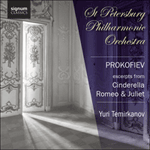
Prokofiev: Suites from Cinderella & Romeo and Juliet'No doubt about it, Sergei Prokofiev was Tchaikovsky’s heir as chief purveyor of high-class ballet music. This disc has 16 excerpts from his two most popular, Cinderella and Romeo And Juliet, well played by the St Petersburg Philharmonic. Alas, half an hour from each isn’t enough :… still, an anthology to enjoy' (The Daily Telegraph)
14 January 2011
The Telegraph, Geoffrey Norris
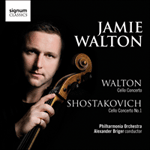
Walton & Shostakovich: Cello Concertos'With the Philharmonia alert both to the brio and to the underlying pensive traits of the concerto, Jamie Walton has an ideal partner, echoed in a performance of the Shostakovich that is lithe, pungent and, just as it should be, profoundly disquieting' (The Telegraph)
» More