1 April 2014
Classica, France, Antoine Mignon
Beethoven: Cello Sonatas«Robert Levin et Steven Isserlis parviennent en effet dans les Sonates op. 5 à un équilibre sonore naturel leur permettant d’associer la verve classique et la liberté pré-romantique présentes dans ces deux partitions de jeunesse. On perçoit également parfaitement comme le style beethovénien s’affirme dans la Sonate op. 69, comme l’écriture se dessine et se structure, en une véritable fête permanente et perpétuellement attrayante. Il ne faudrait toutefois pas penser que l’on assiste à une conférence esthétique : au contraire, cette justesse de propos doit sa réussite à l’enthousiasme des deux musiciens qui parviennent brillamment à dégager de chaque mesure une âme musicale convaincante, à l’image de la Sonate op. 102 no 1» (Classica, France)
» More
29 March 2014
The Daily Telegraph, Geoffrey Norris
Pierné: Piano Quintet; Vierne: String Quartet‘Louis Vierne (1870-1937) is by no means obscure, but his contemporary Gabriel Pierné (1863-1937) is one of those composers who continues to occupy specialist territory. His substantial Piano Quintet … presents a fascinating synthesis of ripe late 19th-century romantic sensibility and the new ideas of texture and harmony emerging in the early years of the 20th century … in the Vierne Quartet of 1894, the Goldners pitch their playing perceptively, pointing to the influences of Franck and Mendelssohn. There is discipline in this music, but also a warmth of spirit that finds an outlet in the third movement, and which the Goldners interpret with stylish sensitivity—a characteristic, indeed, of the whole disc’ (The Daily Telegraph)
» More27 March 2014
Singapore Straits Times, Chang Tou Liang
Zarębski: Piano Quintet Op 34; Żeleński: Piano Quartet Op 61‘British pianist and specialist in Polish music Jonathan Plowright is well supported by the Szymanowski Quartet from Poland, and the performances of both works are exemplary for their passion and emotional sweep’ (Singapore Straits Times)
» More16 March 2014
The Observer, Fiona Maddocks
Schubert: Winterreise‘Gerald Finley's interpretation is inward, poised, heartbreaking in holding back. The more quietude he brings to each song—as in the early sequence of Erstarrung (Numbness), Der Lindenbaum (The Linden Tree) and Wasserflut (Flood)—the more potent his reading. Julius Drake, accompanying, is equally lyrical, fluent, expressive. Neither lets the music shout. They respond minutely to the shifts from bright to dark, major to minor. The disc lends itself to repeated exploration, a bonus in itself with so familiar a work’ (The Observer)
» More
16 March 2014
The Observer, Stephen Pritchard
Tallis: Missa Puer natus est nobis & other sacred music‘Tallis's Christmas Mass … is sung here with customary perfection by The Cardinall's Musick, who polish other Tallis gems alongside it, most notably
Videte miraculum, a work of such sensuous beauty it quite eclipses the Mass’ (The Observer)
» More16 March 2014
The Independent on Sunday, Claudia Pritchard
Williamson: The Complete Piano Concertos‘Master of the Queen’s Music from 1975 until his death in 2003—a post that becomes free again this month—Australian-born composer Malcolm Williamson left a body of work scarcely performed today … his six freewheeling piano concertos are often reminiscent of Poulenc, sometimes of Bernstein … a box of surprises’ (The Independent on Sunday)
» More15 March 2014
The Daily Telegraph, Geoffrey Norris
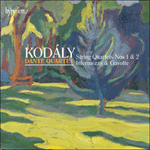
Kodály: String Quartets, Intermezzo & Gavotte‘The delicate, wistful Gavotte joins a similarly beguiling Intermezzo for string trio between Zoltán Kodály’s two string quartets, tougher nuts than either of the two miniatures and stylistically fascinating. Kodály’s studies in Paris in the early 20th century clearly rubbed off in certain similarities that the First Quartet betrays to the milieu of Debussy and Ravel, but it is Gallicism with a Hungarian accent. The Dante Quartet responds both subtly and animatedly to this piquant, passionate music, as it does in the Second Quartet, alert to its mix of astringency and lyricism’ (The Daily Telegraph)
» More