
1 January 1900

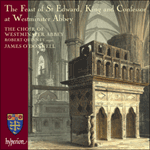
The Feast of St Edward at Westminster Abbey
CDA67586 

‘As with the previous releases in this series, the choir (and organist Robert Quinney, who here ends the disc in spectacular fashion with Jeanne Demessieux's Te Deum), under the fluent direction of James O'Donnell, is above reproach’ (International Record Review)

1 January 1900

The Feast of St Edward at Westminster Abbey
CDA67586 

‘Early notice is served of how well the Abbey's choristers are currently singing … an admirably varied programme, with excellent Hyperion recording’ (BBC Music Magazine)
1 January 1900

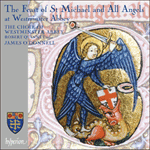
The Feast of St Michael and All Angels at Westminster Abbey
CDA67643 

‘The disc is a splendid and colourful addition to the Abbey Choir's recordings of special services. They themselves are in fine form, sovereign (as befits the status of their church) in musical confidence, as well placed as the bright-toned voices of the boys who rise with an aplomb many opera house choruses might envy to the high Cs of the Langlais Mass, and show their mastery in still more wonderful ways by finding the notes scattered with hide-and-seek devilry in Tippet's Magnificat and Nunc Dimittis. And in that connection the soloist Nicholas Trapp deserves particular mention. Their style, under James O'Donnell's sure direction, is forthright and spirited, well attuned to the Jacobean mysticism of Dering's Factus est silentium as to Howell's ecstatic Sequence for St Michael … Kenneth Leighton's Responses are subtly varied and inventive’ (Gramophone)
1 January 1900
The Daily Telegraph
The Feast of St Michael and All Angels at Westminster Abbey
CDA67643 

‘The choir, atmospherically recorded in the Abbey itself, sings this demanding repertoire with its customary zeal and a well-blended sound, and the performances are directed with the panache and style one has come to expect from James O'Donnell. Robert Quinney's contribution as organist culminates in a Laus Deo from Jonathan Harvey aptly described by O'Donnell in his booklet note as "the opulent psychedelia of [Messiaen's] Turangalîla compressed into four minutes"’ (The Daily Telegraph)
1 January 1900

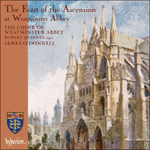
The Feast of the Ascension at Westminster Abbey
CDA67680 

‘This close-your-eyes and you're there service is almost matter-of-fact in its excellence … it's good to see that English cathedral music is still intact: its future is represented by Francis Pott's Toccata, commandingly played by Robert Quinney, which rounds off a truly feel-good recording for cathedral music fans’ (Choir & Organ)
1 January 1900
American Record Guide
The Feast of the Ascension at Westminster Abbey
CDA67680 

‘No one does this grand scale of Anglican service music better than Westminster Abbey, and again the performances of this very demanding music are of the highest order … truly a triumphant recording’ (American Record Guide)
1 January 1900
bbc.co.uk
The Feast of the Ascension at Westminster Abbey
CDA67680 

‘Another offering to lift the soul heavenwards from James O'Donnell and his choir, as they continue their exploration of liturgical repertoire across the centuries … the first thing that hits you about the singing is the celebratory tone. The boys might be singing Stanford's Caelos ascendit hodie, but they could just as easily be trilling 'Woohoo! It's Ascension Day!'. I love such musical joie de vivre, and not every choir is able to produce it convincingly as these chaps. It doesn't come at the expense of quality, though; this is Westminster Abbey Choir at their crystalline best, with spot-on pitching, enviable articulation and sympathetic phrasing … it is a stirring, beautifully judged programme of music, performed to the highest standard’ (bbc.co.uk)
1 January 1900

The Feast of the Ascension at Westminster Abbey
CDA67680 

‘The planning is astute … just as cunning is the way some old cathedral favourites nestle alongside more contemporary settings. O clap your hands and God is gone up may be Anglican staples, but they are given fresh and energetic renditions here, while the brief Stanford motet at the start is a most exhilarating introduction. Best of all, perhaps, is Ascension motet Viri Galilaei by Patrick Gowers … this splendid and dramatic setting with its concluding triumphant hymn is further vibrant proof of his sympathetic writing for voices’ (International Record Review)
1 January 1900

The Feast of the Ascension at Westminster Abbey
CDA67680 

‘Everything is a joy here, including the modern works, the anthem Viri Galilaei by Patrick Gowers and Francis Pott's brilliant Toccata for organ, played with assured virtuosity by Robert Quinney. The choir of Westminster Abbey under James O'Donnell sing with the happy care which his choristers at the Cathedral used to bring to their work with him’ (Gramophone)
1 January 1900
The Times
The Feast of the Ascension at Westminster Abbey
CDA67680 

‘After seven years at the helm, James O'Donnell has made a formidable singing outfit of the Westminster Abbey Choir … the treble line is robust and thrilling, its soloist, Jacob Ewens, a sinuous star in Britten's Te Deum in E’ (The Times)
1 January 1900
The Daily Telegraph
The Feast of the Ascension at Westminster Abbey
CDA67680 

‘This addition to Westminster Abbey's invaluable series of music for feast-days gets off to a cracking start with Stanford's magnificent eight-part motet Caelos ascendit hodie. This sets a jubilant tone for the whole programme, which contains some outstanding 20th-century contributions to the Anglican repertoire, including Britten's Festival Te Deum with its exciting organ effects, Finzi's triumphant God is gone up and Patrick Gowers's Viri Galilaei, whose meditative opening leads to a paean of exultation. All these, and Schutz's Der 100. Psalm, are sung with exhilarating panache’ (The Daily Telegraph)
1 January 1900
Audiophile Audition, USA, Stephen Coombs
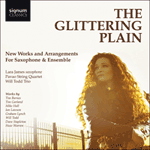
The glittering plain
Studio Master: SIGCD286  Download only  Studio Master FLAC & ALAC downloads available

'The Sparkling Heavens makes an immediate impact. Scored for soprano sax, strings, piano and percussion, there are some minimalist elements to the piano part that serve as an anchor for a long, beautiful sax line and some lovely chordal fabric underneath. This is a really nice work!  … Lara James is a really fine young player and all performers and composers represented here are also truly gifted. I recommend this heartily to anyone but especially to jazz sax players—or classical folks interested in something a bit different and very attention getting!’ (Audiophile Audition, USA)» More
More