1 January 1900

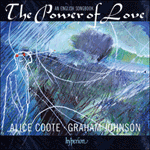
The Power of Love
CDA67888 

‘The sheer quality of the songs will come as a surprise to many listeners … from start to finish, the artistry of Alice Coote and Graham Johnson is of the highest order’ (Gramophone)
1 January 1900

The Power of Love
CDA67888 

‘One of the finest British mezzo-sopranos since Janet Baker, an intellectual artist with an international career in recital, concert and opera. Here she selects classic English songs, but also , less expectedly, what's still thought of as Victorian parlour repertoire. Since her accompanist is the immensely knowledgeable and perceptive Graham Johnson, though, this proves most admirably suited to her distinctively creamy yet expressive voice, and occasionally revelatory’ (BBC Music Magazine)
1 January 1900
San Francisco Chronicle
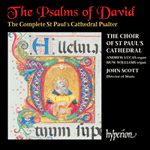
The Psalms of David
CDS44101/12  12CDs Boxed set (at a special price) — Download only 

‘A landmark in choral recordings and a uniquely serene, sweet listening experience’ (San Francisco Chronicle)
1 January 1900
Cathedral Music
The Psalms of David
CDS44101/12  12CDs Boxed set (at a special price) — Download only 

‘Hyperion is to be congratulated for releasing these discs … a gem; beautiful language, wonderful music, superb accompaniments, magnificent singing. Buy this and relish in its freshness’ (Cathedral Music)
1 January 1900
Music Week
The Psalms of David
CDS44101/12  12CDs Boxed set (at a special price) — Download only 

‘Scott and his choir explore the essential musical core of Anglican worship, soaring high above the ordinary and fully exploiting the reverberant acoustics of Wren’s cathedral’ (Music Week)
1 January 1900

The Psalms of David
CDS44101/12  12CDs Boxed set (at a special price) — Download only 

‘Will surely remain unique for many decades’ (Gramophone)
1 January 1900
The Times
The Psalms of David
CDS44101/12  12CDs Boxed set (at a special price) — Download only 

‘All Old Testament life is here … how useful to be able to hold such a big chunk of English culture in a box five inches square’ (The Times)
1 January 1900
Der Tagesspiegel, Germany
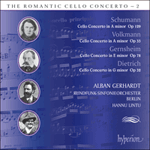
The Romantic Cello Concerto, Vol. 2 - Volkmann, Dietrich, Gernsheim & Schumann
CDA67583 

‘Alban Gerhardt flourishes with cello personality, radiant colour and untiring eloquence in all of the concerti collected on this CD. The greatest discovery is probably the E minor Concerto by Friedrich Gernsheim … Alban Gerhardt plays this short work with voluptuous delicacy and lyric rapture. The music becomes light and sanguine: qualities that can be praised on this CD as a whole … with neck-breaking thrills, Alban Gerhardt reaps musical acrobatic effects from this. Definitely worth hearing on the CD. On this voyage of discovery Alban Gerhardt again proves to be a skilled storyteller and a superb musical cicerone … a showpiece for collectors, and proof of the intelligence and far-sightedness of a cellist who combines virtuosity and content with a touch of genius … on the CD, The Romantic Cello Concerto, Gerhard couples it with the Gernsheim concerto and the also forgotten cello concerti of Brahms’ contemporaries Albert Dietrich and Robert Volkmann. In case someone misunderstands: of course Schumann is the better composer, but the very thin canon of first-rate cello concerti could do with some expansion. To this extent, Gerhardt’s spirit of discovery is also a strategy of frustration avoidance. Having to play the same five or six pieces constantly leads to burnout for most soloists’ (Der Tagesspiegel, Germany)
1 January 1900
Partituren, Germany
The Romantic Cello Concerto, Vol. 2 - Volkmann, Dietrich, Gernsheim & Schumann
CDA67583 

‘The superbly worked cello concerti by Dietrich and Gernsheim, both first-time recordings. These discoveries make Gerhardt’s CD a must-buy for connoisseurs of late Romanticism’ (Partituren, Germany)
1 January 1900
Fono Forum, Germany
The Romantic Cello Concerto, Vol. 2 - Volkmann, Dietrich, Gernsheim & Schumann
CDA67583 

„After the splendid start made by the Hyperion Series with Romantic cello concerti, the second album turns out to be a treasure-box as well. This refers less to Schumann‘s familiar late work than to the compositions that have long been absent from the repertoire, by Robert Volkmann, Albert Dietrich and Friedrich Gernsheim—scores with wonderful, melancholic themes, deeply felt harmony, passages of ravishing sound, and especially the more melodically than brilliantly conceived solo part. The happily chosen compilation responds well to Alban Gerhardt’s rich tone, too“ (Fono Forum, Germany)
1 January 1900
Classics Today
The Romantic Cello Concerto, Vol. 2 - Volkmann, Dietrich, Gernsheim & Schumann
CDA67583 

‘The continuous offerings of Hyperion to music culture are admirable’ (Classics Today)
1 January 1900
Süddeutsche Zeitung, Germany
The Romantic Cello Concerto, Vol. 2 - Volkmann, Dietrich, Gernsheim & Schumann
CDA67583 

„Alban Gerhardt, one of the most inquisitive, versatile and, above all, best cello virtuosos of our times has now recorded a second CD with romantic works for his instrument. On the first he presented works by Ernst von Dohnányi, Eugène d’Albert and George Enescu. Now, to the Schumann work, he has added three others that were composed in the circle around Schumann and Brahms … Volkmann’s virtuoso a-minor concerto, in its key and single-movement form, reminds one, rather distantly, of Schumann’s both familiar and alienating miracle in sound  … the concerto in C minor by Gernsheim was published in 1907. With its network of symphonic style it might remind one of Brahms or, no less, of Elgar. The fact that thoughts of this kind come up at all, that one is so fascinated by the difference as well as the similarity of the sound languages, is due to Alban Gerhardt’s brilliant cello approach. He realises the works of Brahms’s three friends with vital virtuosity and an intensity of playing that raises them to pieces of a high rank. The accompaniment of the Berlin Radio Symphony Orchestra under Hannu Lintu is very emphatic. But when the opening bars of the Schumann concerto spread their magic and Alban Gerhardt articulates the insatiable longing of the theme, then Volkmann, Dietrich and Gernsheim cannot but move to the back row“ (Süddeutsche Zeitung, Germany)
More