1 January 1900
The Guardian
Schubert: Death and the Maiden
CDA67585 

‘It is a considerable coup for Hyperion to sign up the Takács Quartet. They are currently the greatest string quartet in the world … the first product of the group's new partnership is outstanding … the recording quality is ideal—natural, never aggressive. This disc is a model for what chamber music should be’ (The Guardian)
1 January 1900
Classics Today France
Schubert: Death and the Maiden
CDA67585 

«Certes nous n'avions «besoin» d'une nouvelle interprétation des Quatuors «La Jeune fille et la mort» et «Rosamunde», mais ce CD est imparable … les Takács ont plus que bein réussi leur entrée au catalogue Hyperion. Si leur version de «La Jeune fille et la mort» fait jeu égal avec les meilleurs, celle de «Rosamunde» se dégage vraiment comme un très grand moment de la discographie schubertienne» (Classics Today France)
1 January 1900
Ensemble, Germany
Schubert: Death and the Maiden
CDA67585 

„Ein wunderbare Einspielung mit einem Quartett, das vielleicht bislang zu wenig Beachtung fand—Is there really a view of Schubert's String Quartet No 14 that hasn't yet been considered? Is it possible to add to the already countless number of interpretations one that is fresh and new? On hearing this recent recording by the Takács Quartet, the answer has to be 'Yes!' For here less emphasis is placed on Schubert's melodic language, and on the purely songlike, and much more weight is given to the sense of dramatic development so important in this work: an intensive interplay with the formal material, with the expressive power of communication itself. And so the Takács Quartet builds up a musical portrayal as intoxicating as it is charged with emotion, one of a kind that has never been heard before. Beauty of tone is not the main aim here, but rather the harmonious euphony of the different voices, here achieved so superbly: above all in the quartet's second movement, the variations, before melancholy and despair take a rest during the Presto, then culminate completely in the Tarantella of the Finale. The recording of the Quartet No 13, the so-called Rosamunde also shows the same approach of constant urgency, possibly expressing Schubert's intentions far better than the usual meticulously reproduced melodic treasury. A marvellous recording, by a quartet to which perhaps too little attention has been paid so far“ (Ensemble, Germany)
1 January 1900
Strings, USA
Schubert: Death and the Maiden
CDA67585 

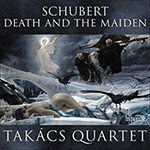
‘If their recent Hyperion debut is any indication, everything is pretty copacetic. The recordings capture the quartet's ability in concert to build a seemingly spontaneous rhetorical structure for its characteristic drive, fire and focus, while making each member of the audience feel that the quartet is playing for him or her alone … Hyperion has outdone itself for the release, choosing for the CD cover Hungarian artist Adolph Hiremy-Hirsch's darkly intense 1888 painting 'Ahasuerus at the End of the World', which powerfully reflects the composer's transformation of death into something beautiful’ (Strings, USA)
1 January 1900
Fanfare, USA
Schubert: Death and the Maiden
CDA67585 

‘Another great achievement of this recording is the sound. The engineers really surpassed themselves; it is natural, reverberant and crystal clear—always bright and detailed. The Takács Quartet's move from Decca to Hyperion certainly seems to be a successful marriage … a worthy contender among the elite of Schubert string quartet recordings’ (Fanfare, USA)
1 January 1900
The Dallas Morning News
Schubert: Death and the Maiden
CDA67585 

‘The impassioned beginning of Death and the Maiden sweeps all before it, and the jittery refrain from the finale sounds like a madman's jig, different each time it appears, too. The Rosamunde is simply heartbreaking. The playing from all four instruments is spectacular in its force and finesse. For once, that abused term 'definitive' is absolutely justified’ (The Dallas Morning News)
1 January 1900
CD Hotlist, USA
Schubert: Death and the Maiden
CDA67585 

‘These are warm and insightful performances of two of Schubert's most affecting chamber music works, both written during a period of intense depression. Though they remain some of the bleakest music of his career, these two string quartets still demonstrate Schubert's sublime melodic gift, and with this disc the Takács Quartet makes a valuable addition to the recorded catalog of these important pieces. Recommended’ (CD Hotlist, USA)
1 January 1900
ResMusica.com, France
Schubert: Death and the Maiden
CDA67585 

«Ces deux grands quatuors à cordes de 1824 sont ici réunis ensemble dans une interprétation absolument renversante du Quatuor Takács. D’un jeu pleinement engagé, ils s’adonnent à merveille aux gammes tourbillonnantes et aux rythmes endiablés de la Jeune fille et la mort, ne relâchant qu’occasionnellement la vive tension de la musique de Schubert. L’équilibre des quatre instruments est très bien ajusté, il y a vraiment un son d’ensemble sans qu’aucun des solistes ne soit exagérément privilégié. Il en résulte que l’on entend magnifiquement bien les voix intermédiaires, le second violon et l’alto se révélant notamment avec des guirlandes et des motifs resplendissants, trop souvent étouffés et négligés dans d’autres versions. Un disque événement à savourer sans plus attendre» (ResMusica.com, France)
1 January 1900
Bay Area Reporter, USA
Schubert: Death and the Maiden
CDA67585 

‘Now, with veteran San Francisco Symphony principal violist Geraldine Walther replacing their former violist, their new recording that pairs Schubert's Death and the Maiden and Rosamunde string quartets (Hyperion) retains if not magnifies the same impact. The essential interplay and cooperation between viola and cello that make the slow movement of Death and the Maiden sing with such devastating eloquence are reinforced by the heart-breaking sweetness and forceful cries of first violinist Edward Dusinberre. These are great musicians, with veteran second violinist Karoly Schranz and cellist Andras Fejer equally eloquent. The performance is riveting, as shattering as it is ultimately uplifting. If the Rosamunde quartet represents a gentler excursion into melancholy, it is no less filled with beauty. Here again, the extraordinary oneness between the members of the quartet enriches musicianship as thought through as it is alive to every moment. What keeps the playing fresh is the tension and the constant interplay of pitch, rhythm, and nuance that declare Schubert's emotions as real and relevant today as they were close to two centuries ago’ (Bay Area Reporter, USA)
1 January 1900
CDReview
Schubert: Death and the Maiden
CDA67585 

‘The ensemble, even with a new viola player, is impeccable—this is still a quartet that sounds as though it breathes and thinks as one – and some of leader Edward Dusinberre’s playing is intensely beautiful. The recording is superb: up close and personal, so all the detail’s there, yet there’s enough ambient detail to stop it from becoming too invasive. It’s the first recording the Takács has made for its new label Hyperion, and they must be thrilled with it’ (CDReview)
1 January 1900

Schubert: Death and the Maiden
CDA67585 

‘This is superb quartet-playing, the quality of which becomes even more formidable over several listens … the latest stage of the Takács Quartet's career has got off to a very impressive start’ (Classical Source)
1 January 1900
Classic FM Magazine
Schubert: Death and the Maiden
CDA67585 

‘Edgy, inspired playing, with enough broody lyricism to set the atmosphere of the A minor's opening in a few notes, and to balance its outwardly more cheerful finale with a disingenous wistfulness that tells us we're hearing the tip of Schubert's emotional iceberg. Death and the Maiden is given a high-octane treatment that exposes Schubert's raw nerve-endings with strong tempi and a near-violent intensity of tone’ (Classic FM Magazine)
More
