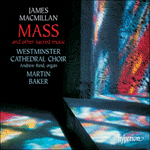
‘Anyone familiar with the ambience of Westminster Cathedral from the sound of the choir and organ to the pungent scents of wax polish and incense will feel at home immediately and it is difficult to imagine this music sounding as good in any other place. Highly recommended, these performances of this powerful music will repay concentrated listening and repetition’ (Organists' Review)
‘A busy railway carriage is probably not the ideal environment in which to listen to James MacMillan’s music. But the fact that it transported me to another place is proof of the power of his music’ (Classic FM Magazine)
‘This music, the Mass in particular, is virtually guaranteed a passage into the central repertoire of choirs around the world; it could hardly have had a better springboard than this recording’ (International Record Review)
‘If you've heard them and followed the laudatory press they've gotten worldwide, you already know that this [Polyphony] is one of the world's truly great chamber choirs. Layton always gets breathtaking beauty of tone from them, as well as exquisite interpretive and dynamic nuances. They bring Macmillan's compelling sound-world to life more vibrantly than any other choir I've heard his music from. Organist Vivian and the Britten Sinfonia supply excellent support, and Hyperion seals the bargain with rich, clean SA sound that's a joy to hear’ (American Record Guide)
‘This stunning work, brilliantly performed by Stephen Layton's chamber choir Polyphony and the Britten Sinfonia, is something no serious lover of choral music should be without’ (Birmingham Post)
‘The qualities which have made Polyphony one of the finest choirs around at the moment are very much in evidence in these assured and perceptive performances. James Vivian's organ accompaniments are perfectly balanced and the overall recorded sound is exquisite. All told, this disc offers a mesmerising listening experience’ (International Record Review)
‘This splendid new performance from Polyphony also conveys dignity, and a sense (hard to explain) that the suffering is, in some mysterious way, redemptive. Easier to quantify, the singing is also remarkably secure technically, the ensemble near perfect. Beautiful, powerful playing too from the Britten Sinfonia’ (BBC Music Magazine)
‘An intense, deeply felt interpretation, full of beautiful and affecting singing, with all the elements—string orchestra, featured violin, choir and soloists—nicely balanced … as ever, MacMillan incorporates all his allusions, including those to Scottish traditional music, into an utterly individual style. The performance confirms Polyphony's place in the front rank of choirs’ (Gramophone)
‘In an ideal world, Hyperion's August disc of the month would sell by the truckload. The sheer quality of James MacMillan's Seven Last Words, the intensity of Stephen Layton's interpretation and the unrestrained, heartfelt performances of Polyphony and the Britten Sinfonia should guarantee critical acclaim’ (Music Week)
‘James MacMillan's work is informed by his Catholic faith, but rarely has he communicated his spiritual message as effectively as in this large-scale piece. Perhaps Haydn's example has forced him to raise his game, or maybe it was the heartrending text: either way, this is a modern choral masterpiece, and Stephen Layton and his forces its ideal interpreters’ (The Independent)