
Welcome to Hyperion Records, a British classical label devoted to presenting high-quality recordings of music of all styles and from all periods from the twelfth century to the twenty-first.
Hyperion offers both CDs, and downloads in a number of formats. The site is also available in several languages.
Please use the dropdown buttons to set your preferred options, or use the checkbox to accept the defaults.


The great nineteenth-century music historian August Wilhelm Ambros memorably described this Mass as ‘unique in its terrible magnificence, gloomy and bleak, as if one were walking among dark tombs under heavy vaults supported by massive pillars—this is the Missa pro defunctis. Here everything is as simple, as austere as possible: in the sight of death, the colours of life grow pale, its vibrant adornment fades. This Spaniard grasps death in all its terrible seriousness.’ And while musicologists (unfortunately) no longer write this way, it is not hard even at this distance to feel what he meant. Right from the start, the Introit and Kyrie, which in the service are performed together, show a disarming simplicity and directness, with the chant for the Mass for the Dead paraphrased very lightly in the top voice, mostly in plain breves, and the lower voices supporting it with equal dignity: there are only a few bars in these movements without at least one breve in the lower voices. It is a texture that can pall in lesser hands, but Morales, through unexpected chords and bits of activity here and there in the lower voices, never lets the dark intensity slip—a musical feat that is anything but simple to pull off.
Morales is intense, but he is not relentless. After the first two movements, the chant continues to be always there, but not always predominantly in breves and not always in the top voice: it migrates to the third voice in the Gradual and to the second in the Offertory; in the Communion it goes mostly in semibreves; and in the Offertory it tends to move at nearly the same speed as the other voices and to blend inconspicuously into the generally active sound. (The sequence Dies irae, normally one of the most conspicuous movements of the Requiem, is omitted here as it was not included in the funeral liturgy in either Rome or Spain during Morales’s time.) And for the Sanctus and Agnus Dei he returns to the slow-moving, breve-dominated stillness of the opening, lending the whole Mass a most satisfactory emotional unity.
from notes by Kenneth Kreitner © 2025
Le grand historien de la musique du XIXe siècle August Wilhelm Ambros décrit remarquablement cette messe comme «unique dans sa terrible magnificence, lugubre et sinistre, comme si l’on marchait parmi de sombres tombeaux sous de lourds caveaux soutenus par des colonnes massives—telle est la Missa pro defunctis. Ici tout est aussi simple, aussi austère que possible: à la vue de la mort, les couleurs de la vie blêmissent, sa décoration éclatante s’estompe. Cet Espagnol saisit la mort dans tout son terrible sérieux.» Et si les musicologues n’écrivent (malheureusement) plus ainsi, il n’est pas difficile, même à deux siècles de distance, de comprendre ce qu’il voulait dire. Dès le début, l’Introït et le Kyrie, qui sont exécutés ensemble pendant l’office, font preuve d’une désarmante simplicité et authenticité, avec la mélopée de la Messe des morts paraphrasée très légèrement à la voix aiguë, en majeure partie en brèves simples, et les voix graves qui la soutiennent avec une égale dignité: seules quelques mesures dans ces mouvements sont dépourvues d’au moins une brève aux voix inférieures. C’est une texture qui peut perdre de son charme entre des mains moins habiles, mais Morales, par le biais d’accords inattendus et de petites activités ici et là aux voix inférieures, ne laisse jamais baisser la sombre intensité—une prouesse musicale qui n’a rien de facile à réaliser.
Morales est intense, mais il n’est pas acharné. Après les deux premiers mouvements, la mélopée continue à rester présente, mais pas toujours principalement en brèves et pas toujours à la voix aiguë: elle migre à la troisième voix dans le Graduel et à la deuxième dans l’Offertoire; à la Communion, elle est essentiellement en semibrèves; et à l’Offertoire, elle a tendance à évoluer presque à la même vitesse que les autres voix et à se fondre discrètement dans la sonorité généralement active. (La séquence du Dies irae, normalement l’un des mouvements les plus brillants du Requiem, est omise ici car elle ne figurait dans la liturgie des funérailles ni à Rome ni en Espagne à l’époque de Morales.) Et pour le Sanctus et l’Agnus Dei, il revient au calme lent du début, dominé par des brèves, ce qui donne à l’ensemble de la messe une très belle unité émotionnelle.
extrait des notes rédigées par Kenneth Kreitner © 2025
Français: Marie-Stella Pâris
Der große Musikhistoriker des 19. Jahrhunderts August Wilhelm Ambros beschrieb diese Messe in denkwürdiger Weise: „Ganz eigen grossartig-schauerlich, nächtlich, düster, als wandle man in dunkeln Grüften unter schweren auf schwere Pfeiler gestützten Gewölben, ist die Missa pro defunctis. Hier ist Alles so einfach, so schmucklos wie möglich, vor dem Anblick des Todes erbleichen die Farben des Lebens, schwindet seine bunte Zier. Dieser Spanier fasst den Tod in seinem ganzen furchtbaren Ernst.“ Und obwohl Musikwissenschaftler (leider) nicht mehr so schreiben, fällt es auch aus dieser Entfernung nicht schwer, nachzuvollziehen, was er meinte. Gleich zu Beginn zeichnen sich der Introitus und das Kyrie, die im Gottesdienst gemeinsam vorgetragen werden, durch eine entwaffnende Einfachheit und Direktheit aus, wobei der Gregorianische Choral der Totenmesse in der Oberstimme leicht paraphrasiert—zumeist in schlichten Breven—und von den Unterstimmen entsprechend würdevoll unterstützt wird: es gibt nur wenige Takte in diesen Sätzen ohne mindestens eine Brevis in den Unterstimmen. Es handelt sich dabei um eine Struktur, die in geringeren Händen scheitern kann, doch Morales sorgt durch diverse unerwartete Akkorde und originelle Wendungen in den Unterstimmen dafür, dass die dunkle Intensität nie entgleitet—eine musikalische Leistung, deren Durchführung alles andere als einfach ist.
Morales ist intensiv, aber er ist nicht unerbittlich. Nach den ersten beiden Sätzen ist der Choral weiterhin stets präsent, aber nicht immer überwiegend in Breven und nicht immer in der Oberstimme. Im Graduale wandert er in die dritte Stimme und im Offertorium in die zweite; in der Communio erklingt er meist in Semibreven; und im Offertorium neigt er dazu, sich fast im gleichen Tempo wie die anderen Stimmen zu bewegen und sich unauffällig in das allgemein aktive Klangbild zu mischen. (Die Sequenz Dies irae, normalerweise einer der hervorstechendsten Sätze des Requiems, wird hier weggelassen, da sie zu Morales’ Zeiten weder in Rom noch in Spanien in der Totenliturgie enthalten war.) Im Sanctus und Agnus Dei kehrt Morales zu der langsamen, von Breven dominierten Stille des Anfangs zurück, was der ganzen Messe eine sehr befriedigende emotionale Einheit verleiht.
aus dem Begleittext von Kenneth Kreitner © 2025
Deutsch: Viola Scheffel
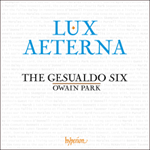 Lux aeterna Lux aeternaStudio Master: CDA68388Studio Master FLAC & ALAC downloads available  ‘A sequence for the souls of the departed, to be heard by those who remember them’ is Owain Park’s summing up of this latest Gesualdo Six album.» More |