
Welcome to Hyperion Records, a British classical label devoted to presenting high-quality recordings of music of all styles and from all periods from the twelfth century to the twenty-first.
Hyperion offers both CDs, and downloads in a number of formats. The site is also available in several languages.
Please use the dropdown buttons to set your preferred options, or use the checkbox to accept the defaults.

from notes by Peter Phillips © 2007
extrait des notes rédigées par Peter Phillips © 2007
Français: Gimell
aus dem Begleittext von Peter Phillips © 2007
Deutsch: Renate Wendel
 Allegri: Miserere; Palestrina: Missa Papae Marcelli Allegri: Miserere; Palestrina: Missa Papae MarcelliStudio Master: CDGIM041Download onlyStudio Master FLAC & ALAC downloads available  Music written for the Sistine Chapel, including two new recordings of Allegri's Miserere—one with the familiar top Cs, and one with additional embellishments developed by Deborah Roberts during hundreds of concert performances by The Tallis Schola ...» More |
 Sacred Music in the Renaissance, Vol. 3 Sacred Music in the Renaissance, Vol. 3Studio Master: GIMBX3034CDs Boxed set (at a special price) — Download onlyStudio Master FLAC & ALAC downloads available The third of three volumes featuring The Tallis Scholars' finest recordings, one for each decade, and each offering over five hours of the award-winning performances that helped establish Renaissance Polyphony as one of the great repertoires of we ...» More |
 The Tallis Scholars Live in Rome The Tallis Scholars Live in RomeCDGIM994Download only Peter Phillips directs The Tallis Scholars in the historic concert celebrating Palestrina's 400th anniversary, recorded in the Roman Basilica of Santa Maria Maggiore where the composer sang as a choirboy and later became maestro di cappella.» More |
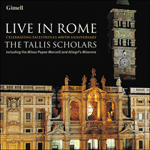 The Tallis Scholars Live in Rome The Tallis Scholars Live in RomeGIMDP903SOLD OUT!This album is not available for download PAL FORMAT DVD. Peter Phillips directs The Tallis Scholars in the historic concert celebrating Palestrina's 400th anniversary, filmed in the Roman Basilica of Santa Maria Maggiore where the composer sang as a choirboy and later became maestro di c ...» More |