
Welcome to Hyperion Records, a British classical label devoted to presenting high-quality recordings of music of all styles and from all periods from the twelfth century to the twenty-first.
Hyperion offers both CDs, and downloads in a number of formats. The site is also available in several languages.
Please use the dropdown buttons to set your preferred options, or use the checkbox to accept the defaults.
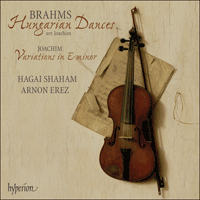

The forty-year friendship between Brahms and Joseph Joachim, violinist and composer, was one of the most significant and fruitful relationships in nineteenth-century music. Their admiration of each other’s artistry was profound and unwavering, and bore sustained creative fruit on Brahms’s side of which his Violin Concerto and Double Concerto are only the most famous examples.
Joachim’s transcriptions of Brahms’s famous Hungarian Dances—originally written for piano duet or solo piano—are technically challenging for any violinist, and superbly idiomatic, constituting a kind of gypsy ‘Art of the Violin’. They represent the summit of Brahms’s ‘Hungarian’ art, and Joachim’s powers of transcription match them with violin writing of the greatest fastidiousness and authentic feeling. The brilliant Hagai Shaham, acclaimed for his recordings of Hubay, is the ideal performer.

Joachim, for his part, already had a European reputation when Brahms appeared at his lodgings in Hanover in the spring of 1853, not yet twenty, a mere talented youth from Hamburg; but he was among the first to recognize and hail the young man’s astonishing gifts. Before long he came to see Brahms’s compositional mastery as not being worth competing with: having been the more prominent composer in the 1850s Joachim wrote less and less, concentrating on his other talents as one of the greatest violinists of his age, and as a conductor, teacher and administrator. (He founded and ran the Hochschule für Musik at the Royal Academy of Art in Berlin.) Brahms had been the foremost admirer of Joachim’s own works, and always regretted that his mentor had virtually ceased to compose, but Joachim remained the musician to whom Brahms most readily turned for criticism and advice.
Born at Kittsee near the polyglot city of Poszónyi (Pressburg)—now in Slovakia (where it is called Bratislava) but then part of the Kingdom of Hungary—where Austrian, Czech, Slovak and Hungarian cultures intermingled, Joachim was steeped from his childhood in the ‘Hungarian’ gypsy idioms which symbolized the romantic and exotic to the young Brahms. Joachim had early been drawn to the Hungarian nationalist school of Franz Liszt, and though when he first met Brahms he was on the rebound from the cloying atmosphere of Liszt’s circle in Weimar, he remained proud of his Hungarian origins and determined to integrate the ‘Hungarian style’ in a more organic and symphonic form. His primary achievement in this direction, and probably his most important original work, was his Violin Concerto No 2 in D minor ‘in the Hungarian manner’, which he was composing at exactly the same time as the young Brahms was struggling with the composition of his own, vastly ambitious, Piano Concerto No 1. (Brahms once said his ideal concert programme would consist of the two concertos, his and Joachim’s, played back to back.) Thus it was practically pre-ordained that Joachim would eventually arrange Brahms’s famous Hungarian Dances, originally published for piano duet or solo piano, for violin.
Brahms probably first heard Hungarian gypsy tunes, and started to collect them, from his violinist friend Eduard Reményi, in whose repertoire they featured prominently. When Reményi planned a tour of Germany in 1853, Brahms went with him as accompanist—his first trip away from Hamburg—and it was Reményi’s decision to make their way to Hanover, where Joachim was musical director of the court orchestra. Soon Brahms was making his own arrangements of Hungarian material: a version of the Rakoczky March dates from 1853, as (probably) does his Variations on a Hungarian Song for piano. In her memoirs, Schumann’s daughter Eugenie remembered Brahms playing melancholy Hungarian melodies to the Schumann children, for which in later life she looked in vain among his published works. Of course many other composers in and out of Hungary had been making use of the ‘Zigeuner’ style, from Haydn and Dittersdorf to Liszt, Volkmann and Joachim; but Brahms took to the idiom so thoroughly he was soon able to inhabit it with particular boldness, affection and intensity, producing such astonishing music as the ‘Rondo alla Zingarese’ of his G minor Piano Quartet and the achingly plangent slow movement of the Clarinet Quintet.
We know that early in 1867, while he was still writing his German Requiem, Brahms offered six dances for solo piano to the Budapest publisher Dunkl, only to have them turned down. His first set of Hungarian Dances, now grown to ten and arranged for piano duet (the most popular medium for home music-making), seems first to have been heard in Oldenburg in 1868, performed by Brahms and Clara Schumann, and did not appear in print until the following year, from Simrock, who had now become his principal publisher. Like the Liebeslieder Waltzes for vocal quartet and piano duet, composed around the same time, the first set of Hungarian Dances, which was printed in two books of five dances each, was an enormous popular and commercial success which made Simrock a small fortune. (Brahms had sold them to him for a simple down payment with no royalties.)
Brahms did not consider the Hungarian Dances as original compositions but as arrangements—which is why he gave them no opus number—and though a few of the melodies may in fact be his own, the bulk of them derive from popular gypsy tunes of the csárdás type, many of which could be found in Hungarian editions attributed to individual composers. Brahms did not acknowledge his sources, however, and was therefore accused of plagiarism, though it is likely he noted down most of the tunes by ear, some from café entertainers, while others must go back to the repertoire he heard from Reményi. (Two of the tunes are apparently Reményi’s own, and he was one of the first to call Brahms a plagiarist.) But the forms and intensifications which Brahms has imposed on his favoured material are unquestionably his; the Dances are real compositions, even if he did not compose their basic material. They are generally quite large-scale, multi-section forms, whose capricious and often fiery alternations of material, mood and tempo re-create the traditionally passionate performance style of gypsy violinists. Brahms takes full advantage of the rhythmic freedom, the opportunities for cross-rhythm and rubato, the popular melodic style and exotically inflected cadences that the idiom offered. It is abundantly clear he enjoyed writing against his own habits of logical and conscientious development.
Simrock wanted to encourage the widest possible circulation of the Hungarian Dances, and commissioned a large number of arrangements. They soon appeared in a variety of different instrumental combinations including solo flute and piano, two violins and piano, three players at one piano and military band. In 1872 Brahms issued all ten dances in a version for solo piano, presumably worked up from the original form he had offered to Dunkl, and the following year arranged Nos 1, 3, and 10 for orchestra. Meanwhile Joachim’s version of the dances—which Brahms welcomed enthusiastically—had already appeared in 1871, and through his performances of them Joachim did much to spread their fame across Europe.
Brahms eventually produced a second set of eleven Hungarian Dances, which was published—again in two books, this time of six and five dances—in 1880. Joachim immediately set to work to produce another complete set of transcriptions, published in the same year. His friendship with Brahms seemed to have attained a new pitch of mutual trust around this time, consolidated by the the composition of Brahms’s Violin Concerto and G major Violin Sonata; Joachim had been intimately involved with the creation and the premieres of both. However, this second group of Hungarian Dance transcriptions was to be Joachim’s last artistic collaboration with Brahms before the debacle over his divorce attempt soured relations between them for most of the 1880s.
Joachim’s transcriptions of the Hungarian Dances are technically challenging for any violinist, constituting a kind of gypsy ‘Art of the Violin’. As a native Hungarian, Joachim was the ideal arranger and, as his own Violin Concerto No 2 had shown, he had an unrivalled understanding of the gypsy idiom. The violin was, in any case, regarded as the gypsy instrument par excellence, and it could reasonably be said that it captures the spirit of the dances more effectively than the piano duet medium; so in one sense Joachim was ‘restoring’ the dances to their original instrument, if not their original form. His violin parts, though extremely difficult, full of double stops and frequently demanding octaves for emphasis, are superbly idiomatic. He freely ornamented the melodic lines and transposed four of the dances into new and more brilliant keys in order to utilize the instrument’s natural sonority most effectively. He sometimes inserts additional passagework (for instance the short cadenza, employing left-hand tremolos, in No 7).
Of the various numbers of Volume 1, No 1 is based on a csárdás by Béla Sarkozi, with its sonorous, soulful rhythm. No 2 takes as its model Emma csárdás, a piece by Mor Windt: it alternates a kind of soulful flamboyance with impulsive dashes and has a rumbustious but very short middle section marked Vivo. No 3 is a whimsical wedding dance spun out of tunes by Reményi and József Rizner. No 4 uses a tune (by N Merty) also to be found in Liszt’s Hungarian Rhapsody No 8, while No 5 (originally in F sharp minor) takes a melody by Béla Keler and juxtaposes it with a Slavonic rather than Hungarian melody. Joachim transposed it to G minor, apparently to enhance the soulfulness of its elegiac colouring. No 6 (originally in D flat), after a tune ascribed to Adolf Nittinger, is one of the most remarkable of the Hungarian Dances, with the recurring hesitations and pauses in its first theme, its frequent changes of tempo and improvisatory succession of striking ideas. No 7, known to be on a melody by Reményi, is more playful with its strutting dotted rhythms and capricious cascades of thirds, perhaps suggesting an accordion as much as a violin. No 8 is adapted from Louisa-csárdás by Szadaby-Frank, a piece itself based on themes from Donizetti’s Lucia di Lammermoor. No 9 uses a csárdás by János Travnik, while No 10, with its capricious succession of contrasting ideas, is another wedding dance from the collection Tolnai Lakadalmas by Rizner.
The second volume of Hungarian Dances is generally considered a subtler, more introspective collection, less dependent on pre-existing sources. According to Joachim himself, Nos 11, 14 and 16 were entirely Brahms’s original compositions on themes ‘in Hungarian style’, but his sources for the others remain matters of debate. No 15, at least, uses a tune that occurs in Liszt’s Hungarian Rhapsody No 12, but in which some commentators have seen a further reference to Donizetti’s Lucia. Harmonically and texturally richer, and perhaps more varied and subtle in character, this second set of dances represents the summit of Brahms’s ‘Hungarian’ art, and Joachim’s powers of transcription match this with violin writing of the greatest fastidiousness and authentic ‘gypsy’ feeling.
Another set of ‘folk dances’ for violin and piano—the Spanish Dances of Pablo de Sarasate—seems to have provided the impulse for the composition, or at least the completion, of Joachim’s own Variations in E minor heard on this disc, for Sarasate had dedicated his Dances to Joachim, and Joachim responded by dedicating his Variations to Sarasate. As already mentioned, most of Joachim’s original works were composed in the 1850s and early 1860s, and only a few pieces followed in the remaining forty years of his life. His output includes, notably, several impressive orchestral overtures inspired by literary subjects, three violin concertos and a number of shorter works for violin and orchestra: all of the latter also exist in alternative versions for violin and piano, as does the Variations. Officially this is one of his few ‘late’ works, for he premiered it in Berlin on 15 February 1881—not long after his arrangement of the second volume of Brahms’s Hungarian Dances and just two months after his rift with Brahms over his attempts to divorce Amalie. It is possible, however, that some of it dates from a good deal earlier.
Incidentally this is not Joachim’s first set of variations for a solo string instrument: in the late 1850s he had composed his Variations on an Original Theme for viola and piano, Op 10. These two variation-sets make an interesting comparison, not least because they share the key of E and because the theme of the 1881 violin variations is hardly an independent invention but at best a close variant of the theme of the viola set. But while the viola set simply comprises its theme followed by ten variations, the violin set is considerably more sophisticated structurally, consisting of an introduction, theme, eighteen variations and finale. Despite this it is much more concise than the viola variations, which are decorative and rhapsodic and unashamedly flaunt their ‘Hungarian’ colouring. The individual variations in the violin set generally keep to the same dimensions as their theme and follow each other briskly, building up structural paragraphs across several variations rather than making each variation a separate episode in the form.
The dreamy, rhapsodizing introduction, in which the violin speaks with the unmistakable accents of the gypsy fiddler, is one of the few overtly ‘Hungarian’ passages in the work. The lyrical theme itself is announced by the piano, espressivo, and is then restated by the violin to form the first variation. The next four variations decorate the theme in progressively smaller note-values, giving the impression of a controlled acceleration that arrives at a ‘hunting’ variation with the violin in virtuosic counterpoint against horn-imitations in the piano. After a lively continuation in variation 7, variation 8 features the violin, unaccompanied, with impressive chords which are taken up by the piano in variation 9.
A new and pensive melody, sung by the violin over the theme’s original harmonies, forms variation 10 and leads to two expressive major-key variations (11 and 12) which, with 10, form a kind of central ‘slow movement’ in the sequence. The momentum picks up over the next four variations (13–16), culminating in another ‘hunting’ variation (17) shared between violin and piano. Variation 18 forms the introduction to the finale, a lively movement founded on a new violin theme that goes in combination with the original theme in the piano. This is a kind of rondo (and here Joachim again indulges in explicit colouring all’Ongarese) that races to a brilliant conclusion in E major.
Calum MacDonald © 2008
Joachim, lui, s’était déjà acquis une réputation européenne lorsque Brahms vint le trouver dans son meublé de Hanovre, au printemps de 1853; mais il fut parmi les premiers à percevoir et à saluer les dons prodigieux de ce banal Hambourgeois qui n’avait pas encore vingt ans. Bien vite, il comprit qu’il était inutile de vouloir rivaliser avec la maîtrise compositionnelle brahmsienne: après avoir été le compositeur le plus en vue des années 1850, il écrivit de moins en moins et se concentra sur ses autres talents—chef d’orchestre, professeur et administrateur, il fut l’un des plus grands violonistes de son temps et le fondateur– directeur de la Hochschule für Musik (Académie royale des Beaux-Arts de Berlin). Brahms regretta toujours que Joachim eût presque cessé de composer, lui le mentor dont il admirait tant les œuvres et vers qui il se tournait le plus volontiers pour chercher critiques et conseils.
Né à Kittsee, près de Poszónyi (Presbourg)—située dans l’actuelle Slovaquie, où elle est devenue Bratislava, cette ville polyglotte appartenait alors au Royaume de Hongrie et voyait se mêler les cultures autrichienne, tchèque, slovaque et hongroise—, Joachim fut imprégné, dès l’enfance, des idiomes tziganes «hongrois» qui symbolisaient le romantisme et l’exotisme aux yeux du jeune Brahms. Très vite, il avait été attiré par l’école nationaliste hongroise de Franz Liszt et même si, lors de sa première rencontre avec Brahms, il se remettait à peine de l’atmosphère écœurante du cercle weimarois de Liszt, il demeurait fier de ses origines et déterminé à intégrer le «style hongrois» dans une forme davantage organique et symphonique. Sa principale réalisation en ce sens, et probablement sa plus importante œuvre originale, fut le Concerto pour violon no 2 en ré mineur «in ungarischer Weise» qu’il écrivit au moment même où le jeune Brahms se débattait avec la composition du Concerto pour piano no 1, infinement ambiteux. (Brahms déclara un jour que son programme de concert idéal réunirait ces deux concertos, le sien et celui de Joachim, joués l’un après l’autre.) Il était donc plus ou moins dit que Joachim finirait par arranger pour violon les fameuses Danses hongroises de Brahms, originellement publiées pour duo pianistique ou piano solo.
Ce fut certainement par son ami le violoniste Eduard Reményi, qui les faisait figurer en bonne place dans son répertoire, que Brahms découvrit et commença de collecter les airs tziganes hongrois. Lorsque Reményi organisa une tournée en Allemagne, en 1853, Brahms se joignit à lui comme accompagnateur (son premier voyage hors de Hambourg) et se rangea à sa décision de pousser jusqu’à Hanovre, où Joachim était Kapellmeister de l’orchestre de la cour. Bientôt, Brahms écrivit ses propres arrangements de matériels hongrois: une version de la Marche de Rakoczky date ainsi de 1853, année probable de ses Variations sur un lied hongrois pour piano. Dans ses mémoires, Eugenie Schumann se rappela l’avoir entendu jouer de mélancoliques mélodies hongroises aux enfants Schumann, des mélodies dont elle ne trouva aucune trace dans les œuvres publiées. Bien sûr, nombre d’autres compositeurs—de Haydn et Dittersdorf à Liszt, Volkmann et Joachim—avaient utilisé, en Hongrie ou ailleurs, le style «Zigeuner»; mais Brahms mordit si profondément à cet idiome qu’il se l’appropria avec une hardiesse, une tendresse et une intensité particulières, produisant des pièces aussi étonnantes que le «Rondo alla Zingarese» de son Quatuor avec piano en sol mineur et le mouvement lent, à la mélancolie douloureuse, de son Quintette avec clarinette.
Dès 1867, alors qu’il n’en avait pas encore fini avec son Requiem allemand, Brahms proposa six danses pour piano solo à l’éditeur Dunkl (Budapest), qui s’empressa de les refuser. Il les fit alors passer au nombre de dix et les arrangea pour duo pianistique (le médium le plus en vogue pour la Hausmusik): ainsi naquit le premier corpus des Danses hongroises, qu’il créa, semble-t-il, à Oldenburg en 1868, aux côtés de Clara Schumann, avant de les faire paraître l’année suivante (en deux livres de cinq danses chacun) chez Simrock, devenu son principal éditeur. Comme les Liebesliederwalzer pour quatuor vocal et duo pianistique, à peu près contemporaines, cette série fut un énorme succès populaire et commercial, qui rapporta une petite fortune à Simrock (Brahms la lui avait cédée moyennant un simple acompte, sans droits d’auteur).
Brahms ne considérait pas les Danses hongroises comme des compositions originales mais comme des arrangements—d’où l’absence de numéro d’opus—et, hormis quelques-unes qu’il pourrait avoir écrites, ces mélodies viennent essentiellement d’airs populaires tziganes du genre csárdás, souvent trouvables dans des éditions hongroises et attribués à des compositeurs précis. Mais Brahms, refusant d’avouer ses sources, fut accusé de plagiat, alors même qu’il nota probablement la plupart de ces airs à l’oreille, après les avoir entendus soit dans des cafés, soit dans le répertoire de Reményi (lequel, en ayant manifestement signé deux, fut parmi les premiers à le traiter de plagiaire). Pourtant, Brahms imposa à son matériau favori des formes et des intensifications qui sont indubitablement de lui et, même s’il n’en écrivit pas la matière de base, ses danses sont d’authentiques compositions, généralement de belle envergure, à plusieurs sections, dont les alternances, fantasques et souvent fougueuses, de matériau, de climat et de tempo recréent le style interprétatif traditionnellement enflammé des violonistes tziganes. Exploitant au maximum les possibilités offertes par cet idiome en termes de liberté rythmique, de contre-rythmes et de rubato, de style mélodique populaire et de cadences aux inflexions exotiques, Brahms aima de toute évidence écrire au rebours de ses habitudes de développement logique et consciencieux.
Désireux de les voir diffuser le plus possible, Simrock commanda de nombreux arrangements de ces Danses hongroises, qui parurent bientôt dans diverses combinaisons instrumentales (flûte solo et piano, deux violons et piano, trois interprètes assis à un même piano, fanfare militaire, etc.). En 1872, Brahms en publia une version pour piano solo, probablement élaborée à partir de l’original qu’il avait proposé à Dunkl; l’année suivante, il arrangea les nos 1, 3 et 10 pour orchestre. Entre-temps, en 1871, étaient parues les versions de Joachim—accueillies avec enthousiasme par Brahms—qui, en les jouant, fit beaucoup pour leur réputation en Europe.
Finalement, Brahms conçut un deuxième corpus de Danses hongroises, qui parut, en deux cahiers de six et cinq danses, en 1880. Aussitôt, Joachim se mit à l’ouvrage pour sortir dans l’année une autre série complète de transcriptions. Vers cette époque, son amitié avec Brahms sembla connaître un nouveau pic de confiance, consolidé par le Concerto pour violon et la Sonate pour violon en sol majeur, œuvres dans la création et la première desquelles il avait été étroitement impliqué. Mais ce deuxième volet de transcriptions de Danses hongroises devait être la dernière collaboration artistique des deux hommes avant que la débâcle de la tentative de divorce de Joachim ne vînt dégrader leurs relations pendant l’essentiel des années 1880.
Les transcriptions des Danses hongroises effectuées par Joachim sont un défi technique à tout violoniste, une manière d’«Art du violon» tzigane. Hongrois de naissance, Joachim était l’arrangeur idéal doué, comme l’avait montré son propre concerto pour violon no 2, d’une compréhension sans pareille de l’idiome tzigane. Le violon était tenu pour l’instrument gitan par excellence et l’on peut raisonnablement dire qu’il saisit l’esprit des danses plus efficacement que ne le fait un duo pianistique; en un sens, Joachim «rendit» donc ces danses à leur instrument, sinon à leur forme d’origine. Présenter une extrême difficulté, regorger de doubles cordes et puiser un surcroît d’emphase dans de fréquentes octaves n’empêche pas ses parties de violon d’être superbement idiomatiques. Il orna librement les lignes mélodiques et transposa quatre danses dans des tonalités plus brillantes, afin de mieux exploiter la sonorité naturelle de l’instrument. En outre, il inséra quelques passages supplémentaires (ainsi la courte cadenza, avec trémolos à la main gauche, dans la no 7).
La no 1 du Livre 1 repose sur une csárdás de Béla Sarkozi, au rythme grandiloquent, émouvant. La no 2 prend pour modèle Emma csárdás, une pièce de Mor Windt qui fait alterner une sorte de flamboyance mélancolique avec des éclats impulsifs et dont la section centrale, turbulente mais très courte, est marquée Vivo. La no 3 est une fantasque danse nuptiale bâtie d’airs de Reményi et de József Rizner. La no 4 recourt à une mélodie de N. Merty également présente dans la Rhapsodie hongroise no 8 de Franz Liszt, tandis que la no 5 (originellement en fa dièse mineur) juxtapose une mélodie de Béla Keler à un air plus slave que hongrois. Joachim le transposa en sol mineur, apparemment pour rehausser la mélancolie de sa couleur élégiaque. La no 6 (à l’origine en ré bémol), d’après une mélodie attribuée à Adolf Nittinger, est l’une des Danses hongroises les plus remarquables par les hésitations et les pauses récurrentes de son premier thème comme par ses fréquents changements de tempo et par sa succession presque improvisée d’idées saisissantes. La no 7, sur une mélodie de Reményi, est davantage enjouée, avec des rythmes pointés qui plastronnent et des cascades de tierces capricieuses évoquant peut-être autant l’accordéon que le violon. La no 8 est une adaptation de Louisa-csárdás de Szadaby-Frank, elle-même fondée sur des thèmes de Lucia di Lammermoor de Donizetti. La no 9 utilise une csárdás de János Travnik, tandis que la no 10, avec sa changeante succession d’idées contrastées, est une nouvelle danse nuptiale tirée d’un recueil de Rizner intitulé Tolnai Lakadalmas.
Le Livre 2 des Danses hongroises est généralement considéré comme plus subtil, plus introspectif, moins inféodé aux sources que le précédent. Selon Joachim lui-même, les nos 11, 14 et 16 sont des compositions entièrement originales de Brahms sur des thèmes «en style hongrois»; quant aux sources des autres pièces, elles font encore débat. Tout au moins la no 15 utilise-t-elle un air présent dans la Rhapsodie hongroise no 12 de Liszt—mais certains commentateurs y décèlent une nouvelle référence à Lucia. Plus riche sur le plan de l’harmonie et de la texture, d’un caractère plus varié et plus subtil, ce second corpus de danses constitue le summum de l’art «hongrois» de Brahms, la puissance de transcription de Joachim en faisant l’égal de l’écriture violonistique la plus méticuleuse qui soit, avec un authentique sentiment «tzigane».
Une autre série de «danses populaires» pour violon et piano—les Danses espagnoles de Pablo de Sarasate—semble avoir suscité sinon la composition, du moins l’achèvement des Variations en mi mineur proposées ici: Sarasate avait dédié ses Danses à Joachim qui, en retour, lui avait dédié ses Variations. Comme nous l’avons vu, Joachim composa la plupart de ses œuvres originales dans les années 1850 et au début des années 1860, seules quelques pièces datant des quarante dernières années de sa vie. Sa production comprend notamment plusieurs ouvertures orchestrales impressionnantes, d’inspiration littéraire; trois concertos pour violon et quelques œuvres plus courtes pour violon et orchestre, toutes disponibles dans des versions pour violon et piano, à l’instar des présentes Variations. Officiellement, ces dernières comptent parmi ses rares pièces «tardives»: elles furent créées à Berlin le 15 février 1881, peu après son arrangement du Livre 2 des Danses hongroises et tout juste deux mois après sa fâcherie avec Brahms suite à sa tentative de divorce d’avec Amalie. Certaines pourraient cependant être bien antérieures.
Pour la petite histoire, ce corpus de variations n’est pas le premier écrit par Joachim pour un instrument à cordes solo: à la fin des années 1850, il signa des Variations sur un thème original pour alto et piano, op. 10. Ces séries sont d’ailleurs intéressantes à comparer, ne serait-ce que parce qu’elles sont toutes deux en mi et que le thème des variations violonistiques est tout au plus une proche variante de la série pour alto. Mais alors que cette dernière offre juste un thème suivi de dix variations, celle pour violon est structurellement bien plus sophistiquée, avec une introduction, un thème, dix-huit variations et un finale. Ce qui ne l’empêche pas d’être beaucoup plus concise que la série pour alto, dont les variations décoratives et rhapsodiques affichent sans vergogne leur couleur «hongroise». Dans le corpus violonistique, les variations s’en tiennent généralement aux dimensions de leur thème et se suivent sans temps morts, élaborant non un épisode chacune, mais des paragraphes structurels, qui courent sur plusieurs d’entre elles.
L’introduction langoureuse, en manière de rhapsodie, où le violon chante avec cet accent rustique tzigane reconnaissable entre mille, est l’un des passage les plus ouvertement «hongrois» du corpus. Le thème lyrique est annoncé par le piano, espressivo, puis réexposé par le violon pour former la première variation. Les quatre variations suivantes ornent le thème en valeurs de note de plus en plus petites, d’où cette impression d’une accélération contrôlée aboutissant à une variation «de chasse», avec le violon en contrepoint virtuose contre des imitations de cor au piano. La variation 7 poursuit gaiement et la variation 8 met en scène le violon solo avec d’impressionnants accords repris par le piano dans la variation 9.
Dans la variation 10, le violon chante une mélodie nouvelle, pensive, par-dessus les harmonies originales du thème avant deux variations en majeur (11 et 12). À elles trois, ces variations forment une sorte de «mouvement lent» central dans la séquence. Puis l’élan s’affirme au fil des quatre variations suivantes (13–16) pour culminer dans une seconde variation «de chasse» (17) partagée entre violon et piano. La variation 18 forme l’introduction au finale, un mouvement enjoué fondé sur un nouveau thème violonistique qui se combine avec le thème original au piano. Il s’agit d’une sorte de rondo (là encore, Joachim prend plaisir à une couleur explicitement all’Ongarese) qui se précipite vers une conclusion brillante, en mi majeur.
Calum MacDonald © 2008
Français: Hypérion
Der Geiger seinerseits hatte schon europaweit einen guten Ruf, als Brahms im Frühjahr 1853 aus Hamburg, noch nicht zwanzig Jahr alt und mit gerade einmal seinem Talent im Gepäck, in der Wohnstatt Joachims in Hannover auftauchte. Joachim erkannte jedoch die erstaunlichen Talente des jungen Mannes und gehörte zu den Ersten, die sie priesen. Joachim sah bald ein, dass er mit Brahms’ kompositorischer Meisterschaft nicht mithalten konnte. Bis zu den 1850er Jahren war Joachim der etabliertere Komponist gewesen, nun schrieb er immer weniger und konzentrierte sich auf seine anderen Talente: Er zählte zu den besten Violinisten seiner Zeit und zeichnete sich auch als Dirigent, Lehrer und Organisator aus. (Er gründete und leitete die Königliche akademische Hochschule für Musik in Berlin.) Brahms war der größte Verehrer von Joachims eigenen Arbeiten gewesen und bedauerte es immer, dass sein Mentor mit dem Komponieren nahezu aufgehört hatte. Brahms wandte sich aber auch später meistens an Joachim, wenn er von einem Musiker Kommentare und Ratschläge haben wollte.
Joachim wurde in Kittsee, in der Nähe der polyglotten Stadt Poszónyi (Pressburg) geboren—die heute in der Slowakei liegt (wo sie Bratislava heißt), damals allerdings Teil des ungarischen Königreichs bildete—wo sich österreichische, tschechische, slowakische und ungarische Kulturen miteinander vermischten. Von früher Kindheit an war Joachim mit dem „ungarischen“ Zigeunerstil vertraut, der für den jungen Brahms das Romantische und Exotische verkörperte. Joachim fühlte sich früh von der ungarischen Nationalschule Franz Liszts angezogen. Beim ersten Treffen mit Brahms nahm Joachim aber gerade Abstand von der unangenehmen Atmosphäre in Liszts Weimarer Kreis. Doch blieb Joachim weiterhin stolz auf seine ungarischen Wurzeln und fest entschlossen, den „ungarischen Stil“ in eine thematisch einheitlichere und stärker sinfonische Form zu integrieren. Seine größte Errungenschaft in dieser Richtung, und womöglich seine wichtigste Schöpfung, war sein Violinkonzert Nr. 2 in d-Moll „in der ungarischen Art“, das Joachim genau zur gleichen Zeit schuf, als der junge Brahms mit der Komposition seines eigenen, ungeheuer ehrgeizigen, ersten Klavierkonzertes kämpfte. (Brahms sagte einmal, sein perfektes Konzertprogramm bestünde aus zwei Konzerten, seinem und Joachims, direkt aufeinander folgend.) So war es fast vorherbestimmt, dass Joachim eines Tages Brahms’ berühmte Ungarischen Tänze, die ursprünglich für vierhändiges Klavier bzw. Klavier solo veröffentlicht wurden, für Violine bearbeiten sollte.
Anfänglich hörte und sammelte Brahms wahrscheinlich ungarische Zigeunerweisen von seinem Freund und Violinisten Eduard Reményi, in dessen Repertoire sie häufig auftauchten. Als sich jener dann 1853 auf eine Reise durch Deutschland begab, begleitete ihn Brahms als Pianist—sein erster Aufbruch aus Hamburg. Es war Reményis Idee, sich nach Hannover zu begeben, wo Joachim Konzertmeister des Hoforchesters war. Bald schrieb Brahms seine eigenen Bearbeitungen des ungarischen Materials: eine Fassung des Rákóczi-Marsches von 1853 sowie (wahrscheinlich) auch seine Variationen über ein ungarisches Lied für Klavier. In ihren Memoiren erinnerte sich Schumanns Tochter Eugenie, wie Brahms Schumanns Kindern melancholische ungarische Melodien vorspielte, etwas, nach dem sie später vergeblich in den veröffentlichten Werken des Komponisten suchte. Natürlich zogen auch viele andere Komponisten innerhalb und außerhalb von Ungarn den Zigeunerstil heran, angefangen bei Haydn und Dittersdorf bis zu Liszt, Volkmann und Joachim. Brahms eignete sich indes dieses Idiom so vollständig an, dass er es bald mit einer besonderen Kühnheit, Anteilnahme und Intensität füllen konnte und dabei solche erstaunliche Musik wie das „Rondo alla Zingarese“ aus seinem G-Moll-Klavierquartett oder den schmerzhaft klagenden langsamen Satz aus dem Klarinettenquintett schuf.
Wir wissen, dass Brahms zu Beginn des Jahres 1867, noch während er am Deutschen Requiem arbeitete, dem Budapester Verleger Dunkl sechs Tänze für Klavier solo anbot, leider vergeblich. Seine erste Reihe Ungarischer Tänze, die jetzt auf zehn Nummern angewachsen und für vierhändiges Klavier (die beliebteste Besetzung damals für das Musizieren zuhause) bearbeitet worden war, erklang wahrscheinlich erstmals 1868 in Oldenburg, mit Brahms und Clara Schumann am Klavier. Im Druck erschienen die Tänze allerdings erst im darauf folgenden Jahr, bei Simrock, der nun Brahms’ wichtigster Verleger war. Wie die Liebesliederwalzer für Gesangsquartett und Klavier zu vier Händen, die ungefähr zur gleichen Zeit entstanden, hatte die erste Reihe der Ungarischen Tänze, die in zwei Bänden mit jeweils fünf Tänzen veröffentlicht wurde, einen enormen Erfolg, auch finanziell. Sie verdiente Simrock ein kleines Vermögen. (Brahms hatte sie für eine einmalige Abfindung verkauft ohne Anrecht auf Tantiemen).
Brahms hielt die Ungarischen Tänze nicht für eigenständige Kompositionen, sondern für Bearbeitungen—was auch der Grund ist, weshalb er ihnen keine Opusnummer gab. Einige der Melodien mögen zwar tatsächlich von ihm selbst stammen, der Großteil gehört aber zu den beliebten Zigeunerweisen der Csárdás-Art, von denen viele in ungarischen Ausgaben wiederzufinden und einzelnen Komponisten zugeschrieben sind. Brahms gab seine Vorlagen aber nicht an und wurde deshalb des geistigen Diebstahls beschuldigt. Es kann allerdings gut sein, dass Brahms die meisten Melodien nach dem Hören notierte, einige von Cafémusikanten, während sich andere Melodien auf das Repertoire zurückführen lassen, das er von Reményi gehört hatte. (Zwei dieser Melodien sind angeblich Reményis eigene Schöpfungen. Der war dann auch einer der ersten, die Brahms einen Plagiator nannten.) Die von Brahms an seinem ausgewählten Material vorgenommenen Formungen und Verstärkungen sind allerdings zweifelsfrei eigene Schöpfungen des Komponisten. Die Tänze sind richtige Kompositionen, selbst wenn Brahms das Quellenmaterial nicht selbst erfand. Sie sind im Allgemeinen ziemlich großangelegt und in viele Abschnitte unterteilt. Ihre kapriziösen und häufig feurigen Wechsel des Materials, der Stimmung und des Tempos imitieren den bekannten leidenschaftlichen Interpretationsstil von Zigeunergeigern. Brahms nutzt hier ausgiebig die Gelegenheiten zu rhythmischer Freiheit, Konfliktrhythmen und Rubati und verwendet oft den beliebten Melodietyp und die exotisch flektierenden Kadenzen, die dieser Musiksprache eigen sind. Es wird immer wieder deutlich, dass es Brahms genoss, gegen seine eigene Neigung zu logischer und gewissenhafter Durchführung zu arbeiten.
Simrock wollte den weitesten Vertrieb der Ungarischen Tänze erreichen und gab deshalb eine große Anzahl von Bearbeitungen in Auftrag. Sie erschienen bald für eine Fülle unterschiedlicher Besetzungen einschließlich für Flöte solo und Klavier, zwei Violinen und Klavier, Klavier sechshändig und Blasorchester. 1872 gab Brahms alle zehn Tänze in einer Fassung für Klavier solo heraus, wahrscheinlich eine Erweiterung der Dunkl angebotenen Fassung, und im folgenden Jahr bearbeitete er Nr. 1, 3 und 10 für Orchester. Inzwischen war 1871 schon Joachims Fassung der Tänze—die Brahms enthusiastisch begrüßte—erschienen. Durch Joachims Aufführungen dieser Stücke verbreitete der Geiger den Ruhm der Tänze in ganz Europa.
Brahms schuf später eine zweite Reihe Ungarischer Tänze. Sie bestand aus 11 Nummern und wurde 1880 veröffentlicht—wieder in zwei Bänden, einer mit sechs und einer mit fünf Nummern. Joachim begab sich sofort an die Arbeit, um auch diese Reihe vollständig zu bearbeiten. Diese Transkriptionen erschienen im gleichen Jahr im Druck. Seine Freundschaft zu Brahms scheint zu jener Zeit eine neue Stufe des Vertrauens erreicht zu haben, das durch die Kompositionen von Brahms’ Violinkonzert und der Violinsonate in G-Dur befestigt wurde, beides Werke, bei denen Joachim eng am Entstehungsprozess und den Uraufführungen beteiligt war. Die Bearbeitungen der zweiten Folge der Ungarischen Tänze sollte allerdings die letzte künstlerische Zusammenarbeit zwischen Joachim und Brahms darstellen. Dann trübten die Auseinandersetzungen über Joachims Scheidungsversuch die Beziehungen zwischen den beiden für fast die gesamten 1880er Jahre.
Joachims Bearbeitungen der Ungarischen Tänze sind für alle Violinisten technisch schwierig, man könnte sie als eine Art „Zigeunerkunst der Violine“ bezeichnen. Als geborener Ungar war Joachim der perfekte Bearbeiter und besaß, wie sein eigenes Violinkonzert Nr. 2 gezeigt hatte, ein einzigartiges Verständnis für die Musiksprache der Zigeuner. Die Violine wurde ohnehin für das Zigeunerinstrument par excellence gehalten, und man kann wohl sagen, dass es das Wesen der Tänze besser als das Klaviermedium zu vier Händen zum Ausdruck bringt. In gewisser Hinsicht führte Joachim also die Tänze zu ihrem ursprünglichen Instrument, wenn auch nicht zu ihrer originalen Form, „zurück“. Seine Violinstimmen, die mit ihren zahlreichen Doppelgriffen und ihrem häufig zur Hervorhebung geforderten Oktavspiel zwar äußerst schwierig sind, eignen sich hervorragend für das Instrument. Joachim verzierte die melodischen Linien frei und transponierte vier Tänze in neue und leuchtendere Tonarten, in denen sich der natürliche Klang der Violine am wirksamsten entfalten konnte. Manchmal fügte Joachim zusätzliche Laufpassagen ein (zum Beispiel die kurze Kadenz mit u.a. den Tremolos der linken Hand in der Nr. 7).
Die einzelnen Stücke im ersten Band lassen sich wie folgt beschreiben. Der Tanz Nr. 1 beruht mit seinen klangvollen, schmachtenden Rhythmus auf einem Csárdás von Béla Sarkozi. Nr. 2 nimmt sich Emma Csárdás, ein Stück von Mor Windt, zum Vorbild. Hier wechselt sich eine Art gefühlvoller Farbigkeit mit impulsiven Einschlägen einander ab. Das Stück enthält einen lärmenden, wenn auch nur sehr kurzen Mittelteil, der mit Vivo überschrieben ist. Nr. 3 stellt einen drolligen Hochzeitstanz dar, der von Melodien Reményis und József Rizners abgeleitet wurde. Nr. 4 zieht eine Melodie (von N. Merty) heran, die man auch in Liszts Ungarischer Rhapsodie Nr. 8 findet. Dagegen beruht Nr. 5 (ursprünglich in fis-Moll) auf einer Melodie von Béla Keler. Der Melodie wurde hier eine eher slawische als ungarische Melodie zur Seite gestellt. Joachim transponierte den Tanz nach g-Moll, anscheinend um die gefühlvolle Stimmung seiner elegischen Harmonien hervorzuheben. Nr. 6 (ursprünglich in Des-Dur) beruht auf einer Adolf Nittinger zugeschriebenen Melodie. Mit ihren wiederkehrenden Verzögerungen und Pausen im ersten Thema, mit ihren häufigen Tempoänderungen und ihrer improvisiert klingenden Folge auffallender musikalischer Gedanken zählt diese Nummer zu den bemerkenswertesten Schöpfungen in den Ungarischen Tänzen. Nr. 7, von der man weiß, dass sie eine Melodie von Reményi verwendet, gibt sich mit ihren stolzierenden punktierten Rhythmen und eigensinnigen, vielleicht eher an ein Akkordeon als eine Violine mahnenden Terzkaskaden verspielter. Nr. 8 ist eine Bearbeitung von Szadaby-Franks Louisa-Csárdás, ein Stück, das wiederum auf Themen aus Donizettis Lucia di Lammermoor beruht. Nr. 9 nimmt ihren Ausgangspunkt von einem Csárdás János Travniks, während Nr. 10 mit ihrer eigenwilligen Folge kontrastierender Ideen einen weiteren Hochzeitstanz darstellt, der der Sammlung Tolnai Lakadalmas von Rizner entnommen wurde.
Man hält den zweiten Band der Ungarischen Tänze gewöhnlich für eine raffiniertere, introspektivere Sammlung, die sich weniger auf schon existierende Vorlagen bezieht. Laut Joachim waren Nr. 11, 14 und 16 Brahms’ eigene Kompositionen über Themen „im ungarischen Stil“. Die Zuweisung der anderen Tänze zu ihren Quellen bleibt weiterhin umstritten. Zumindest über Nr. 15 wissen wir, dass sie eine Melodie verwendet, die auch in Liszts Ungarischer Rhapsodie Nr. 12 vorkommt. Einige Kommentatoren haben aber darüber hinaus auch eine Beziehung zu Donizettis Lucia hergestellt. Diese zweite Tanzsammlung klingt hinsichtlich der Harmonie und Textur satter und mag abwechslungsreichere und subtilere Stimmungen aufweisen. Sie stellt den Höhepunkt in Brahms’ „ungarischer“ Art dar, und Joachims Bearbeitungskunst kleidet sie in ein Violinkleid von größter Akkuratesse und mit authentischem Zigeunergefühl.
Eine weitere Reihe von Volkstänzen—die Spanischen Tänze für Violine und Klavier von Pablo de Sarasate—scheint die Anregung zur Komposition, oder zumindest zum Abschluss der Komposition von Joachims eigenen, auf dieser Einspielung zu hörenden Variationen in e-Moll gegeben zu haben, denn Sarasate hatte seine Tänze Joachim gewidmet und Joachim reagierte darauf mit einer Widmung seiner Variationen an Sarasate. Wie schon erwähnt, entstand der Großteil von Joachims eigenen Kompositionen in den 1850er und frühen 1860er Jahren. Nur ein paar wenige Stücke folgten in den übrigen 40 Lebensjahren. Zu Joachims Œuvre gehören allem voran einige beeindruckende, von literarischen Themen angeregte Orchesterouvertüren, drei Violinkonzerte und eine Reihe kürzerer Werke für Violine und Orchester. Die letztgenannten Werke gibt es alle auch in alternativen Fassungen für Violine und Klavier, wie auch die Variationen. Offiziell zählen die Variationen zu den wenigen „letzten“ Werken, da sie am 15. Februar 1881 in Berlin uraufgeführt wurden—nicht lange nach Joachims Bearbeitung des zweiten Bandes von Brahms’ Ungarischen Tänzen und nur zwei Monate nach seiner Entzweiung mit Brahms wegen des Versuches, sich von Amalia scheiden zu lassen. Es ist allerdings möglich, dass Teile der Variationen sehr viel früher entstanden.
Übrigens sind sie nicht Joachims erste Variationsreihe für ein Streichinstrument solo. In den späten 1850er Jahren hatte er schon seine Variationen über ein eigenes Thema für Bratsche und Klavier op. 10 komponiert. Diese beiden Variationsreihen bieten sich für einen Vergleich an, nicht zuletzt, weil beide in der Tonart E stehen und weil das Thema der 1881er Variationen für Violine kaum als ein neuen Einfall bezeichnet werden kann, sondern im besten Fall als eine sehr ähnliche Variante des Themas aus der Variationsreihe für Bratsche. Aber während die Bratschenreihe schlicht aus dem Thema besteht, das von 10 Variationen gefolgt wird, erweist sich die Reihe für Violine strukturell als beachtlich komplexer. Sie besteht aus einer Einleitung, einem Thema, 18 Variationen und einem Schlusssatz. Trotzdem ist sie viel kompakter als die Bratschenvariationen, die dekorative, rhapsodische Züge aufweisen und unverhohlen mit ihrer „ungarischen“ Färbung protzen. Die einzelnen Variationen in der Violinreihe halten sich im Allgemeinen an die gleichen Ausmaße wie ihr Thema, folgen rasch aufeinander und verklammern so mehrere Variationen zu strukturellen Paragraphen, anstatt jede einzelne Variation als separate Episode in der Form zu komponieren.
Die verträumte, rhapsodische Einleitung, in der die Violine mit dem unmissverständlichen Akzent eines Zigeunergeigers spricht, gehört zu den wenigen unverbrämt „ungarischen“ Passagen im Werk. Das lyrische Thema wird vom Klavier espressivo vorgestellt und dann von der Violine in Gestalt der ersten Variation wiederholt. Die nächsten vier Variationen verzieren das Thema mit zunehmend kleineren Notenwerten und schaffen somit den Eindruck einer kontrollierten Beschleunigung, die in der „Jagdvariation“ ihren Höhepunkt erreicht, wo die Violine einen virtuosen Kontrapunkt zum den Nachahmungen von Hornrufen im Klavier liefert. Nach einer lebhaften Fortsetzung in der Variation 7 erklingt die Violine in der Variation 8 unbegleitet mit beeindruckenden Akkorden, die in der Variation 9 vom Klavier übernommen werden.
Eine neue und nachdenkliche Melodie, die von der Violine über die ursprünglichen Harmonien des Themas vorgetragen wird, charakterisiert die Variation 10 und leitet zu zwei ausdrucksstarken Durvariationen (11 und 12) über, die zusammen mit der zehnten Variation in der Gesamtabfolge eine Art „langsamen Mittelsatz“ bilden. Im Verlauf der nächsten vier Variationen (13–16) nimmt das Tempo wieder zu und erreicht in einer weiteren Jagdvariation (17) einen Höhepunkt, die sich Violine und Klavier teilen. Variation 18 bildet die Einleitung zum Schlusssatz, ein lebhafter Satz, der auf einem neuen Violinthema beruht, das mit dem vom Klavier vorgetragenen Ausgangsthema kombiniert wird. Hier hat man es mit der Art von Rondo zu tun (und wieder gönnt sich Joachim eine unverhohlene Farbenfreude all’Ongarese), das einem leuchtenden Abschluss in E-Dur entgegenstrebt.
Calum MacDonald © 2008
Deutsch: Elke Hockings





