
Welcome to Hyperion Records, a British classical label devoted to presenting high-quality recordings of music of all styles and from all periods from the twelfth century to the twenty-first.
Hyperion offers both CDs, and downloads in a number of formats. The site is also available in several languages.
Please use the dropdown buttons to set your preferred options, or use the checkbox to accept the defaults.
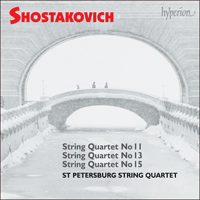


The Eleventh Quartet breaks from the more traditional four-movement structure, and comprises seven separate short movements more comparable with a partita or divertimento. The movements are thematically unified by a sequence of phrases introduced at the beginning of the first movement. The Thirteenth Quartet, on the other hand, forms the only single-movement quartet in Shostakovich's output, and adopts the serial thematicism he introduced to the genre in his previous Twelfth Quartet. It opens with a twelve-note row on unaccompanied viola which is developed melodically and rhythmically throughout the work.
The Fifteenth Quartet was written in 1974, the year before Shostakovich's death. In 1965 he had been diagnosed with a heart condition, and by the time he wrote this, his last quartet, he was very frail. The music seemingly reflects his state of health and mind in that it is a consistently starker, more directly tragic utterance, producing perhaps the most intimate and moving of all his compositions.
All of the music on this album is also available as part of the specially priced box set Shostakovich: The Complete String Quartets: ‘These players approach Shostakovich's mighty cycle with a natural authority that's unanswerable, along with tireless precision and virtuosity, plus a wonderful command of the music's way of switching between sunlight and shadow when you least expect it’ (Classic FM Magazine).

From earliest times to the present day the string quartet has lent itself readily to the composition of a work in more than four movements to a degree which only exceptionally rarely applies to symphonic composition; structurally it has more in common with the partita or divertimento. The violin, the instrument of the group dance, the village dance, the formal social event of the ethnic ‘folk’, was also the instrument of the dancing-masters and has always been a melodic instrument. The instrument’s sustaining power means that both very fast and very slow music are ideally suited to it and the other strings; the wide emotional range lends it naturally to multi-movement composition, either as a multi-movement work, or as parts of a one-movement work.
In Shostakovich’s quartets we have noted how he rose to the formidable challenge of such a compositional discipline, and in the Eleventh Quartet links seven separate short movements in a structural homage to the genre’s roots. The link is the emotional plan. In some respects the Eleventh revisits the Tenth: the first violin opens the work with a series of melodically joined rising and falling (yet modally indeterminate) fifths, which finally settle in F minor. This has been described as a ‘motto’ theme, but it is more a sequence of phrases from which the composer takes that which he needs for the following movements. Thus the movements are separate in character but thematically unified. The Scherzo is conjoined, and the first violin opens again, unaccompanied, with another simple dance-like idea, which falls melodically in thirds, punctuated by intermittent rising glissandos (which texturally anticipate parts of the last four quartets).
An ominous low C on the viola leads to the short yet strongly dramatic Recitative, almost as if it were the musical personification of three heart seizures. In the Etude, the first violin and then the cello envelope the movement, against a simple repeated chorale-like figure, a device which is turned on its head in the Humoresque, wherein the second violin repeats just two notes throughout, G and E, regardless of what else is going on. As this peters out, an interval between them, F sharp, becomes—as F sharp minor—the tonal region of the Elegy, the emotional heart of the work. Perhaps significantly, it is the unaccompanied second violin that leads to the finale, outwardly a very simple piece, initially in F minor/major, but focusing as it progresses on the minor mode as the organic material of the work passes by in affectionate reminiscence until the first violin holds the highest possible C, seemingly forever.
String Quartet No 13 in B flat minor Op 138
Having demonstrated his mastery of serial thematicism in his later style of quartet writing in the Twelfth Quartet, Shostakovich returned to the process for his next work in the series, which was composed during the summer of 1970, and completed in hospital in Kurgan (in the Urals) on 10 August. As with the two previous quartets, Shostakovich dedicated the work to another original member of the Beethoven String Quartet, the violist Vadim Borisovsky (1901–1972), who had taken part in the premieres of Shostakovich’s quartets 2 to 10. He was succeeded by Fyodor Druzhnin, the dedicatee of Shostakovich’s last completed work, the Viola Sonata, Op 147.
The first performance of the Thirteenth Quartet was given by the Beethoven String Quartet on 11 December 1970 at the USSR Composers’ Club in Moscow. Although falling into three broad sections, the work is composed in one movement—the only single-movement quartet in Shostakovich’s output.
The composer’s technical discoveries of the Twelfth Quartet are pursued further in the Thirteenth: the first is the twelve-note opening theme (here on viola), and the second is the structural functions of texture—which had (like the first) been part of Shostakovich’s compositional make-up from his earliest days, but which had assumed greater importance in the music’s foreground in recent years.
There is a third element: the virtually constant underlying pulse, which makes this a genuine one-movement symphonic work. This is not to say that the pulse remains entirely the same throughout; as the work moves to its astonishing coda, the emotional tenor of the music demands, if not forces, the pulse to slacken slightly, yet throughout the main body of the quartet the music always moves to a regular beat.
The Thirteenth Quartet opens with the unaccompanied viola twelve-note row, which possesses greater melodic and rhythmic emphases than that which began No 12. The inherent chromaticism is soon encapsulated into melodic minor seconds—expanded to harmonic minor ninths—when, after the first violin, unaccompanied, varies the row, the second violin presents the tonal ‘second subject’ in D flat (beginning with figurative repeated notes).
There is an imperceptible change of tempo (doppio movimento) and key (open fifths E–B on E minor, the opposite of B flat minor), and the remarkable central developmental section of the work begins. Here the straining minor ninths, against repeated notes and scraps of themes, become more prominent after a third twelve-note row is heard unaccompanied on the second violin. The texture becomes astonishingly varied and more fantastical as all four instruments—barely discoursing together but acting more as individuals arguing amongst themselves—share an extended passage before the cello rebuilds the tonality and customary quartet texture. Strange pianissimo trills (minor seconds this time) then underpin further repeated notes, pizzicato, on the first violin. The ninths burst out again, and it is the solo viola which begins the argument once more. It feels like a recapitulation of the opening material, but a solo cello ‘cadenza’ (reminiscent of the earlier quartets) and yet another strict twelve-note row from the first violin anchors the music to E major.
The begetter of the quartet, the unaccompanied viola, leads proceedings as the final part of the third section of the work gets under way. The ‘second subject’, on both violins, is recapitulated in B flat minor before the meandering viola ends the quartet in more than thirty bars of solo writing (‘accompanied’ by virtually inaudible ‘belly-taps’ on the second violin—the viola had earlier instigated this tone-colour in the central section). The viola moves ever upwards to the highest possible B flat, where it is joined by the violins in a sudden dramatic crescendo to sffff—and the music is gone.
String Quartet No 15 in E flat minor Op 144
In his final years, the texts that Shostakovich chose to set, from the Fourteenth Symphony (1969) onwards, are preoccupied by death. In 1965 a heart condition was diagnosed; aggravated by his chain-smoking, his health—never robust—began to deteriorate, until in his final years he became very frail. Such matters must have prompted his preoccupation with his own mortality; in any event he turned more and more to the intimate forms of song-cycle and string quartet, and within those works we can discern a consistently starker, more directly tragic utterance than hitherto. Nowhere is this more clearly to be found than in his final string quartet, the Fifteenth, in the darkly morbid key of E flat minor, and in his last completed work, the Viola Sonata, Op 147.
As we have noted in discussions of the earlier works in this cycle, Shostakovich’s contribution to the string quartet repertoire is one of the most important of any twentieth-century composer—not purely in the number of his works but in the range and undeviating quality of them. Shostakovich’s Fifteenth Quartet is one of the most moving of all his compositions, the most intimate, and of his chamber works the most directly concerned—in so far as such a claim can be made—with death. The profound melancholy of this music is akin to a Requiem—but not necessarily for himself, although when the work was written Shostakovich must have known his time on earth was now limited.
The final quartet comprises six linked Adagio movements: Elegy, Serenade, Intermezzo, Nocturne, Funeral March and Epilogue, and was completed on 17 May 1974; the first performance took place the following October, by the Taneyev String Quartet, in Leningrad. The first performance in Moscow was by the Beethoven Quartet, on 11 January 1975.
The first movement is a sombre and stately meditation on two simple ideas, unhurried and peaceful, which anchor the music irreducibly to E flat minor and which recall chants from the Kontakion. The Serenade opens with twelve searing cries, which recur at intervals in the movement, juxtaposed with equally dramatic outbursts of pizzicato chords and a recitative-like line, before an angular little waltz passes by. Over a deep pedal, the extraordinary Intermezzo now appears: a powerfully dramatic solo violin cadenza erupts, interspersed with tutti references to scraps from the Serenade, before the Nocturne emerges. This is a relatively impressionistic movement, characterised by delicate tracery from second violin and cello through which the viola initially weaves an expressive line. This becomes the basis for much of the movement’s development before a simple march rhythm pushes itself forward, taken up by the entire quartet to begin the Funeral March proper, punctuated with solo lines from the viola, cello and first violin.
This material is also varied, but gradually the passion ebbs from it, and the quietly flickering Epilogue ensues, with fluttering lines oscillating within the texture, interspersed with reminiscences from earlier parts of the work. The fluttering lines gather themselves for a final outburst, and then—very gradually, over a long paragraph—the music, drained of almost all of its fragile energy, at last withdraws into a reposeful acceptance of Fate.
Robert Matthew-Walker © 2002
Le quatuor à cordes se prête depuis toujours à la composition à plus de quatre mouvements, à un degré qui s’applique par ailleurs à l’écriture symphonique, et encore, rarement; dans sa structure, il a plus de points communs avec la partita ou le divertimento. Le violon, instrument de danse, de fête villageoise (événement social formel du folklore ethnique) est également l’instrument des maîtres de danse et fut toujours un instrument mélodique. Sa flexibilité sonore naturelle, tant dans le legato que dans le pizzicato, en font l’instrument idéal à la fois pour la musique très lente et très rapide; sa grande palette d’émotions le destine, ainsi que les autres instruments à cordes, à la composition à mouvements multiples, divisés en plusieurs mouvements différents ou regroupés en un long mouvement varié.
Nous notons, dans les quatuors de Chostakovitch, avec quelle ardeur le compositeur relève de défi d’une telle discipline de composition, et dans le numéro 11, va jusqu’à lier sept mouvements courts différents en un hommage structurel aux racines du genre. Le lien se situe sur le plan émotionnel. Le Onzième quatuor s’inspire dans certains aspects du numéro 10: à l’instar de ce dernier, l’œuvre s’ouvre au premier violon sur une série de quintes montantes et descendantes (mais indéterminées au plan modal) et liées par la mélodie, pour s’installer dans la tonalité de fa mineur. Cette caractéristique est comparée à un leitmotiv, mais il s’agit davantage d’une séquence de phrases musicales auxquelles le compositeur prend les éléments des mouvements suivants. Les mouvements sont donc distincts dans leur personnalité mais proches dans leur unité thématique. Le Scherzo est adjoint, et le premier violon fait encore une fois l’ouverture, sans accompagnement, à la manière d’une danse, qui retombe en tierces ponctuées de glissandos montants (ces traits anticipent, par leur texture, certaines parties des quatre derniers quatuors).
Un do menaçant à l’alto introduit un récitatif bref et néanmoins dramatique, comme s’il s’agissait de la mise en musique de trois attaques cardiaques. Dans l’Étude, le premier violon suivi du violoncelle enveloppe le mouvement sur fond d’un motif simple et répété à la façon d’un choral, technique reprise et inversée dans l’Humoresque, où le second violon répète simplement deux notes, sol et mi, dans tout le mouvement, obstinément. Alors que ce motif tourne court, l’intervalle qui sépare les instruments, le fa dièse, devient fa dièse mineur, la région tonale de l’Élégie, cœur émotionnel de l’œuvre. Il est sans doute important de noter que c’est le second violon qui mène le groupe au Final, morceau apparemment très simple qui progresse de fa dièse mineur et majeur pour s’imposer, dans la tonalité mineure, comme la réminiscence affectueuse de l’âme de l’œuvre, jusqu’à ce que le premier violon tienne le do le plus aigu possible pendant ce qui semble une éternité.
Quatuor à cordes Nº 13 en si bémol mineur op. 138
Après avoir démontré sa maîtrise des thèmes en série par son style d’écriture dans le Douzième quatuor, Chostakovitch se remet au travail et s’attaque à l’œuvre suivante qu’il commence à l’été 1970 et termine à l’hôpital de Kurgan (dans l’Oural) le 10 août. À l’instar des deux quatuors précédents, celui-ci est dédié à un autre membre d’origine du Quatuor Beethoven, le violoniste Vadim Borisovsky (1901–1972) qui avait pris part aux premières des quatuors 2 à 10 de Chostakovitch. C’est Fyodor Druzhnin qui lui succède, et à qui Chostakovitch dédicace sa toute dernière œuvre achevée, la sonate pour alto et piano, Opus 147.
La première performance du Treizième quatuor met le Quatuor Beethoven à l’honneur, le 11 décembre 1970 au Club des compositeurs d’URSS à Moscou. Bien qu’elle présente trois parties majeures, cette œuvre est en fait un seul et grand mouvement et constitue le seul quatuor en un mouvement de Chostakovitch.
Les découvertes techniques que fera le compositeur dans le Douzième quatuor sont explorées plus à fond dans ce numéro 13. Première découverte, le thème d’ouverture à douze notes (ici à l’alto), et deuxième découverte, les fonctions structurelles données à la texture, qui s’intégraient au style des débuts de Chostakovitch et prirent une importance croissante au fil des ans, surtout récemment.
Troisième élément: la ligne rythmique quasi-constante et sous-jacente qui fait de cette composition une véritable œuvre symphonique en un mouvement. Ceci ne sous-entend pas, toutefois, que la rythmique reste inchangée de bout en bout; au contraire, alors que l’on se rapproche de l’étonnante coda, la teneur émotionnelle du morceau exige, voire force, un net ralentissement du pouls de l’œuvre qui contraste avec les battements réguliers du cœur de ce quatuor étonnant.
Le Treizième quatuor à cordes s’ouvre sur un trait de douze notes à l’alto seul, qui donne une emphase mélodique et rythmique supérieure à l’ouverture du numéro 12. Le chromatisme inhérent est rapidement incorporé à des secondes mineures mélodiques (qui se développent par la suite en neuvièmes mineures harmoniques) lorsque le second violon, après que le premier violon a varié le trait seul et sans accompagnement, présente le «second sujet» tonal en ré bémol qui commence par des notes figuratives répétées.
Le tempo change imperceptiblement (doppio movimento) ainsi que la tonalité (quintes ouvertes mi–si sur mi mineur, l’opposé de si bémol mineur) et c’est alors que s’ouvre le remarquable développement central de l’œuvre. Là, les neuvièmes mineures tendues sur fond de notes répétées et thèmes fragmentaires, s’imposent progressivement après l’apparition d’un troisième trait de douze notes sans accompagnement au second violon. La texture varie alors de manière étonnante et encore plus fantastique aux quatre instruments qui illustrent un long passage d’images faisant penser à des individus en pleine querelle: et puis le violoncelle s’impose et reconstruit la tonalité et la texture habituelle du quatuor. Des trilles pianissimo étranges (secondes mineures cette fois) soutiennent de nouvelles notes répétées, jouées pizzicato au premier violon. Les neuvièmes réapparaissent et l’alto solo reprend la querelle. Elle ressemble à un récapitulatif du début de l’œuvre, mais une cadence au violoncelle seul, qui n’est pas sans rappeler les premiers quatuors, suivie d’un nouveau trait strict de douze notes au premier violon, établit la tonalité de mi majeur.
Seul, l’alto, meneur de l’ensemble, conduit le groupe vers la troisième partie finale de l’œuvre. Le «second sujet» aux deux violons est repris en si bémol mineur avant que les méandres de l’alto n’achèvent le quatuor par plus de trente mesures «accompagnées» par les coups d’archet presque imperceptibles du second violon (l’alto avait entamé cette couleur de tonalité dans la partie centrale). L’alto monte toujours plus haut jusqu’à un si bémol très aigu, pour être rejoint par les violons en un crescendo soudain et dramatique jusqu’au sffff final, et la musique s’éteint brusquement.
Quatuor à cordes Nº 15 en mi bémol mineur op. 144
Les dernières années de sa vie, Chostakovitch choisit principalement de mettre en musique des textes sur la mort, de la Quatorzième symphonie (1969) à la fin. En 1965, les médecins lui trouvent une maladie cardiaque qui est aggravée par le fait qu’il fume énormément, et son état de santé déjà relativement précaire commence à se détériorer; le compositeur est très fragile. Un problème aussi sérieux aura sans doute aiguisé son sens de la mortalité. Quoi qu’il en soit, il se tourne de plus en plus vers les formes intimes des mélodies et des quatuors à cordes. Parmi ces œuvres, nous distinguons une expression plus forte et plus directement tragique que par le passé. Deux œuvres sont des témoins incontestables de cette orientation funèbre: le quatuor numéro 15, écrit dans la tonalité sombre et morbide de mi bémol mineur et sa dernière œuvre achevée, la sonate pour alto et piano, Opus 147.
Comme nous le remarquons dans les discussions sur les œuvres moins récentes de ce cycle, la contribution de Chostakovitch au répertoire du quatuor à cordes est l’une des plus importantes du XXe siècle, non seulement de par le nombre des compositions mais aussi de par la variété et la qualité constante des œuvres. Le Quinzième quatuor à codes de Chostakovitch est l’une de ses œuvres les plus émouvantes, les plus intimes. De toutes ses pièces pour orchestre de chambre, c’est certainement celle qui se préoccupe le plus directement de la mort. La profonde mélancolie qui se dégage de cette musique évoque celle d’un Requiem, non pour le compositeur lui-même mais dans l’absolu, bien que lorsqu’il écrivit ce quatuor, Chostakovitch sût que son heure était bientôt venue.
Ce quatuor final comprend six mouvements Adagio liés les uns aux autres: Élégie, Sérénade, Intermezzo, Nocturne, Marche funèbre et Épilogue, et sera terminé le 17 mai 1974; la première performance a lieu au mois d’octobre suivant et met en scène le Quatuor Taneyev à Leningrad. La première performance à Moscou est assurée par le Quatuor Beethoven, le 11 janvier 1975.
Le premier mouvement est une méditation sombre et imposante sur deux idées simples, lentes et paisibles, qui ancre profondément la musique dans la tonalité de mi bémol mineur et qui évoque les chants du Kontakion. La Sérénade s’ouvre sur douze cris poignants, réitérés à différents endroits du mouvement, juxtaposés à des sursauts tout aussi dramatiques d’accords pizzicato et à une ligne de style récitatif, avant le passage d’une petite valse angulaire et pointue. Sur des accents profonds intervient alors l’extraordinaire Intermezzo: une puissante cadence au violon seul se fait entendre, parsemée de références à la Sérénade, jouées par l’ensemble, avant de laisser la place au Nocturne. Voilà un mouvement relativement impressionniste, caractérisé par les évocations délicates au second violon et au violoncelle, qui s’entremêlent pour former une ligne expressive marquante. Ceci devient la fondation du développement du mouvement avant qu’une simple marche ne s’impose pour donner la Marche funèbre ponctuée de traits à l’alto, au violoncelle et au premier violon.
Le développement est aussi varié, mais la passion s’en échappe progressivement, et l’Épilogue à la texture éphémère apparaît telle une étincelle fragile qui luit de brèves réminiscences des parties précédentes de l’œuvre. Les traits palpitants s’unissent en un dernier sursaut et lentement, le temps d’un long paragraphe, la musique vidée de son énergie fragile se retire avec grâce, en acceptant avec sérénité le Destin.
Robert Matthew-Walker © 2002
Français: Marie Luccheta
Von seinen Anfängen bis auf den heutigen Tag wurde die Gattung des Streichquartetts ohne weiteres für die Komposition von Werken mit mehr als vier Sätzen genutzt, was auf sinfonische Werke nur außerordentlich selten zutrifft; vom Aufbau her hat das Quartett mehr mit der Partita bzw. dem Divertimento gemeinsam. Die Geige, das Instrument des Gruppentanzes, des dörflichen Tanzes, des offiziellen gesellschaftlichen Ereignisses „fürs Volk“ war außerdem das Instrument der Tanzmeister, und sie war schon immer ein Melodieinstrument. Dass dieses Instrument in der Lage ist, ausgehaltene Töne zu spielen, heißt, dass sowohl sehr schnelle als auch sehr langsame Musik ideal dazu und zu den übrigen Streichinstrumenten passt; seine breite emotionale Palette ist ihrem Wesen gemäß für mehrteilige Kompositionen geeignet, seien es Werke mit mehreren Sätzen oder Abschnitte eines einsätzigen Werks.
Im Falle von Schostakowitschs Quartetten haben wir vermerkt, wie er sich der beachtlichen Herausforderung der kompositorischen Disziplin gestellt hat und im Elften Quartett sieben eigenständige kurze Sätze miteinander verbindet—eine strukturelle Huldigung an die Ursprünge der Gattung. Diese Verbindung ist das emotionale Konzept. In mancher Hinsicht greift das Elfte auf das Zehnte Quartett zurück: Die Erste Geige leitet das Werk mit einer Serie ansteigender und abfallender (modal jedoch unbestimmter) Quinten, die sich schließlich auf f-Moll festlegen. Man hat diese Tonfolge als „Mottothema“ bezeichnet, doch ist sie eher eine Sequenz von Phrasen, denen der Komponist entnimmt, was er für die folgenden Sätze braucht. So kommt es, dass die Sätze zwar vom Charakter her eigenständig, aber thematisch vereinheitlicht sind. Das Scherzo ist eingebunden, und die Erste Geige macht wiederum unbegleitet den Anfang, auch diesmal mit einem schlichten tänzerischen Motiv, das melodisch in Terzschritten absteigt und in Abständen von ansteigenden Glissandi unterbrochen wird (die von der Textur her Teile der letzten vier Quartette vorwegnehmen).
Ein beunruhigendes tiefes C auf der Bratsche leitet zum kurzen, aber hochdramatischen Rezitativ über, das den Eindruck erweckt, als sei es die musikalische Umsetzung dreier Herzattacken. In der Etüde belegen die Erste Geige und dann das Cello den Satz mit Beschlag, vor dem Hintergrund einer schlichten wiederholten Choralfigur. Dieses Stilmittel wird in der Humoreske auf den Kopf gestellt; dort nämlich wiederholt die Zweite Geige ein ums andere Mal die zwei Töne G und E, ohne Rücksicht darauf, was sonst vorgeht. Nachdem sie sich totgelaufen hat, wird das dazwischenliegende Intervall Fis—als fis-Moll—zum tonalen Bereich der Elegie, die das emotionale Herzstück des Werks ist. Es ist wohl bedeutsam, dass es der unbegleiteten Zweiten Geige überlassen ist, zum Finale überzuleiten, das oberflächlich betrachtet ein sehr einfaches, anfangs in f-Moll/F-Dur angelegtes Stück ist, sich jedoch im weiteren Verlauf auf die Molltonart konzentriert, während das organisch zusammenhängende Material in zärtlicher Besinnung vorüberzieht, bis die Erste Geige das höchste mögliche C spielt und es scheinbar unendlich lang aushält.
Streichquartett Nr. 13 in b-Moll op. 138
Nachdem er seine Beherrschung serieller Themenbehandlung in seinem späteren Quartettstil mit dem Zwölften Quartett bewiesen hatte, griff Schostakowitsch das Verfahren im nächsten Werk der Serie wieder auf, das er im Sommer 1970 zu komponieren begann und am 10. August im Krankenhaus von Kurgan (im Ural) fertig stellte. Wie die vorherigen zwei Quartette widmete Schostakowitsch auch dieses Werk einem der ursprünglichen Mitglieder des Beethoven-Quartetts, nämlich dem Geiger Wadim Borissowski (1901–1972), der an der Uraufführung der Schostakowitsch-Quartette Nr. 2 bis 10 teilgenommen hatte. Sein Nachfolger war Fjodor Druschinin, Adressat der Widmung des letzten vollendeten Werks von Schostakowitsch, der Bratschensonate op. 147.
Die Uraufführung des Dreizehnten Quartetts besorgte das Beethoven-Quartett am 11. Dezember 1970 im Sowjetischen Komponistenverein in Moskau. Das Werk zerfällt zwar in drei große Abschnitte, ist jedoch in einem Satz komponiert—das einzige einsätzige Quartett in Schostakowitschs Gesamtwerk.
Die technischen Neuerungen, die der Komponist im Zwölften Quartett entdeckt hatte, werden im Dreizehnten weiter erforscht: Die erste ist das aus zwölf Tönen zusammengesetzte Einleitungsthema (hier auf der Bratsche gespielt), die zweite die strukturgebende Funktion der Textur—beide waren ihm als Komponisten von Anfang wesensmäßig eigen gewesen, jedoch in den letzten Jahren in den Vordergrund gerückt, um in seiner Musik größere Bedeutung anzunehmen.
Ein drittes Element, der praktisch durchgängige zugrunde liegende Pulsschlag, macht das Quartett zu einem echten, wenn auch einsätzigen sinfonischen Werk. Das soll nicht heißen, dass der Pulsschlag durchweg gleich bleibt; wenn das Werk seiner erstaunlichen Coda entgegen geht, verlangt, ja erzwingt der emotionale Tenor der Musik eine leichtes Abschwächung des Pulses, während die Musik im Hauptteil des Quartetts immer auf der Grundlage eines gleichmäßigen Schlages dahin schreitet.
Das Dreizehnte Quartett setzt mit der unbegleiteten Bratsche und einer Zwölftonreihe ein, die stärkere melodische und rhythmische Akzente besitzt als die, mit der die Nr. 12 begonnen hat. Die inhärente Chromatik wird bald in melodischen kleinen Sekunden verschachtelt; diese werden zu harmonischen kleinen Nonen erweitert, wenn die Zweite Geige, nachdem die Erste Geige unbegleitet die Reihe variiert hat, das tonale „zweite Subjekt“ in Des darbietet (angefangen mit figurativen wiederholten Tönen).
Es folgt eine unmerkliche Veränderung des Tempos (doppio movimento) und der Tonart (leere Quinten E–H in e-Moll, dem Gegensatz von b-Moll), und die bemerkenswerte zentrale Durchführung des Werks beginnt. Hier treten, nachdem eine dritte Zwölftonreihe unbegleitet auf der Zweiten Geige zu hören war, die angestrengten kleinen Nonen vor dem Hintergrund aus wiederholten Tönen und Themenbruchstücken deutlicher hervor. Die Textur wird erstaunlich mannigfaltig und immer abenteuerlicher, wenn alle vier Instrumente—die kaum im Diskus miteinander stehen, sondern sich eher wie Individuen benehmen, die ein Streitgespräch führen—eine längere Passage gemeinsam haben, ehe das Cello die Tonalität und das gewohnte Quartettgefüge wieder aufbaut. Merkwürdige Pianissimo-triller (diesmal in kleinen Sekunden) unterstreichen weitere wiederholte Töne, die pizzicato auf der Ersten Geige erklingen. Die Nonen brechen jedoch erneut hervor, und es ist die Bratsche allein, die das Streitgespräch von vorn anfängt. Man hat den Eindruck einer Reprise des einleitenden Materials, doch eine „Kadenz“ für Cello solo (sie erinnert an die früheren Quartette) und eine weitere strenge Zwölftonreihe der Ersten Geige verankern die Musik in E-Dur.
Das Instrument, mit dem das Quartett seinen Anfang genommen hat, die unbegleitete Bratsche, macht den Anfang, wenn der Schlussteil des dritten Abschnitts seinen Lauf nimmt. Das „zweite Subjekt“, auf beiden Geigen gespielt, wird einer Reprise in b-Moll unterzogen, ehe die gewundenen Klänge der Brasche das Quartett mit über dreißig Takten Solosatz beenden („begleitet“ von praktisch unhörbarem „Bauchklopfen“ auf der Zweiten Geige—eine klangfarbliche Nuance, die die Bratsche im mittleren Abschnitt eingeführt hatte). Die Bratsche schwingt sich immer weiter empor bis zum höchstmöglichen B, wo sich ihr zu einem plötzlichen dramatischen Crescendo bis sffff die Geigen zugesellen—und dann ist es aus mit der Musik.
Streichquartett Nr. 15 in es-Moll op. 144
Gegen Ende seines Lebens beschäftigten sich die Texte, die Schostakowitsch ab der Vierzehnten Sinfonie (1969) vertont hat, mit dem Tod. 1965 wurde ein Herzleiden festgestellt; erschwert durch Kettenrauchen ließ seine Gesundheit—die nie robust gewesen war—allmählich nach, bis er in den letzten Lebensjahren sehr gebrechlich war. Diese Gegebenheiten veranlassten ihn offenbar, über die eigene Sterblichkeit nachzudenken; jedenfalls wandte er sich immer öfter den intimen Musikformen des Liedzyklus und des Streichquartetts zu, und in diesen Werken können wir eine durchweg spröde, unverhohlener tragische Sprache ausmachen als zuvor. Das wird nirgendwo deutlicher als in Schostakowitschs letztem Streichquartett, dem Fünfzehnten in der düster morbiden Tonart es-Moll, und in seinem letzten vollendeten Werk, der Bratschensonate op. 147.
Wie wir anlässlich der Besprechung der früheren Werke dieser Serie festgestellt haben, zählt Schostakowitschs Beitrag zum Repertoire für Streichquartett zu den bedeutendsten, die ein Komponist des zwanzigsten Jahrhunderts geleistet hat—und zwar nicht allein durch die Zahl seiner Werke, sondern auch durch ihre Bandbreite und durchweg hohe Qualität. Schostakowitschs Fünfzehntes Quartett ist eine seiner ergreifendsten und intimsten Kompositionen und dasjenige Streichquartett, das—soweit man so eine Behauptung überhaupt aufstellen darf—am stärksten mit dem Tod befasst ist. Die profunde Melancholie des Werks hat etwas von einem Requiem—aber nicht unbedingt für die eigene Person, obwohl Schostakowitsch, als er es komponiert hat, sicher wusste, dass seine Zeit auf Erden begrenzt war.
Das letzte Quartett setzt sich aus sechs miteinander verbundenen Adagiosätzen zusammen: Elegie, Serenade, Intermezzo, Nocturne, Trauermarsch und Epilog. Es wurde am 17. Mai 1974 fertig gestellt, und die Uraufführung in Leningrad besorgte im Oktober des Jahres das Tanejew-Quartett. Die erste Moskauer Aufführung spielte das Beethoven-Quartett am 11. Januar 1975.
Der erste Satz ist eine ernste und feierliche Meditation über zwei schlichte, gemächlich und friedlich gestimmte Ideen, die die Musik unwiderruflich in es-Moll verankern und an Gesänge aus dem Kontakion erinnern. Die Serenade beginnt mit zwölf eindringlichen Schreien, die sich in Abständen im Verlauf des Satzes wiederholen; ebenso dramatische Ausbrüche von Pizzicato-Akkorden und eine rezitativische Melodielinie werden ihnen gegenübergestellt, und dann zieht ein kantiger kleiner Walzer vorbei. Über einem tiefen Orgelpunkt erklingt nun das außergewöhnliche Intermezzo: eine eindrucksvoll dramatische Soloviolinkadenz bricht hervor, solange durchsetzt mit Tutti-Verweisen auf Bruchstücke aus der Serenade, bis die Nocturne hervortritt. Es handelt sich um einen eher impressionistischen Satz, gekennzeichnet durch fein ziselierte Klänge auf der Zweiten Geige und dem Cello, durch die die Bratsche zu Anfang eine expressive Melodielinie fädelt. Diese Linie dient als Grundlage für große Teile der Durchführung des Satzes; dann schiebt sich ein einfacher Marschrhythmus in den Vordergrund, der vom gesamten Quartett aufgegriffen wird und den eigentlichen Trauermarsch einleitet, unterbrochen durch Solopassagen der Bratsche, des Cellos und der Ersten Geige.
Dieses Material ist genauso abwechslungsreich, doch die Leidenschaft darin lässt immer mehr nach, und der leise flackernde Epilog entspinnt sich mit flatternden Linien, die innerhalb der Textur oszillieren, und eingestreuten Reminiszenzen an zuvor gehörte Abschnitte des Werks. Die flatternden Linien versammeln sich zu einem letzten Ausbruch, und dann zieht sich die Musik—ganz allmählich über eine lange Passage hin—in ruhige Duldung des Schicksals zurück.
Robert Matthew-Walker © 2002
Deutsch: Anne Steeb/Bernd Müller