
Welcome to Hyperion Records, a British classical label devoted to presenting high-quality recordings of music of all styles and from all periods from the twelfth century to the twenty-first.
Hyperion offers both CDs, and downloads in a number of formats. The site is also available in several languages.
Please use the dropdown buttons to set your preferred options, or use the checkbox to accept the defaults.
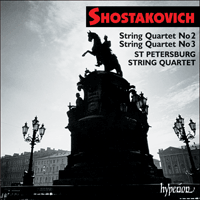


This is the first of what will be the entire set of Shostakovich Quartets recorded by the St Petersburg String Quartet on Hyperion. Shostakovich wrote his first string quartet in 1938, with No 2 following six years later in 1944 (three weeks after the completion of his Piano Trio). The Piano Trio and String Quartet No 2 appear, emotionally, to be the obverse of the same coin and although the Quartet contains structural elements such as found in the Piano Trio, it stands entirely on its own as a wholly convincing work of art.
Having achieved a unique mastery of quartet-writing in No 2, by 1946 Shostakovich tackled the medium again. Also by this time, he had successfully tackled a formal challenge which had long fascinated Beethoven—the joining-together of movements of different character, yet done in such a way as to make their continuation both seamless and inevitable. Shostakovich had done this in the Eighth and Ninth Symphonies, as well as in the Piano Quintet and Piano Trio, but had not thus far attempted it in quartet writing. The Quartet No 3, which is in some respects superficially akin to the Ninth Symphony, revealed new facets of this great composer's compositional mastery, and plumbed considerable depths for Shostakovich than before in this medium.
All of the music on this album is also available as part of the specially priced box set Shostakovich: The Complete String Quartets: ‘These players approach Shostakovich's mighty cycle with a natural authority that's unanswerable, along with tireless precision and virtuosity, plus a wonderful command of the music's way of switching between sunlight and shadow when you least expect it’ (Classic FM Magazine).

However, even among those who were masters of both the symphony and the string quartet there are some whose development as quartet-writers did not invariably run alongside their concurrent symphonic mastery. So far as the twentieth century is concerned, the most important such composer is Dmitri Shostakovich who nonetheless, at the time of his death in 1975 at the age of 68, had completed fifteen symphonies and fifteen string quartets. The equal numbers should not imply an equal concentration throughout his life: by the time he wrote his First Quartet, Opus 49, in 1938, he had already composed five symphonies; but the last thirteen years of his life saw the appearance of just two symphonies, alongside no fewer than six quartets.
It was, therefore, only during the years 1939 to 1962 – a period occupying less than half of Shostakovich's composing career – that his symphonic and chamber works appeared concurrently. These 23 years saw eight symphonies and seven string quartets, during which time he achieved complete mastery as a composer of chamber music, a mastery he had displayed in symphonic writing since 1925.
As the symphony and the string quartet evolved, formally, from the same sources, it may seem odd to say this of Shostakovich, but both forms arose two hundred years or so earlier, and whereas the orchestra had expanded out of virtual recognition from Haydn or even Sammartini, the string quartet remained constant. In addition, the string quartet, as an instrumental group, forms the basis of the symphony orchestra, and whilst there doubtless exist symphonic elements in quartets by composers of all persuasions - three elements, founded upon, in Hans Keller's phrase, 'the large-scale integration of contrasts' (namely themes, keys and statement-and-development), the very nature of the quartet's instrumental make-up, and its historical legacy, have made the twin disciplines of writing symphonies and string quartets by no means complementary or interdependent. The greatest masters of both disciplines have realised the truth of this statement.
Therefore it is quite wrong to consider Shostakovich's string quartets as symphonies in chamber-music guise, and although his delightful First Quartet followed the mighty Fifth Symphony by a year, here is a work utterly conceived for the medium. The First Quartet stands very much apart from its successors in much the same way that Prokofiev's 'Classical' Symphony does from his other six symphonies. It was not until the Second String Quartet, Opus 68, of 1944, that Shostakovich can truly be said to have achieved mastery in quartet composition.
During the six years that separated the First and Second Quartets, Shostakovich wrote two great chamber works – the Piano Quintet (Opus 57), and the Piano Trio in E minor (Opus 67; the Trio was, in fact, his Second; the First, a short, not fully representative very early work, Opus 8, dates from 1923 and was not published until after the composer's death). The Piano Quintet dates from 1940, and was written following a suggestion from the Beethoven String Quartet for a work which they could perform with the composer. It is to this great ensemble that we surely owe Shostakovich's awakening of, and thereafter constant interest in, chamber music. They had given the second performance of the First Quartet in 1938, and gave the first performances of Quartets 2 to 14, as well as of the Piano Quintet and Piano Trio (both with the composer), and gave the second performance, the Moscow premiere, of the final quartet, No 15, in January 1975.
The Second String Quartet was composed in September 1944, less than three weeks after the completion of the Piano Trio to which it appears, emotionally, as the obverse of the same coin. Both were premiered at the same concert on 9 November 1944. The Quartet, whilst containing structural elements such as are found in the Piano Quintet and Piano Trio (notably the recapitulation of themes from earlier movements in the finale), stands entirely on its own as a wholly convincing work of art.
It begins with a magnificent, almost theatrical, gesture – an affirmative theme on first violin, triumphantly in A major, with bare fifths and fourths underlining the tonality. The theme is repeated by the cello, as in E major, but if there seems something almost neo-classical about this opening (hence the movement's title 'Overture', perhaps), it is soon undermined by a darkening of key and irregularly shortened bar-lengths. The semitonal second subject, barely holding on to the dominant as it passes across distant tonalities, is more repetitiously nervous and uncertain, leading to the (very exceptional, but also used in the Ninth Symphony) exposition double-bar and repeat.
The development is both extensive and masterly. The first subject is sung as a waltz-tune in a kind of C minor, with gentle pizzicato accompaniment, echoed (as in the exposition) by the cello, and the second subject, also in C minor, is developed by the viola. The previously barely-referred-to gruppetto which ended the first subject and the rhythmic ictus which characterised the second now take centre stage. The music is carried into fearful uncharted territories as the impetus remains fast and the dynamic rarely falls below forte, until a sudden, deathly E flat minor chord – the farthest possible key from A major – slides the second subject's semitonality upwards, until A major is reached, the movement's material now recapitulated in reverse order and shortened form. The first subject appears to end the movement, but is interrupted by a final defiant reference to the second before an astonishing, classical perfect cadence peremptorily closes the discussion.
The second movement, 'Recitative and Romance', is enveloped by two long declamatory un-barred solos for first violin, accompanied by long-held lower chords; the effect is no-wise predictable, at times recalling Orthodox Church music, Middle Eastern incantations, the Gesangszene of Louis Spohr and J S Bach – but always remaining spiritually expressive. If, structurally, this also anticipates the recitatives in the Ninth Symphony, it surely is a glimpse into the more private world of the composer, which surfaced directly in the works of his final decade. The 'Romance', in a slow 3/4, brings no new material to the work, for it is based almost entirely on the material of the first movement, now changed virtually beyond recognition and developed along quite different lines and moving to an impressive climax. The shortened return of the Recitative closes with clear references to the first movement's subjects before the final simple B flat major.
Connected thematically as they are, the nature of each of the first two movements is introductory, a characteristic which is carried over into the third movement, 'Waltz'. Here we encounter one of the most amazing movements in Shostakovich's music up to that time, a movement so subtle in its construction and breathtaking in its achievement. Naturally in 3/4 (almost) throughout, the triple time which has characterised the first two movements is carried forward, but the tonality and timbre are vastly different. It is in E flat minor, the tonal opposite from the first movement, and of which B flat (which ended the second) is the dominant. The four instruments are muted throughout, even when marked fff thus giving an astonishingly ghostly, almost glassy, feel to the music. Finally, the waltz-theme itself is based on the destabilising second subject of the first movement. As this unique movement comes to its close on a ppp E flat minor chord, the air is full of mystery.
Shostakovich has here presented himself with an extraordinary compositional problem – which he solves with genius. The formal devices which he has used in the Quartet up to now demand a resolution in semi-classical structure; the tonality should return to A, but it is unlikely, in view of what has occurred, to be A major. Therefore, a semi-classical return to A minor is the tonal solution. But the material of the Quartet demands both a return that embraces triple time and a solution that combines elements of both subjects from the first movement. Quite apart from anything else, this has to make sense as music, and the implication is a finale which carries the psychologically penetrating emotional weight of the entire work.
The result is a 'Theme and Variations', prefaced by an introduction taking E flat minor as its starting point in powerful octaves on second violin, viola and cello, akin to the opening statement of the Quartet and answered by first violin unaccompanied, thematically musing over the Waltz theme at infinitely slower tempo, but texturally recalling the Recitative and Romance. The new element is a 4/4 pulse, in which, Moderato con moto, the viola, unaccompanied, has a folk-like theme in A minor with a single 3/2 bar for variety, but which theme actually includes the movement's introductory octave idea. Gradually, the variations follow, almost as in classical precedent: second violin, first violin and cello add to the texture, but A minor is not relinquished, until the astonishing thematic unity of this work is revealed when pianissimo triplets urge the music faster. Now the second group of variations unfolds, set in motion in 3/4 by the cello. They gather, ever more brilliantly in character, as the music, expanding with genuine energy, embraces both duple and triple time with cumulative power. An attempt to drag the music back to E flat minor fails as the springboard which launched the finale is brought into play again; a minor third higher, in F sharp minor, heralds a new variation, and another one, to A minor, into which deep tonal region the Quartet now moves, secure in its final symphonic integration of all of this undoubted masterpiece's large-scale contrasts.
Having achieved a unique mastery of quartet-writing in No 2, by 1946 Shostakovich tackled the medium again. Also by this time, he had successfully tackled a formal challenge which had long fascinated Beethoven – the joining-together of movements of different character, yet done in such a way as to make their continuation both seamless and inevitable. Shostakovich had done this in the Eighth and Ninth Symphonies, as well as in the Piano Quintet and Piano Trio, but had not thus far attempted it in quartet writing. The Quartet No 3, which is in some respects superficially akin to the Ninth Symphony, revealed new facets of this great composer's compositional mastery, and plumbed considerable depths for Shostakovich than before in this medium.
The work is ostensibly in five movements and begins, somewhat light-heartedly, in a clear F major, Allegretto, with an innocent-sounding theme. The second subject, in C, is rhythmically first cousin to that in the Ninth Symphony, and with the double bar and repeat (as in the Second Quartet and Ninth Symphony) the listener may be forgiven for imagining that Shostakovich has here embarked upon another friendly neo-classical piece. If he has, he does not continue it, at least in terms of sonata structure, for the development is nothing less than a double fugue and the recapitulation strains to keep on track – the second subject hinting at B minor (!) and the coda finally getting us back on track with a pizzicato perfect cadence. The second movement, Moderato con moto, is like a slower, troubled reminiscence of the Scherzo in the Eighth Symphony at first, the viola ostinato heralding bitter music – strongly dissonant, the freely contrapuntal nature producing a deep unease almost throughout the movement – not always violent, but full of foreboding. The tonality is E minor – so near and yet so far from the clear F major which began the work.
Aggression is the emotion of the gripping third movement, a mixture of Scherzo and March, 3/4 and 2/4 alternating almost at every bar in a bitter G sharp minor, looking forward, surely, to the eruptive second movement in the Tenth Symphony. The tonality switches to a kind of E flat major for what must pass as the Trio section, dominated first by the viola, before the opening bursts through the fabric to end the movement with a fierce challenge.
The fourth movement, an extended Passacaglia – a form in which Shostakovich had already proved himself an expert – anticipates a movement in another masterpiece, the Violin Concerto No 1 of 1947/8, but here it is rather freer, and therefore more personal and expressive. Beginning fortissimo, it tends to fall in dynamic, and in tonality, becoming almost bereft of energy until the finale enters, faster of course but very quietly and simply, a little uncertain at first, but growing in confidence until the music sings more lyrically, with F major more or less firmly established.
But it is not so easily achieved. As a climax builds, the theme from the Passacaglia strides across the texture, and then fades over a single repeated E from the cello. Was it all, tonally, in vain? No, for Shostakovich reaches his goal by making E the dominant of A minor, in turn the mediant of F major. By this un-classical, yet infinitely logical and moving progression, Shostakovich has revealed a profound musical truth; the pizzicatos which ended the first movement now bringing a deep pacification to the music which had earlier so troubled us.
It is sometimes claimed, not always convincingly, that there is often a hidden meaning in Shostakovich's work. Whilst the character of his instrumental art frequently exhibits great drama, his mastery of composition is such that his music has, in the last analysis, to stand or fall solely as music, and not through the imposition of some extra-musical programme. With regard to his Third String Quartet, however, the Borodin Quartet, one of the leading Soviet ensembles of their day, established in 1946, insisted upon the following subtitles being appended to the movements in every programme whenever they performed this work. Whilst they have never been published in any edition of the music, the Borodin Quartet clearly felt they had the composer's approval, and the subtitles fit the nature of the music:
I: 'Calm unawareness of the future cataclysm'
II: 'Rumblings of unrest and anticipation'
III: 'The forces of war unleashed'
IV: 'Homage to the dead'
V: 'The eternal question: Why? And for what?'
If indeed these are Shostakovich's original thoughts, then they assist in understanding the character of the work more, but what cannot be denied is that, in his Second and Third String Quartets, Dmitri Shostakovich declared himself to be one of the greatest quartet writers of the century, and continued as such in his successive masterpieces in the genre.
Robert Matthew-Walker © 1999
Toutefois, certains maîtres de la symphonie et du quatuor à cordes ne virent pas leur développement d’auteurs de quatuors aller invariablement de pair avec leur maîtrise symphonique. Au XXe siècle, le plus important de ces compositeurs, Dmitri Chostakovitch, avait tout de même achevé à sa mort, en 1975 (à l’âge de soixante-huit ans), quinze symphonies et autant de quatuors à cordes. Cette égalité numérique n’implique pas une égalité de répartition tout au long de sa vie: à l’époque de son Premier quatuor, op.49 (1938), il avait déjà composé cinq symphonies, cependant que les treize dernières années de son existence ne furent témoins que de deux symphonies, contre pas moins de six quatuors.
Ce fut donc seulement durant les années 1939-1962 (soit moins de la moitié de la carrière de compositeur de Chostakovitch) qu’œuvres symphoniques et œuvres de chambre parurent concurremment, avec huit symphonies et sept quatuors à cordes. Au cours de ces vingt-trois années, Chostakovitch atteignit à une totale maîtrise de la musique de chambre, maîtrise dont il avait fait montre dans son écriture symphonique dès 1925.
Comme la symphonie et le quatuor à cordes évoluèrent, formellement, à partir des mêmes sources, dire cela de Chostakovitch peut sembler curieux, mais les deux formes surgirent deux siècles auparavant et, tandis que l’orchestre se développa et jouit d’une quasi-reconnaissance à partir de Haydn, voire de Sammartini, le quatuor à cordes demeura constant, constituant en outre, en tant que groupe instrumental, la base de l’orchestre symphonique; mais, si des éléments symphoniques émaillent indubitablement les quatuors de compositeurs de tous ordres – i.e. trois éléments fondés, pour reprendre l’expression de Hans Keller, sur «l’intégration à grande échelle des contrastes» (savoir les thèmes, les tonalités et l’énonciation-et-développement) –, la nature même de la facture instrumentale du quatuor, et son héritage historique, firent que les écritures de symphonies et de quatuors à cordes, deux disciplines jumelles, ne sont nullement complémentaires ou interdépendantes – assertion dont les plus grands maîtres de ces deux disciplines réalisèrent la véracité.
Il est donc tout à fait erroné de considérer les quatuors à cordes de Chostakovitch comme des symphonies aux dehors de musique de chambre, et, quoiqu’il suivît d’un an la puissante Cinquième symphonie, le ravissant Premier quatuor est une œuvre entièrement conçue pour le moyen d’expression qu’est le quatuor à cordes. Il se tient très à l’écart des quatuors suivants, comme la Symphonie «classique» se départit des six autres symphonies de Prokofiev. Ce fut seulement avec le Deuxième quatuor à cordes, op.68 (1944) que Chostakovitch atteignit véritablement à la maîtrise du quatuor.
Au cours des six années qui séparèrent le Premier du Deuxième quatuor, Chostakovitch écrivit deux grandes œuvres de chambre: le Quintette avec piano (op.57) et le Trio avec piano en mi mineur (op.67; ce Trio fut, en réalité, le deuxième du compositeur; le premier, op.8 – une pièce brève, fort ancienne (1923) et non pleinement représentative – ne fut publié qu’après la mort du musicien). Le Quintette avec piano (1940) fut écrit suite à une suggestion du Quatuor Beethoven, en quête d’une œuvre à interpréter avec le compositeur. C’est assurément à ce grand ensemble que nous devons les débuts de Chostakovitch en musique de chambre – pour laquelle il ne cessa ensuite de manifester de l’intérêt. Après avoir donné la deuxième exécution du Premier quatuor en 1938, le Quatuor Beethoven créa les Quatuors nos 2 à 14, ainsi que le Quintette avec piano et le Trio avec piano (avec le compositeur); en outre, il assura la deuxième exécution, et la première moscovite, du quinzième et dernier quatuor, en janvier 1975.
Le Deuxième quatuor à cordes, composé en septembre 1944, fut commencé moins de trois semaines après l’achèvement du Trio avec piano, par rapport auquel il appardit, émotionnellement, comme l’avers d’une même médaille – les deux œuvres furent créées lors d’un même concert, le 9 novembre 1944. Le Quatuor, tout en recelant des éléments structurels présents dans le Quintette avec piano et le Trio avec piano (notamment la reprise de thèmes, issus de mouvements antérieurs, dans le finale), s’avère être une œuvre d’art à part entière, pleinement convaincante.
La pièce s’ouvre sur un geste magnifique, quasi théâtral, un thème affirmatif exécuté par le premier violon, triomphalement en la majeur, de simples quintes et quartes soulignant la tonalité. Le thème est repris par le violoncelle, comme en mi majeur, mais si ce début semble avoir quelque chose de néo-classique (d’où, peut-être, le titre du mouvement: «Ouverture»), il est bientôt ébranlé par un assombrissement de la tonalité et un accourcissement irrégulier de la longueur des mesures. Le second sujet semitonal, s’agrippant simplement à la dominante lors du franchissement de tonalités distantes, est davantage répétitivement nerveux et incertain, qui conduit à la double barre de l’exposition (fort exceptionnelle, mais également utilisée dans la Neuvième symphonie) et à la reprise.
Le développement est à la fois ample et maîtrisé. Le premier sujet est chanté comme un air de valse, dans une sorte d’ut mineur, avec un doux accompagnement en pizzicato, renvoyé (comme dans l’exposition) par le violoncelle, cependant que le second sujet, lui aussi en ut mineur, est développé par l’alto; mais le gruppetto auquel il avait à peine été fait référence auparavant, en clôture du premier sujet, et l’ictus rythmique caractéristique du second sujet occupent désormais le centre de la scène, transportant la musique en d’effroyables terrae incognitae, tandis que l’élan demeure rapide et que la dynamique tombe rarement en dessous de forte, jusqu’à ce qu’un soudain, un mortel accord de mi bémol mineur – la tonalité la plus éloignée qui soit de la majeur – fasse glisser la semitonalité du second sujet vers le haut, pour atteindre la majeur, le matériau du mouvement étant alors repris en ordre inverse et sous forme abrégée. Le premier sujet semble terminer le mouvement, mais est interrompu par une ultime référence provocatrice au second sujet, avant qu’une étonnante cadence parfaite classique ne close péremptoirement la discussion.
Le deuxième mouvement, «Récitatif et Romance», est drapé en deux longs solos déclamatoires, débridés, dévolus au premier violon et accompagnés par des accords inférieurs tenus: l’effet, nullement prévisible, rappelle parfois la musique liturgique orthodoxe, les incantations moyen-orientales, la Gesangszene de Louis Spohr et J. S. Bach, mais demeure toujours spirituellement expressif. Ce qui, structurellement, anticipe aussi les récitatifs de la Neuvième symphonie, tout en offrant un aperçu de l’univers plus privé du compositeur, lequel affleura franchement dans les œuvres de la dernière décennie. La «Romance», sise en un lent 3/4, n’apporte aucun matériau neuf à l’œuvre, car elle repose presque entièrement sur le matériau du premier mouvement, devenu quasi méconnaissable et développé fort différemment, avec un apogée impressionnant. La reprise accourcie du Récitatif s’achève par de claires références aux sujets du premier mouvement, avant le simple si bémol majeur final.
Thématiquement liés, les deux premiers mouvements ont une nature introductive – une caractéristique reportée dans le troisième mouvement, «Valse». Nous rencontrons ici l’un des mouvements les plus étonnants de toute la musique de Chostakovitch écrite jusqu’alors. De construction subtile, de facture époustouflante, il est naturellement sis (presque) de bout en bout dans une mesure à 3/4; si la mesure ternaire caractéristique des deux premiers mouvements est reportée, la tonalité et le timbre diffèrent du tout au tout. Ce mouvement est en mi bémol mineur (opposé tonal du premier mouvement), dont si bémol (qui closait le deuxième mouvement) est la dominante. Les quatre instruments sont toujours con sordini, même quand ils sont marqués fff, ce qui confère une atmosphère incroyablement spectrale, quasi vitreuse, à la musique. Finalement, le thème de la valse même repose sur le déstabilisant second sujet du premier mouvement. Lorsque ce mouvement unique arrive a sa conclusion, sur un accord de mi bémol mineur ppp, l’ambiance est au mystère complet.
Ici, Chostakovitch se trouva confronté à un extraordinaire problème compositionnel – qu’il résolut avec génie. Les procédés formels employés jusqu’alors requièrent une résolution dans une structure semi-classique: la tonalité devrait revenir à la, mais, eu égard à ce qui s’est produit, ce ne sera probablement pas la majeur. La solution tonale consiste donc en un retour semi-classique à la mineur. Mais le matériau du Quatuor exige et un retour embrassant une mesure ternaire et une solution combinant des éléments des deux sujets du premier mouvement. Le tout doit, en outre, avoir un sens musical, d’où un final qui véhicule le poids émotionnel, psychologiquement pénétrant, de toute l’œuvre.
Ce qui aboutit à un «Thème et Variations», préfacé par une introduction prenant mi bémol mineur pour point de départ, en puissantes octaves réalisées au second violon, à l’alto et au violoncelle – présentant une parenté avec l’énonciation initiale du Quatuor et trouvant réponse dans le premier violon seul, dont le thème rêvasse sur celui de la Valse, à un tempo infiniment plus lent, mais dont la texture rappelle le Récitatif et Romance. Le nouvel élément est un rythme à 4/4 où, Moderato con moto, l’alto, sans accompagnement, présente un thème populaire en la mineur avec, pour variété, une seule mesure à 3/2; mais ce thème inclut en réalité l’idée introductive, en octaves, du mouvement. Peu à peu, les variations suivent, presque comme dans la tradition classique: second violon, premier violon et violoncelle ajoutent à la texture, mais la mineur n’est pas abandonné avant que la surprenante unité thématique de l’œuvre ne soit révélée, quand des triolets pianissimo précipitent davantage encore la musique. Le second groupe de variations s’éploie alors, mis en mouvement, à 3/4, par le violoncelle. Elles se rassemblent, toujours plus brillantes, à mesure que la musique, qui croît avec une authentique énergie, embrasse les mesures binaire et ternaire, avec une puissance cumulative. Une tentative de ramener la musique à mi bémol mineur échoue, car le tremplin qui déclenchait le finale est remis en marche, une tierce mineure plus haute, en fa dièse mineur, annonce une nouvelle variation, puis une autre, pour atteindre la mineur, profonde région tonale où le Quatuor se meut désormais, certain quant à son ultime intégration symphonique de l’ensemble des contrastes à grande échelle de ce chef-d’œuvre incontesté.
Ayant atteint, dans le no2, à une maîtrise unique de l’écriture de quatuors à cordes, Chostakovitch réaborda le genre, en 1946. À cette époque, il s’était attaqué, avec succès, à un défi forinel qui avait longtemps fasciné Beethoven: la réunion de mouvements de caractère différent, mais réalisée de manière à rendre leur continuité aussi homogène qu’inévitable. Chostakovitch y était déjà parvenu dans les Huitième et Neuvième symphonies, ainsi que dans le Quintette avec piano et le Trio avec piano, mais n’avait encore pas tenté de le faire dans un quatuor. Le Quatuor no3, qui, à certains égards, recèle de superficielles analogies avec la Neuvième symphonie, révéla de nouvelles facettes de la maîtrise compositionnelle de ce grand musicien, le plongeant dans des tréfonds jamais atteints avec un quatuor.
L’œuvre, apparemment à cinq mouvements, commence, quelque peu gaiement, en un clair fa majeur, Allegretto, doté d’un thème d’allure innocente. Le second sujet, en ut, est le cousin germain rythmique de celui de la Neuvième symphonie; et, avec la double barre et la reprise (comme dans le Deuxième quatuor et la Neuvième symphonie), il n’est pas interdit à l’auditoire d’imaginer que Chostakovitch s’est lancé dans une autre pièce aimable, néoclassique. Ce qu’il fait, mais ne poursuit pas, du moins en termes de structure de sonate, car le développement n’est rien moins qu’une double fugue, tandis que la reprise s’efforce de suivre – le second sujet insinuant si mineur (!) et la coda nous faisant finalement reprendre le fil, avec une cadence parfaite en pizzicato. Le deuxième mouvement, Moderato con moto, ressemble d’abord à une réminiscence ralentie, troublée, du Scherzo de la Huitième symphonie, l’ostinato de l’alto annonçant une musique amère – fortement dissonante, la nature librement contrapuntique engendrant un profond malaise presque tout au long du mouvement –, pas toujours violente, mais pleine de pressentiment. La tonalité est mi mineur, si proche et pourtant si éloigné du clair fa majeur, qui inaugurait l’œuvre.
L’agression est l’émotion du troisième, et captivant, mouvement, mélange de scherzo et de marche, qui voit 3/4 et 2/4 alterner presque à chaque mesure, dans un amer sol dièse mineur, et regarde assurément vers l’éruptif deuxième mouvement de la Dixième symphonie. La tonalité est conduite à une sorte de mi bémol majeur pendant ce qui doit passer pour la Section en trio, dominée d’abord par l’alto, avant que l’ouverture ne fasse brusquement irruption pour clore le mouvement sur une féroce contestation.
Le quatrième mouvement, une Passacaille prolongée – forme dans laquelle Chostakovitch s’était déjà avéré expert – anticipe un mouvement d’un autre chef-d’œuvre, le Concerto pour violon no1 (1947), mais ici, il est plus libre et, partant, plus personnel et expressif Commencé fortissimo, il tend à baisser en dynamique et en tonalité, devenant presque veuf d’énergie, jusqu’à ce que le finale entre, plus rapide, bien sûr, mais fort paisiblement et simplement, un peu incertain, d’abord, mais d’une assurance croissante, pour atteindre une musique plus lyrique, avec fa majeur plus ou moins fermement établi.
Mais il n’est pas si aisément réalisé. À mesure qu’un apogée se construit, le thème de la Passacaille parcourt à grands pas la texture, avant de s’évanouir sur un mi unique, répété, du violoncelle. Était-ce, tonalement, en vain? Non, car Chostakovitch parvient à son but en faisant de mi la dominante de la mineur et la méchante de fa majeur. Par cette progression non classique, mais pourtant infiniment logique, Chostakovitch a révélé une profonde vérité musicale, les pizzicati qui terminaient le premier mouvement apportant désormais une intense pacification à la musique qui nous avait tant troublés auparavant.
D’aucuns affirment, de manière pas toujours convaincante, que les œuvres de Chostakovitch ont souvent un sens caché. Si son art instrumental fait fréquemment montre d’un grand drame, sa maîtrise de la composition est telle que sa musique doit, en dernière analyse, toujours être envisagée comme une musique à part entière, sans imposition de quelque programme extra-musical. Toutefois, concernant le Troisième quatuor à cordes, le Quatuor Borodine, lun des grands ensembles soviétiques de l’époque (fondé en 1946), insistait pour que les sous-titres suivants fussent affixés aux mouvements, sur tous les programmes, à chaque fois qu’ils donnaient cette oeuvre. Ces sous-titres, appropriés à la nature de la musique, n’ont jamais été publiés dans aucune édition de l’œuvre, mais le Quatuor Borodine sentait clairement qu’il avait l’approbation du compositeur:
I: «Calme inconscience du futur cataclysme»
II: «Présages de troubles et anticipation»
III: «Les forces de la guerre déchaînées»
IV: «diommage aux morts»
V: «L’éternelle question: pourquoi? et pour quoi?»
S’ils sont bien les pensées originales de Chostakovitch, ces sous-titres nous aident à mieux comprendre le caractère de l’œuvre. Impossible de nier, cependant, que, dans ses Deuxième et Troisième quatuors à cordes, Dmitri Chostakovitch se révéla l’un des plus grands auteurs de quatuors du siècle, ce qu’il confirma dans ses quatuors suivants, chefs-d’œuvre du genre.
Robert Matthew-Walker © 1999
Français: Hypérion
Aber selbst unter denen, die Meister sowohl der Sinfonie als auch des Streichquartetts waren, gibt es einige, deren Entwicklung als Quartettkomponisten nicht gleichzeitig und gleichlaufend mit ihrem Heranreifen zu sinfonischer Meisterschaft erfolgt ist. Im zwanzigsten Jahrhundert war der wichtigste dieser Komponisten Dmitri Schostakowitsch, der jedoch, als er 1975 mit 68 Jahren starb, immerhin fünfzehn Sinfonien und fünfzehn Streichquartette fertiggestellt hatte. Aus der gleichen Anzahl darf nicht geschlossen werden, daß er zeit seines Lebens mit gleicher Konzentration auf beiden Gebieten tätig war: Bis sein Erstes Quartett op. 49 herauskam (1938), hatte er bereits fünf Sinfonien komponiert; dafür erschienen in den letzten fünfzehn Jahren seines Lebens nur zwei Sinfonien und nicht weniger als sechs Quartette.
Nur von 1939 bis 1962 – in einem Zeitraum, der weniger als die Hälfte von Schostakowitschs Komponistenlaufbahn ausmacht – schuf er sowohl sinfonische als auch kammermusikalische Werke. In den genannten 23 Jahren waren es acht Sinfonien und sieben Streichquartette und er brachte es als Komponist von Kammermusik zu vollendeter Meisterschaft, wie er sie beim Komponieren von Sinfonien seit 1925 an den Tag gelegt hatte.
Da die Sinfonie und das Streichquartett formal aus den gleichen Quellen hervorgegangen sind, mag eine solche Aussage über Schostakowitsch seltsam erscheinen. Beide Formen sind jedoch rund zweihundert Jahre zuvor aufgekommen und das Orchester hat sich seit Haydns oder gar Sammartinis Zeit bis zur Unkenntlichkeit verändert, während das Streichquartett gleichgeblieben ist. Zudem bildet das Streichquartett als Instrumentalgruppe die Grundlage des Sinfonieorchesters. Zwar weisen die Quartette von Komponisten aller möglichen Richtungen zweifellos sinfonische Elemente auf – drei Elemente, die laut Hans Keller auf die umfassende Integration von Kontrasten (nämlich des Themas, der Tonart, der Darbietung und Durchführung) gegründet sind. Allerdings haben das Wesen der instrumentalen Zusammensetzung des Quartetts und sein historisches Erbe dafür gesorgt, daß die verwandten Disziplinen des sinfonischen und des Quartettsatzes weder komplementär noch voneinander abhängig sind. Die größten Meister beider Disziplinen haben den Wahrheitsgehalt dieser Aussage erkannt.
Es wäre daher ganz falsch, Schostakowitschs Streichquartette als Sinfonien in kammermusikalischer Verkleidung anzusehen: Obwohl sein herrliches Erstes Quartett der mächtigen Fünften Sinfonie im Abstand von nur einem Jahr folgte, handelt es sich um ein Werk, das ganz und gar für sein Medium konzipiert ist. Das Erste Quartett unterscheidet sich ebenso stark von seinen Nachfolgern, wie sich Prokofjews ‘Klassische Sinfonie’ von seinen sechs anderen Sinfonien unterscheidet. Erst beim Zweiten Streichquartett op. 68 (1944) darf mit Fug und Recht behauptet werden, daß Schostakowitsch es im Komponieren von Quartetten zu wahrer Vollendung gebracht hatte.
In den sechs Jahren, die das Erste und Zweite Quartett trennen, schrieb Schostakowitsch zwei bedeutende Kammermusikwerke – das Klavierquintett op. 57 und das Klaviertrio in e-Moll op. 67 (dieses Trio war eigentlich schon sein zweites; op. 8, das erste, ist ein kurzes, nicht wirklich repräsentatives, sehr frühes Werk; es entstand 1923 und wurde erst nach dem Tod des Komponisten veröffentlicht). Das Klavierquintett stammt aus dem Jahr 1940 und wurde auf Vorschlag des Beethoven-Streichquartetts komponiert, das sich ein Werk wünschte, das es mit dem Komponisten aufführen konnte. Diesem großartigen Ensemble ist mit Sicherheit Schostakowitschs erwachendes und fortdauerndes Interesse an der Kammermusik zu verdanken. Es hatte 1938 die zweite Aufführung des Ersten Quartetts besorgt, die Uraufführungen der Quartette Nr. 2 bis 14, des Klavierquintetts und des Klaviertrios (jeweils mit dem Komponisten) sowie die zweite Aufführung und Moskauer Erstaufführung des letzten Quartetts, der Nr. 15, im Januar 1975.
Das Zweite Streichquartett ist im September 1944 entstanden und wurde weniger als drei Wochen nach Fertigstellung des Klaviertrios begonnen, dessen emotionale Kehrseite es zu sein scheint – beide Stücke wurden bei ein und demselben Konzert am 9. November 1944 uraufgeführt. Das Konzert enthält Strukturelemente, wie sie im Klavierquintett und Klaviertrio zu finden sind (speziell die Reprise von Themen aus früheren Sätzen im Finale), hat jedoch als vollends überzeugendes Kunstwerk aus sich selbst heraus Bestand.
Es beginnt mit einer erhabenen, beinahe theatralischen Geste, einem bekräftigenden Thema der ersten Geige in triumphalem A-Dur, mit leeren Quinten und Quarten, die die Tonalität unterstreichen. Das Thema wird vom Cello quasi in E-Dur wiederholt, aber wenn diese Eröffnung beinahe neoklassisch wirkt (gemäß dem Satztitel ‘Ouvertüre’), wird dies durch eine Verdüsterung der Tonart und unregelmäßig gekürzte Taktlängen bald hintertrieben. Das halbtönige zweite Thema, das mit Mühe an der Dominante festhält, während es entlegene Tonalitäten durchläuft, wirkt auf Grund seiner ständigen Wiederholungen nervöser und unsicherer und führt (ein sehr seltener Fall, der jedoch auch in der Neunten Sinfonie vorkommt) zum Doppelstrich und der Wiederholung der Exposition.
Die Durchführung ist sowohl ausführlich als auch meisterhaft. Das erste Thema wird sanglich als Walzermelodie in einer Art c-Moll dargeboten, mit sanfter Pizzicato-Begleitung, die (wie in der Exposition) vom Cello nachgeahmt wird. Das zweite Subjekt, ebenfalls in c-Moll, wird von der Bratsche durchgeführt, doch der zuvor kaum benutzte Gruppetto, mit dem das erste Thema ausgeklungen ist, und die rhythmische Betonung, die das zweite gekennzeichnet hat, stehen nun im Rampenlicht und betreten mit der Musik beängstigend unerschlossenes Terrain. Der Impetus bleibt erhalten und die Dynamik ist selten geringer als forte, bis ein plötzlicher, tödlicher es-Moll-Akkord – soweit wie nur möglich von A-Dur entfernt – die Halbtönigkeit des zweiten Themas aufwärts schiebt. Dies geht so weiter, bis A-Dur erreicht ist und das Material des Satzes einer Reprise in umgekehrter Reihenfolge und gekürzter Form unterzogen wird. Das erste Thema macht Anstalten, den Satz zu beenden, wird jedoch von einem letzten trotzigen Verweis auf das zweite unterbrochen, ehe eine erstaunlich klassisch anmutende, authentische Kadenz der Diskussion ein kategorisches Ende bereitet.
Den zweiten Satz mit dem Titel ‘Rezitativ und Romanze’ rahmen zwei lange, deklamatorische, ohne Taktstriche notierte Soli der ersten Geige ein, die von ausgehaltenen tieferen Akkorden begleitet werden; der Effekt ist in keiner Weise berechenbar und erinnert zeitweise an orthodoxe Kirchenmusik, an orientalische Beschwörungen, an Louis Spohrs In Form einer Gesangsszene, an J.S. Bach – bleibt aber immer spirituell expressiv. Der Satz nimmt strukturell die Rezitative der Neunten Sinfonie vorweg, ist jedoch sicherlich auch ein Einblick in die eher private Welt des Komponisten, die in den Werken aus dem letzten Jahrzehnt seines Lebens direkt an der Oberfläche auszumachen war. Die ‘Romanze’ im langsamen 3/4-Takt bringt kein neues Material in das Werk ein, sondern stützt sich fast ausschließlich auf solches aus dem ersten Satz. Dieses Material ist fast bis zur Unkenntlichkeit verändert, wird nach völlig anderen Kriterien durchgeführt und mündet in einen eindrucksvollen Höhepunkt. Die gekürzte Rückkehr des Rezitativs endet mit eindeutigen Verweisen auf die Themen des ersten Satzes, ehe das abschließende schlichte B-Dur erklingt.
Angesichts ihrer thematischen Verknüpfung ist der Charakter der beiden ersten Sätze der einer Einleitung, eine Besonderheit, die sich noch im ‘Walzer’ betitelten dritten Satz bemerkbar macht. Dies ist einer der erstaunlichsten Sätze, den Schostakowitsch bis dahin geschaffen hatte, ein Satz, der vom Aufbau her besonders raffiniert und von der Wirkung her besonders atemberaubend ist. Da er natürlich (fast) durchweg im 3/4-Takt gehalten ist, wird der Dreiertakt weitergeführt, der die ersten beiden Sätze gekennzeichnet hat, doch sind Tonalität und Timbre radikal anders geartet. Der Satz steht in es-Moll, dem tonalen Gegenteil des ersten Satzes, dessen Dominante B-Dur den zweiten Satz abgeschlossen hat. Die vier Instrumente sind durchweg gedämpft, auch dort, wo fff angegeben ist, was der Musik eine verblüffend gespenstische, beinahe gläserne Atmosphäre verleiht. Das eigentliche Walzerthema beruht auf dem destabilisierenden zweiten Thema des ersten Satzes. Und wenn dieser einzigartige Satz mit einem ppp gespielten es-Moll-Akkord ausklingt, ist die Luft von Geheimnissen erfüllt.
Schostakowitsch hat sich hier ein außerordentliches kompositorisches Problem gestellt – und es genial gelöst. Die formalen Mittel, derer er sich bis jetzt im Quartett bedient hat, verlangen eine nach klassischem Vorbild strukturierte Auflösung; die Tonalität müßte nach A zurückfinden, doch ist es in Anbetracht der Ereignisse unwahrscheinlich, daß es sich dabei um A-Dur handeln würde. Die quasi klassische Rückkehr nach a-Moll ist darum die tonale Lösung. Allerdings verlangt das Material des Quartetts sowohl eine Rückkehr, die den Dreiertakt berücksichtigt, als auch eine Lösung, die Elemente beider Themen aus dem ersten Satz verbindet. Von allem anderen einmal ganz abgesehen, muß dies musikalisch einen Sinn ergeben, und es wird ein Finale vorausgesetzt, welches das psychologisch eindringliche emotionale Gewicht des gesamten Werks trägt.
Das Ergebnis ist ein ‘Thema mit Variationen’, eingeleitet von einer der Eröffnungsfloskel des Quartetts ähnlichen Introduktion, die sich, in wirkungsvollen Oktaven auf zweiter Geige, Bratsche und Cello gespielt, es-Moll zum Ausgangspunkt nimmt. Die unbegleitete erste Geige antwortet, indem sie in unendlich viel langsamerem Tempo thematisch über das Walzerthema nachsinnt, strukturell jedoch an den ‘Rezitativ und Romanze’ betitelten Satz erinnert. Das neue Element ist ein 4/4-Takt, in dem die unbegleitete Bratsche moderato con moto ein volkstümliches Thema in a-Moll spielt, mit einem einzigen 3/2 notierten Takt zur Abwechslung. In diesem Thema ist die oktavische Idee inbegriffen, die den Satz eingeleitet hat. Es folgen fast dem klassischen Vorbild gemäß nacheinander die Variationen; zweite Geige, erste Geige und Cello verdichten die Struktur. A-Moll wird derweil nicht aufgegeben, bis die verblüffende thematische Einheitlichkeit des Werks deutlich geworden ist und Pianissimo-Triolen die Musik zu schnellerem Tempo anspornen. Daraufhin entfaltet sich, vom Cello im 3/4-Takt in Gang gesetzt, die zweite Gruppe der Variationen. Diese gewinnen immer größere Brillanz, während die Musik, die sich dank ihrer echten Energie ausweitet, mit kumulativer Wucht sowohl für den Zweier- als auch den Dreiertakt Platz findet. Der Versuch, die Musik nach es-Moll zurückzuzerren, schlägt fehl, denn nun wird das Sprungbrett, von dem das Finale ausgegangen ist, erneut ins Spiel gebracht; eine kleine Terz höher in fis-Moll kündigt sich eine neue Variation an, gefolgt von einer, die in a-Moll ansetzt, in einer tiefen tonalen Region, in die das Quartett vordringt und gekonnt die abschließende sinfonische Integration aller groß angelegten Kontraste dieses unbestrittenen Meisterwerks vollbringt.
Nachdem er es bereits bei seiner Nr. 2 zu besonderer Meisterschaft im Quartettsatz gebracht hatte, nahm sich Schostakowitsch die Gattung 1946 erneut vor. Um diese Zeit hatte er mit Erfolg eine formale Herausforderung bewältigt, die Beethoven lange fasziniert hatte – die Verknüpfung von Sätzen mit unterschiedlichem Charakter, so daß ihre Aneinanderreihung sowohl nahtlos als auch unausweichlich erscheint. Schostakowitsch hatte es in seiner Achten und Neunten Sinfonie geschafft, im Klavierquintett und Klaviertrio, es beim Schreiben von Quartetten jedoch noch nicht versucht. Das Quartett Nr. 3, das gewisse oberflächliche Ähnlichkeiten mit der Neunten Sinfonie aufweist, zeigt neue Facetten der kompositorischen Meisterschaft des bedeutenden Komponisten auf und lotet für Schostakowitsch größere Tiefen aus, als er es in diesem Medium bis dahin gewagt hatte.
Das Werk ist, oberflächlich gesehen, in fünf Sätzen angelegt und beginnt eher unbeschwert in klarem F-Dur und Allegretto mit einem unschuldig klingenden Thema. Das zweite Thema in C ist rhythmisch mit dem der Neunten Sinfonie verwandt. In Anbetracht des Doppelstrichs und der Wiederholung (wie im Zweiten Quartett und der Neunten Sinfonie) ist es verzeihlich, wenn der Hörer annimmt, Schostakowitsch habe hier wiederum zu einem freundlich neoklassischen Stück angesetzt. Sollte dies der Fall gewesen sein, macht er damit nicht weiter, wenigstens nicht in Sonatensatzform: Die Durchführung ist kein geringeres Unterfangen als eine Doppelfuge und die Reprise hat Mühe, auf der richtigen Spur zu bleiben – das zweite Thema läßt h-Moll (!) anklingen und die Coda führt uns mit einer pizzicato gespielten authentischen Kadenz zurück in die rechte Bahn. Der Moderato con moto bezeichnete zweite Satz wirkt anfangs wie eine langsamere, beunruhigte Reminiszenz des Scherzos der Achten Sinfonie. Das Ostinato der Bratsche kündigt bittere Musik an – stark dissonant und mit freiem kontrapunktischem Charakter, der fast den ganzen Satz hindurch für tiefes Unbehagen sorgt. Diese Musik ist nicht immer heftig, aber voller böser Vorahnungen. Die Tonalität ist e-Moll – so nah und doch so fern vom klaren F-Dur, mit dem das Werk begonnen hat.
Aggression ist die Gefühlslage des packenden dritten Satzes, einer Mischung aus Scherzo und Marsch. 3/4- und 2/4-Takt wechseln sich in fast jedem Takt in bitterem gis-Moll ab – mit Sicherheit ein Vorgriff auf den explosiven zweiten Satz der Zehnten Sinfonie. Die Tonalität geht für die Dauer dessen, was als Triopassage herhalten muß, in eine Art Es-Dur über. Dieser Abschnitt wird erst von der Bratsche dominiert, ehe die Einleitung aus dem Gefüge hervorbricht und den Satz mit einer finsteren Herausforderung beschließt.
Der vierte Satz, eine umfangreiche Passacaglia – Schostakowitsch hatte sich bereits als Meister im Umgang mit dieser Form erwiesen –, nimmt einen Satz aus einem anderen Meisterwerk vorweg, dem Violinkonzert Nr. 1 von 1947, doch ist sie im vorliegenden Fall wesentlich freier und darum persönlicher und expressiver. Sie beginnt fortissimo und tendiert sowohl dynamisch als auch tonal abwärts, bis sie schließlich so gut wie aller Energie beraubt ist. Dann jedoch setzt das Finale ein, schneller natürlich, aber sehr ruhig und schlicht, zunächst ein wenig unsicher, aber mit wachsendem Selbstvertrauen, bis die Musik eher lyrisch singt und F-Dur mehr oder weniger fest etabliert ist.
Das jedoch ist so einfach nicht zu bewerkstelligen. Während sich ein Höhepunkt herausbildet, durchwandert das Thema der Passacaglia die Struktur und verklingt dann über einem einzelnen wiederholten E des Cellos. War etwa tonal alles umsonst? Nein, denn Schostakowitsch erreicht sein Ziel, indem er E zur Dominante von a-Moll und Mediante von F-Dur macht. Mit dieser unklassischen und doch unendlich logischen und bewegenden Fortschreitung hat Schostakowitsch eine profunde musikalische Wahrheit offengelegt; die Pizzicati, die den ersten Satz beendet haben, bringen nun tiefe Friedfertigkeit in die Musik ein, die uns zuvor so beunruhigt hatte.
Es wird manchmal, wenn auch nicht immer überzeugend behauptet, daß in Schostakowitschs Werken oft eine geheime Bedeutung enthalten sei. Zwar beweist seine Musik vom Charakter her häufig erhebliche Dramatik, doch sein Können als Komponist ist so groß, daß seine Musik letztlich als solche stehen und fallen muß, ohne ein außermusikalisches Programm für ihre Zwecke zu nutzen. Im Fall des Dritten Streichquartetts jedoch hat das 1946 gegründete Borodin-Quartett, eines der führenden sowjetischen Ensembles seiner Zeit, darauf bestanden, daß jedesmal, wenn es das Werk aufführte, den Sätzen im Programmheft folgende Untertitel angehängt wurden. Diese sind zwar in keiner Druckausgabe der Musik veröffentlicht worden, doch das Borodin-Quartett war eindeutig der Meinung, daß es mit Zustimmung des Komponisten handelte, und die Untertitel passen zum Wesen der Musik:
I: 'Ruhige Unkenntnis der künftigen Umwälzungen’
II: 'Unruhiges und ahnungsvolles Murren’
III: 'Die entfesselten Mächte des Krieges’
IV: 'Huldigung an die Toten’
V: 'Die ewige Frage: Warum? Und wozu?’
Sollten dies wahrhaftig Schostakowitschs ursprüngliche Gedanken sein, tragen sie dazu bei, den Charakter des Werks besser zu verstehen. Dessen ungeachtet ist nicht zu leugnen, daß sich Schostakowitsch im Zweiten und Dritten Streichquartett als einer der bedeutendsten Quartettkomponisten des Jahrhunderts angekündigt und in seinen nachfolgenden Meisterwerken der Gattung weiterhin als solcher erwiesen hat.
Robert Matthew-Walker © 1999
Deutsch: Anne Steeb/Bernd Müller