Welcome to Hyperion Records, a British classical label devoted to presenting high-quality recordings of music of all styles and from all periods from the twelfth century to the twenty-first.
Hyperion offers both CDs, and downloads in a number of formats. The site is also available in several languages.
Please use the dropdown buttons to set your preferred options, or use the checkbox to accept the defaults.
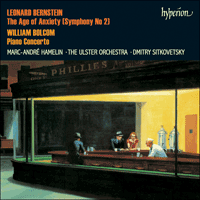



These two important American works for piano and orchestra are rather different stylistically but both are concerned with the very 20th-century issues of man's purpose in life and his place in a society when there are no longer any absolute values. As such they are far removed from the conventional idea of the concerto as display piece and both integrate piano and orchestra symphonically (indeed Bernstein calls his work a symphony).
Bernstein's The Age of Anxiety is based on a poem of that name by W.H.Auden and its contents follow closely the narrative of that work. It is a moving and predominantly sombre composition though The Masque section is an exhilarating, jazz-inspired piece.
Bolcom has, rather like Ives before him, always integrated the disparate styles of popular and serious music in his work and his concerto is no exception. The piece was written in 1976 as a cynical response to the glitz of the American bicentennial celebrations. Though the many quotations from American popular songs in the last movement are meant to be ironic, to most listeners their effect is of a riot of musical humour.
Though not much represented in his output for Hyperion, Marc-André Hamelin has long made a speciality of American contemporary music. His feel for jazz and the rhythmic drive of much of this music and his interest in popular North American culture make him the ideal interpreter for these major works.

Part One
A: The Prologue – four mixed-up characters in a Third Avenue bar try to sort themselves out: Quant, son of an Irish immigrant; Malin, a medical intelligence officer in the Canadian Air Force; Rosetta, a buyer for a big department store; and Emble, who is in the Navy. A very soft duet for clarinets is followed by a scalic descent on the flute acting as a ‘bridge into the realms of the unconscious’.
B: The Seven Ages – a four-fold discussion, ‘reasonable and didactic in tone’.
The seven variations, without a common theme, arise from aspects of previous sections.
1: A lyrical piano solo ending with the scalic descent on the harp.
2: Interactions between piano and orchestra.
3: Cantabile strings without piano.
4: A miniature scherzo in five-time (3/8 + 2/8).
5: A clarinet initiates a restless agitato.
6: A wistful piano solo.
7: Woodwinds lead into a long scalic descent from the piano.
C: The Seven Stages – seven more variations representing a dream-odyssey which symbolizes the inner journey of the four characters in various relationships leading to a ‘hectic but indecisive close’.
8: A heavy passacaglia – a regular six-note figure in the bass.
9: A waltz related to the passacaglia theme, which increasingly dominates.
10: The piano leads off into rapid seven-beat figures (4/4 + 3/4).
11: The piano leads in a fugato.
12: A light moto perpetuo, mostly piano.
13: The piano retires and the passacaglia theme enters like a chorale.
14: The piano returns to dominate the ending.
Part Two
A: The Dirge – expressing the feelings of the four as they take a taxi together to Rosetta’s apartment and lament the lack of a father-figure to disentangle their problems. The piano introduces the dirge with a rising Bergian twelve-note row. Bernstein described the middle section (mostly piano solo) of this ‘strangely pompous lamentation’ as of ‘almost Brahmsian romanticism’.
B: The Masque – now the group at the apartment is ‘weary, guilty, determined to have a party, each one afraid of spoiling the others’ fun by admitting he should be home in bed’. This is a brilliant jazz-derived scherzo with an enchanting accompaniment of harp, celesta and percussion.
C: The Epilogue – the party has purged the four characters of their past and they now look towards faith as ‘something pure’, symbolized by the sound of a solo trumpet preceded by a distant piano in the orchestra playing echoes of the jazz masque. Then the tone becomes serious: a kind of chorale with interpolations, a piano cadenza recalling earlier themes, more distant piano, followed by a slow affirmation. Originally the piano was left out of the epilogue, apart from the one solo chord at the end. But in 1965 Bernstein revised this section to keep the piano involved. The opening duet for clarinets, the third variation and the main theme of the Epilogue all come from earlier works (see Leonard Bernstein by Humphrey Burton, 1994), but the overall conception behind this symphony about the individual desperately trying to make sense of his/her own destiny is a recurring theme in Bernstein’s life and work. Here, in tandem with Auden, he embodies the dilemma in a unique way.
William Bolcom, born in Seattle, Washington, in 1938, is one of the most vivid characters amongst living American composers. As a performer he is a wonderfully idiomatic ragtime pianist and a stylish accompanist in all kinds of music, especially the repertoire he has pioneered with his wife Joan Morris. His refusal to segregate popular and classical idioms is an attractive feature of his Piano Concerto, a 1976 commission from the Seattle-based group PONCHO. The first performance was given at Seattle by the composer with the Seattle Symphony Orchestra under Milton Katims on 8 March 1976.
In his programme notes for the first performance of the Concerto Bolcom referred to it as ‘one of the bitterest pieces’ he had yet written. This was largely his reaction to the whole question of the American Bicentennial celebrations. With John Cage he wondered what could be celebrated with a straight face. However, it is difficult for music to be specifically ironic and Bolcom discovered that listeners enjoyed the riotous potpourri of popular tunes in his finale in much the same way that they respond to the last movement of Shostakovitch’s Fifth Symphony – at face value. He has pointed out that the Concerto is ‘a very direct piece … and in many ways a wry commentary on the Gershwin F major Concerto, particularly in its episodic form’. This does emerge, but overall, like Bolcom’s earlier ‘Commedia’ and later Fifth Symphony, the Concerto mixes styles in a way that is absolutely personal in a context where the soloist is far removed from the victorious hero of some nineteenth-century concerto scenarios.
I: Andante spianato – Allegro
The first movement opens with the simplest kind of C major walking bass from the piano in a way which recalls Milhaud, one of Bolcom’s teachers, or the opening of Copland’s Clarinet Concerto. The brass poke in some blue notes and then everyone starts to decorate. The episodes which follow alternate more dissonant styles with popular types. The piano hints at habanera, introduces pop music clichés, and then explores the sound of harmonics. There’s an intimate solo with a Spanish tinge which the piano shares around before getting into stride tempo to build to the climax. When it comes this is the opening C major texture exultant in the full orchestra followed by what the composer originally called ‘a terse, tragic coda’.
II: Regrets
If Bolcom had not told us that the second movement opens with what he calls ‘an ironic answer to the lovely clarinet beginning of the Gershwin Concerto slow movement’ we would never have guessed. There is much delicate question-and-answer between the soloist, marked ‘conversational’ to begin with, and the mood is introspective as if to create a foil for what comes next.
III: Finale
The slow movement runs straight into the finale, which is a mix-up that Bolcom tells us is ‘ridiculous and terrifying at the same time’. Charles Ives, with some of the same tunes, taught us the uninhibited enjoyment of such capers and it is notable that Bolcom completed his Concerto only two years after the Ives centenary. He has said that the finale is ‘intentionally like one of those TV cavalcades of the period, with every patriotic emblem heaved at us all at once in a mad collage’. It starts with fragments of ‘Yankee Doodle’; then introduces ‘Dixie’s Land’ and ‘Columbia the Gem of the Ocean’; then there’s a ‘pseudo-patriotic’ theme featured by the piano, but introduced just before by the cornet, which is Bolcom’s own. It feels like a nineteenth-century popular march complete with the barbershop chord routines. There’s a sentimental cornet solo in the middle, supported by bell effects, which turns into a country waltz then ups it into Broadway tempo. Occasionally the piano tries to be more sober – but not for long – and the ‘pseudo-patriotic’ theme comes back in the full orchestra with all the exhilaration of the real thing. Nobody but Bolcom could have dreamt up such a menagerie of Americana – triumphant in the end.
Peter Dickinson © 2000
Première partie
A: Le Prologue – quatre personnages déboussolés, dans un bar de la Troisième Avenue, tentent de s’en sortir : Quant, fils d’un immigrant irlandais ; Malin, médecin-officier de renseignements dans l’armée de l’air canadienne ; Rosetta, responsable des achats pour un grand magasin ; et Emble, qui est dans la Navy. Un très doux duo pour clarinettes est suivi d’une descente en gammes, à la flûte, qui sert de « pont menant au royaume de l’inconscient ».
B: Les Sept âges – une discussion à quatre, « au ton raisonnable et didactique ».
Les sept variations, dépourvues de thème commun, dérivent d’aspects de sections précédentes.
1: Un lyrique solo de piano, qui s’achève par la descente en gammes, à la harpe.
2: Interactions entre le piano et l’orchestre.
3: Cordes cantabile, sans le piano.
4: Un scherzo miniature à cinq temps (3/8 + 2/8).
5: Une clarinette lance un agitato animé.
6: Un mélancolique solo de piano.
7: Les bois débouchent sur une longue descente en gammes, émanant du piano.
C. Les Sept étapes – sept nouvelles variations, qui représentent un rêve-odyssée, symbole du voyage intérieur des quatre personnages, liés par diverses relations, pour aboutir à une « fin mouvementée mais peu concluante ».
8: Une lourde passacaille – une régulière figure de six notes, à la basse.
9: Une valse rattachée au thème de la passacaille, qui domine de plus en plus.
10: Le piano introduit de rapides figures à sept temps (4/4 + 3/4).
11: Le piano conduit à un fugato.
12: Un léger moto perpetuo, essentiellement au piano.
13: Le piano se retire et le thème de la passacaille fait son entrée, tel un choral.
14: Le piano revient dominer la conclusion.
Deuxième partie
A: Le Chant funèbre – expression des sentiments des quatre personnages lorsqu’ils prennent un taxi pour l’appartement de Rosetta et déplorent l’absence d’une figure paternelle à même de démêler leurs problèmes. Le piano introduit le chant funèbre par une série dodécaphonique ascendante, bergienne. Bernstein décrivit la section centrale (le plus souvent, un solo de piano) de cette « lamentation étrangement pompeuse » comme étant « d’un romantisme quasi brahmsien ».
B: Le Masque – le groupe, arrivé à l’appartement, se sent « fatigué, coupable, décidé à faire la fête, chacun redoutant de gâcher la joie des autres en reconnaissant qu’il devrait être chez lui, dans son lit ». Ce brillant scherzo, dérivé du jazz, recèle un enchanteur accompagnement de harpe, célesta et percussion.
C: L’Épilogue – la fête a débarrassé de leur passé les quatre personnages, qui se tournent désormais vers la foi comme vers « quelque chose de pur », symbolisé par le son d’une trompette solo, que précède un lointain piano, dans l’orchestre, jouant des échos du masque jazz. Puis le ton se fait sérieux : sorte de choral avec interpolations, cadenza pianistique rappelant les thèmes antérieurs, piano plus lointain, suivi d’une lente affirmation. À l’origine, le piano était exclu de l’épilogue, hormis l’unique accord solo, à la fin. Mais, en 1965, Bernstein révisa cette section afin de conserver la participation de l’instrument.
Le duo d’ouverture pour clarinettes, la troisième variation et le thème principal de l’Épilogue proviennent tous d’œuvres antérieures (cf. Leonard Bernstein de Humphrey Burton, 1994), mais la notion cachée derrière cette symphonie – celle de l’individu tentant désespérément de donner un sens à sa destinée – est un thème récurrent dans la vie et l’œuvre de Bernstein. Ici, de conserve avec Auden, il exprime ce dilemme d’une manière unique.
Né en 1938 à Seattle (Washington), William Bolcom est l’un des plus brillants compositeurs américains actuels. Pianiste de ragtime merveilleusement idiomatique, il est aussi un fin accompagnateur dans tous les genres musicaux, mais surtout dans le répertoire qu’il a défriché avec sa femme Joan Morris. Son refus d’opérer une ségrégation entre styles populaire et classique est une séduisante caractéristique de son Concerto pour piano, commandé en 1976 par le groupe PONCHO, basé à Seattle. La première de cette œuvre fut donnée le 8 mars 1976, à Seattle, par le compositeur et l’Orchestre Symphonique de Seattle, sous la direction de Milton Katims.
Dans les notes de programme qu’il rédigea pour la première, Bolcom parle de ce Concerto comme de « l’une des pièces les plus âpres » qu’il ait jamais écrites. Cette pièce fut avant tout sa réaction à la question des célébrations du bicentenaire américain, John Cage et lui se demandant ce qui pourrait être célébré avec sérieux. Toutefois, il est difficile pour la musique d’être expressément ironique et Bolcom découvrit que les auditeurs goûtaient l’exubérant pot-pourri d’airs populaires de son finale à peu près de la même manière qu’ils répondaient au dernier mouvement de la Cinquième symphonie de Chostakovitch – en le prenant pour argent comptant. Le Concerto est, souligne-t-il, « une pièce fort directe … et, à bien des égards, un commentaire désabusé sur le Concerto en fa majeur de Gershwin, notamment dans sa forme épisodique ». Ce qui apparaît effectivement, quoique d’une manière globale, et, à l’instar de sa « Commedia » antérieure et de sa Cinquième symphonie ultérieure, le Concerto mélange les styles d’une façon complètement personnelle, dans un contexte où le soliste est bien loin du héros victorieux de certains scénarios de concertos du XIXe siècle.
I: Andante spianato – Allegro
Le premier mouvement débute par la plus simple « walking bass » en ut majeur qui soit, au piano, d’une manière qui rappelle Milhaud, l’un des professeurs de Bolcom, ou l’ouverture du Concerto pour clarinette de Copland. Les cuivres lancent quelques « blue notes », puis chacun commence d’ornementer. Les épisodes suivants alternent des styles davantage dissonants et des styles populaires. Le piano insinue une habanera, introduit des clichés de musique pop, puis tente d’être sérieux avec des harmoniques. L’on remarque un solo intime, aux nuances espagnoles, que le piano partage un peu avant de prendre le tempo pour aboutir à l’apogée. Au moment où il survient, l’on retrouve la texture d’ouverture en ut majeur, exultante, au grand orchestre, suivie de ce que le compositeur qualifia originellement de « coda brusque, tragique ».
II: Regrets
Si Bolcom ne nous avait dit que le second mouvement s’ouvre sur ce qu’il appelle « une réponse ironique au charmant début, à la clarinette, du mouvement lent du Concerto de Gershwin », nous ne l’aurions jamais deviné. Il renferme un fort délicat jeu de question-réponse avec le soliste, marqué « conversationnel » pour commencer, et l’atmosphère est introspective, comme pour mettre en valeur ce qui suit.
III: Finale
Le mouvement lent aboutit directement au Finale, confusion « à la fois ridicule et terrifiante », pour citer Bolcom. Charles Ives, avec certaines des mêmes mélodies, nous a enseigné la joie sans retenue de ce genre de farces et Bolcom acheva justement son Concerto deux années seulement après le centenaire d’Ives. Ce finale « ressemble délibérément », selon le compositeur, « à l’une de ces cavalcades que l’on voyait à l’époque, à la télévision, où tous les emblèmes patriotiques nous sont jetés en même temps, dans un collage fou ». Il s’ouvre sur des fragments de « Yankee Doodle », avant d’introduire « Dixie’s Land » et « Columbia the Gem of the Ocean » ; s’ensuit un thème « pseudo-patriotique » présenté par le piano, mais introduit juste avant par le cornet, qui est celui de Bolcom. Cela ressemble à une marche populaire du XIXe siècle, avec ses accords en harmonie étroite. Un sentimental solo de cornet intervient au milieu, soutenu par des effets de cloche, avant de se muer en une valse paysanne, pour bondir dans le Broadway Tempo. Parfois, le piano tente d’être plus sobre – mais jamais longtemps – et le thème "pseudo-patriotique" revient, au grand orchestre, avec toute l’exaltation du vrai de vrai. Seul Bolcom pouvait imaginer pareille ménagerie de ce qui fait l’Amérique – triomphante, en définitive.
Peter Dickinson © 2000
Français: Hypérion
Teil 1
A: Prolog – vier konfuse Gestalten sitzen in einer Bar an der Third Avenue und versuchen ihre Probleme zu lösen: Quant, der Sohn eines irischen Einwanderers; Malin, Mediziner im Nachrichtendienst der kanadischen Luftwaffe; Rosetta, Einkäuferin bei einem großen Kaufhaus; und Emble, der in der Marine dient. Einem ausgesprochen leisen Duett für Klarinetten folgt eine abwärts gerichtete Flötenskala, die als ‘Brücke ins Reich des Unbewußten’ dient.
B: Die sieben Zeitalter – eine Diskussion zu viert, ‘vernünftig und in lehrhaftem Ton’.
Die sieben Variationen ohne gemeinsames Thema ergeben sich aus Aspekten der vorangegangenen Abschnitte.
1: Ein lyrisches Klaviersolo, das mit der absteigenden Skala auf der Harfe endet.
2: Interaktionen zwischen Klavier und Orchester.
3: Cantabile-Streicher ohne Klavier.
4: Ein Miniaturscherzo im Fünfertakt (3/8 + 2/8).
5: Eine Klarinette initiiert ein rastloses Agitato.
6: Ein wehmütiges Klaviersolo.
7: Holzbläser leiten über zu einer langen absteigenden Skala auf dem Klavier.
C: Die sieben Stadien – weitere sieben Variationen stellen eine Traumodyssee dar, welche die innere Reise der vier Gestalten in verschiedenen Beziehungen symbolisiert und in einem ‘hektischen, aber ergebnislosen Schluß’ mündet.
8: Eine gewichtige Passacaglia – eine regelmäßige, aus sechs Noten bestehende Figur im Baß.
9: Ein Walzer, verwandt mit dem Passacaglia-Thema, das zunehmend dominiert.
10: Das Klavier führt schnelle Figuren im Siebenertakt (4/4 + 3/4) ein.
11: Das Klavier spielt die führende Rolle in einem Fugato.
12: Ein leichtes Moto perpetuo, größtenteils piano gehalten.
13: Das Klavier zieht sich zurück, und das Passacaglia-Thema setzt choralartig ein.
14: Das Klavier kehrt wieder und beherrscht den Schluß.
Teil 2
A: Der Trauergesang – er drückt die Gefühle der Vier aus, als sie gemeinsam ein Taxi zu Rosettas Wohnung nehmen und das Fehlen einer Vaterfigur beklagen, die ihre Probleme entwirren könnte. Das Klavier stellt den Trauergesang mit einer ansteigenden Zwölftonreihe im Stil von Alban Berg vor. Bernstein hat den (vorwiegend als Klaviersolo konzipierten) Mittelteil dieser ‘seltsam pompösen Wehklage’ als von ‘beinahe Brahmsscher Romantik’ beschrieben.
B: Das Maskenspiel – nun ist die Gruppe in der Wohnung ‘müde, schuldbewußt, zum Feiern entschlossen; jeder von ihnen hat Angst, den anderen den Spaß zu verderben, indem er zugibt, daß er eigentlich zu Hause im Bett sein sollte’. Dies ist ein brillantes, aus Jazzelementen abgeleitetes Scherzo mit bezaubernder Begleitung aus Harfe, Celesta und Schlagzeug.
C: Der Epilog – das Fest hat die Vier von ihrer Vergangenheit gereinigt, und sie betrachten den Glauben nun als ‘etwas Reines’, symbolisiert durch den Klang einer Solotrompete; ihr voran geht ein fernes Klavier im Orchester, das Echos des Jazz-Maskenspiels vorträgt. Dann wird der Tonfall ernst: eine Art Choral mit Einwürfen, eine Klavierkadenz, die an vorangegangene Themen erinnert, weiteres fernes Klavier, gefolgt von einer langsamen Bekräftigung. Ursprünglich war im Epilog kein Klavier vorgesehen, außer für den einen Solo-Akkord am Schluß. Bernstein hat diesen Abschnitt jedoch 1965 dahingehend überarbeitet, daß das Klavier beteiligt bleibt.
Das einleitende Duett für Klarinetten, die dritte Variation und das Hauptthema des Epilogs stammen alle aus früheren Werken (siehe Leonard Bernstein von Humphrey Burton, 1994), aber das Gesamtkonzept der Sinfonie, das davon handelt, wie das Individuum seinem Schicksal verzweifelt einen Sinn abzugewinnen versucht, kommt als Thema in Bernsteins Leben und Werk mehrfach vor. Hier verleiht er zusammen mit Auden dem Dilemma einzigartigen Ausdruck.
William Bolcom, 1938 in Seattle im US-Bundesstaat Washington geboren, ist eine der schillerndsten Gestalten unter den lebenden amerikanischen Komponisten. Als Interpret ist er ein wunderbar idiomatischer Ragtime-Pianist und ein stilsicherer Begleiter von Musik aller Art, insbesondere dem Repertoire, das er mit seiner Frau Joan Morris initiiert hat. Seine Weigerung, populäre und klassische Formen getrennt zu halten, ist ein attraktives Merkmal seines Klavierkonzerts, das 1976 von der in Seattle ansässigen Gruppe PONCHO in Auftrag gegeben wurde. Die Uraufführung gab der Komponist mit dem Seattle Symphony Orchestra unter der Leitung von Milton Katims am 8. März 1976 in Seattle.
In seinem Beitrag zum Programmheft der Uraufführung bezeichnete es Bolcom als ‘eines der bittersten Stücke’, das er je geschrieben habe. Es war im wesentlichen seine Reaktion auf den ganzen Problemkreis der Feiern zum zweihundertjährigen Bestehen der USA. Wie John Cage fragte er sich, was es allen Ernstes zu feiern gebe. Doch ist es schwierig, Musik eindeutig ironisch zu gestalten, und Bolcom stellte fest, daß das Publikum das turbulente Potpourri populärer Melodien im Finale in ähnlicher Weise für bare Münze nahm und ebenso genoß wie den letzten Satz von Schostakowitschs Fünfter Sinfonie. Er hat darauf hingewiesen, daß das Konzert ‘ein sehr direktes Stück’ ist, und ‘speziell durch seinen episodischen Aufbau in vielerlei Hinsicht ein ironischer Kommentar zu Gershwins F-Dur-Konzert’. Das ist wohl herauszuhören, aber insgesamt mischt Bolcoms Konzert ebenso wie seine vorangegangene ‘Commedia’ und seine spätere Fünfte Sinfonie verschiedene Stile auf eine Art, die ihm absolut eigen ist, in einem Kontext, in dem der Solist alles andere darstellt als den siegreichen Helden mancher Konzertszenarien des 19. Jahrhunderts.
I: Andante spianato – Allegro
Der erste Satz beginnt mit einem Laufbaß der schlichtesten Art in C-Dur vom Klavier, der an Milhaud erinnert, einen von Bolcoms Lehrern, oder an den Anfang von Coplands Klarinettenkonzert. Das Blech meldet sich mit einigen blue notes zu Wort, und dann beginnen alle mit Verzierungen. Die folgenden Episoden wechseln eher dissonante Stile mit populären ab. Das Klavier deutet eine Habanera an, bietet Klischees aus der Popmusik dar und versucht sich dann an Ernsthaftem mit Flageolett-Tönen. Ein intimes Solo mit spanischen Anklängen wird vom Klavier rundum verteilt, ehe es ein stride-Tempo anschlägt, um zum Höhepunkt aufzubauen. Wenn der schließlich einsetzt, besteht er aus dem einleitenden C-Dur-Material, unbändig vom ganzen Orchester dargeboten; es folgt, was der Komponist ursprünglich eine ‘knappe, tragische Coda’ genannt hat.
II: Regrets
Wenn Bolcom uns nicht mitgeteilt hätte, daß der zweite Satz mit etwas beginnt, das er ‘eine ironische Antwort auf die wunderbare Klarinette am Anfang des langsamen Satzes von Gershwins Konzert’ nennt, wären wir nie darauf gekommen. Es gibt viel feinfühliges Frage-und-Antwort-Spiel zwischen Solist und Orchester, das zu Beginn mit ‘conversational’ [im Plauderton] bezeichnet wird, und die Stimmung ist versonnen, als wolle sie sich vom Folgenden abheben.
III: Finale
Der langsame Satz geht ohne Unterbrechung ins Finale über, dessen Konfusion Bolcom als ‘lächerlich und erschreckend zugleich’ beschreibt. Charles Ives hat uns unter Verwendung einiger der gleichen Melodien beigebracht, welch ungehemmte Freude solche Kapriolen bringen, und es ist bezeichnend, daß Bolcom sein Konzert nur zwei Jahre nach den Gedenkfeiern zu Ives’ hundertstem Geburtstag fertiggestellt hat. Dem Komponisten zufolge erinnert das Finale ‘bewußt an die damals üblichen Bildfolgen im Fernsehen, die einem, zur wilden Collage zusammengestellt, jedes erdenkliche patriotische Emblem entgegenschleudern’. Es beginnt mit Fragmenten von ‘Yankee Doodle’, stellt dann ‘Dixie’s Land’ und ‘Columbia the Gem of the Ocean’ vor; als nächstes ist ein ‘pseudopatriotisches’ Thema aus Bolcoms eigener Feder zu hören, vom Klavier herausgehoben, aber kurz zuvor vom Kornett eingeführt. Das Ganze gleicht von der Stimmung her einem volkstümlichen Marsch aus dem 19. Jahrhundert, komplett mit alterierten Akkorden im barbershop-Stil. In der Mitte steht ein sentimentales Kornettsolo, unterstützt von Glockeneffekten, das sich in einen ländlichen Walzer verwandelt, um dann ein flottes Broadway-Tempo anzuschlagen. Gelegentlich bemüht sich das Klavier um mehr Ernst, aber nicht lange, und das ‘pseudopatriotische’ Thema kehrt im ganzen Orchester zurück, mit dem ganzen Hochgefühl von wahrem Patriotismus. Niemand anders als Bolcom hätte sich solch eine Menagerie musikalischer Amerikana ausdenken können – am Ende ein Triumph.
Peter Dickinson © 2000
Deutsch: Anne Steeb/Bernd Müller