
Welcome to Hyperion Records, a British classical label devoted to presenting high-quality recordings of music of all styles and from all periods from the twelfth century to the twenty-first.
Hyperion offers both CDs, and downloads in a number of formats. The site is also available in several languages.
Please use the dropdown buttons to set your preferred options, or use the checkbox to accept the defaults.
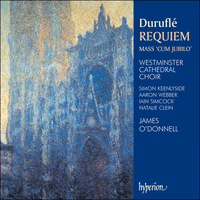



The Requiem
Duruflé was working on a suite of organ pieces based on plainsong from the Mass for the Dead when the commission for the Requiem arrived from his publishers, Durand. The sketches already on his desk proved themselves an ideal starting point, the plainsong becoming the basis of the whole work, unifying it and breathing into it the timelessness and meditative spirituality that are its essence. The model is Fauré’s Requiem; but this is no mere imitation, rather a reworking within the structure and mood established by the older composer, born of admiration and respect. Fauré chose to break away from the examples typified by Berlioz and Verdi and their tragic, blazing images of hell-fire and heaven-storming grief. He omitted the ‘Day of Judgement’ texts and concentrated instead on rest and peace, even going so far as to borrow the In Paradisum from the Burial Service. Duruflé sets the same texts as Fauré (although the division into movements is a little different, and he retains the Benedictus) and adopts a similarly restrained approach. Both use a baritone soloist in the Domine Iesu Christe and Libera me, and a treble for the Pie Iesu. Duruflé opens the work within the same tonality as Fauré, the Offertory with the same voices, and the Pie Iesu in an identical fashion. The structure of the Sanctus owes a huge debt to Fauré’s example, as do the Libera me and In Paradisum—yet the overall effect transcends the possible limitations of such a fine model, and gives us something very original.
The strength of Duruflé’s composition lies in its extraordinary fusion of disparate elements—plainsong, liturgical modality, subtle counterpoint, and the sensuous harmonies and refined scoring of Debussy, Ravel and Dukas. Duruflé’s often literal use of plainsong melody gives the work a great expressive and rhythmic freedom and results in a natural flow of both text and music. When seated within such colourful tonalities and underpinned with modal harmonies, the emotional impact is heightened, yet somehow the all-pervading tranquillity and spiritual optimism is maintained. The Introit flows smoothly, the plainsong rendered note for note, moving into the imitative entries of the Kyrie and its heartfelt pleas for mercy. In the Domine Iesu Christe the text is dramatically declaimed by the choir until Saint Michael leads them into the heavenly light and assures them of the promise of peace. The Sanctus takes the form of an instrumental moto perpetuo against which the voices are cleverly built into a climax at ‘Hosanna in excelsis’, then subsiding, arch-like, to a peaceful conclusion. The Pie Iesu is the physical and emotional centre of the work, a poignant and almost painfully beautiful setting of the plainsong for treble and solo cello, supported by harmonies rich in seconds and sevenths. The Agnus Dei moves us gently onward, yet without detracting from the atmosphere left by the preceding movement. Duruflé weaves an expressive counter-melody around the plainsong, avoiding any dryness of expression without affecting the delicacy of the scoring. More imaginative touches are found in the Lux aeterna—the vocalizing of the lower voices beneath the trebles, and the unison chanting of ‘Requiem aeternam’ over changing chords. The Libera me brings lengthier development, and the dramatic climax of the whole work with the ‘Dies illa’; the last ‘Libera me’, like Fauré’s, is sung in unison to the end of the movement. The final movement, In Paradisum, is an exquisite creation; the opening chords form an ethereal mist from which the trebles emerge, finally at peace. The sensuous chords of the full choir add to the spiritual tranquillity, and the last chord, an unresolved dominant ninth, evaporates into eternity.
Quatre motets sur des thèmes grégoriens
The four motets of 1960 are ideal companion pieces for the Requiem, each being based on the requisite Gregorian chant in the same way as the movements of the larger work. Here again Duruflé shows his particular genius for invoking the spiritual element of plainsong in a polyphonic context, achieving a suppleness of rhythm alongside strong characterization of each text. Ubi caritas et amor flows freely and syllabically in a meditative fashion, while Tota pulchra es (for high voices) is lighter and more sprightly, yet soft and feminine. Tu es Petrus is a rousing and optimistic work, the churches’ foundation on the rock of Peter being indicated by the building of the motet on its canonic opening to a strong and sturdy final cadence. Tantum ergo returns us to the meditative, wistful style which characterizes so much of the Requiem; the concluding ‘Amen’ settles as a sigh on this group of motets, crystallizing as they do the essence of Duruflé’s considered, yet inspired musical language.
Notre Père
As with the other works on this recording, this setting of the Lord’s Prayer clearly demonstrates how Duruflé’s few choral works were fashioned for liturgical use; the French text is used, and set without the doxology. Each phrase is presented separately and with a straightforward homophony which suggests the rhythm of contemplative speech or prayer. The work was published in 1978 and is dedicated to the composer’s wife.
Mass ‘Cum jubilo’
The Mass ‘Cum jubilo’ suggests even more forcefully than does the Requiem the distaste Duruflé felt for ‘excessive’ settings of the text such as had been favoured during the preceding decades. Here only the lower voices from the choir are used and these voices present the text in unison. There are just two short solo sections: in the Gloria at the words ‘Domine fili …’ and in the Benedictus. The comparable work by Fauré is the Messe Basse but even this allows the choir (of two equal-pitch parts for high voices) to sing harmony. Duruflé’s use of plainsong themes is at once apparent but again these are used with a subtlety which belies their underlying simplicity. The organ part contributes to this effect. The flourish which announces the Gloria marks the key moment for the glory of God to be celebrated in the Mass while, by contrast, the accompaniment to the closing movements—the Sanctus, Benedictus and Agnus Dei, which complement the act of communion itself—suggests an atmosphere of ethereal journeying and a more detached wonder at the divine presence. This is music for the Catholic Mass at its most practical level, but also at its most beautiful.
Wadham Sutton © 1989
Le Requiem
Duruflé travaillait à une suite de morceaux d’orgue basés sur le plain-chant de la Messe des Morts, lorsqu’il reçut de son éditeur, Durand, la commande du Requiem. Les esquisses qui se trouvaient déjà sur son bureau lui fournirent un point de départ idéal pour le Requiem, le plain-chant devenant la base de toute l’œuvre, l’unifiant et lui conférant le sentiment d’éternité et la spiritualité méditative qui constituent son essence. Il prit pour modèle le Requiem de Fauré; mais ce n’est pas une simple imitation, plutôt une re-création, dans le cadre et l’atmosphère établis par son aîne, pour qui il éprouvait admiration et respect. Fauré s’était écarté des exemples de Berlioz et de Verdi, images brûlantes de feu infernal et de chagrin qui défie le paradis. Il avait omis les textes du Jugement Dernier pour se concentrer sur le repos et la paix, allant jusqu’à emprunter le In Paradisum de l’Office des Morts. Duruflé prend les mêmes textes que Fauré (mais sa division en mouvements est légèrement différente et il conserve le Benedictus) et adopte une attitude tout aussi retenue. L’un et l’autre utilisent un baryton solo dans le Domine Iesu Christe et le Libera me, et une soprano pour le Pie Iesu. Duruflé commence l’œuvre dans la même tonalité que Fauré, l’Offertoire avec les mêmes voix et le Pie Iesu de la même manière. La structure du Sanctus doit beaucoup à l’exemple de Fauré, ainsi que celle du Libera me et d’In Paradisum; mais l’effet général dépasse les limites d’un si beau modèle et nous donne une composition très originale.
La puissance de la composition de Duruflé provient de sa fusion extraordinaire d’éléments disparates: plain-chant, modes liturgiques, contrepoint subtil, et les harmonies sensuelles et l’orchestration raffinée de Debussy, Ravel et Dukas. La façon parfois littérale dont Duruflé utilise la mélodie du plain-chant donne à l’œuvre une grande liberté rythmique et expressive, et produit un déroulement naturel du texte et de la musique. Enveloppée de ces tonalités colorées et soutenue par des harmonies modales, l’émotion est renforcée, mais malgré tout la tranquillité dominante et l’optimisme spirituel sont maintenus. L’Introit coule sans heurt, le plain-chant est reproduit note pour note, menant aux entrées imitatives du Kyrie et à ses appels bien sentis à la clemence. Dans le Domine Iesu Christe, le texte est declamé de façon dramatique par le chœur, jusqu’à ce que St Michel le conduise vers la lumiere divine et lui promette la paix. Le Sanctus prend la forme d’un moto perpetuo instrumental sur lequel les voix s’élèvent en un crescendo bien calculé à l’«Hosanna in excelsis», puis retombent, en forme de voûte, pour arriver à une conclusion paisible. Le Pie Iesu est le centre physique et émotionnel de l’œuvre, avec une mélodie poignante et d’une beauté presque douloureuse en plain-chant, pour soprano et violoncelle solo, soutenue par des harmonies où abondent les secondes et les septièmes. L’Agnus Dei va doucement de l’avant, sans toutefois détruire l’atmosphère du mouvement précédent. Duruflé tisse une contre-mélodie expressive autour du plain-chant, évitant ainsi toute sécheresse d’expression sans affecter la délicatesse de l’orchestration. On trouve d’autres détails originaux dans le Lux aeterna: la vocalisation des voix basses en dessous des sopranos, et le chant à l’unisson de «Requiem aeternam» sur des accords changeants. Le Libera me amène un plus long développement et l’apogée dramatique de l’œuvre avec le «Dies illa»; le dernier «Libera me» comme celui de Fauré, est chanté à l’unisson jusqu’à la fin du mouvement. Le dernier mouvement, In Paradisum, est une composition exquise; les premiers accords du chœur au complet renforcent la tranquillité spirituelle et le dernier accord, de neuvième de dominante sans résolution, s’évapore dans l’éternité.
Quatre motets sur des thèmes grégoriens
Les quatre motets de 1960 sont des morceaux idéaux pour accompagner le Requiem, car chacun est basé sur le chant grégorien approprié, de la même façon que les mouvements de ce dernier. Là aussi, Duruflé révèle son talent particulier pour faire ressortir l’élément spirituel du plain-chant dans un contexte polyphonique tout en obtenant un rythme souple apparenté à la prière humaine. Ubi caritas et amor coule librement, de façon syllabique et méditative, alors que Tota pulchra es (pour voix hautes) est plus léger et plus gai tout en restant doux et féminin. Tu es Petrus est un morceau entraînant et optimiste: la fondation de l’église sur un rocher est suggérée par la construction du motet sur son ouverture en canon jusqu’à sa dernière cadence robuste. Tantum ergo nous ramene au style mélancolique et méditatif qui caractérise une grande partie du Requiem; l’«Amen» final tombe comme un soupir sur ce groupe de motets, cristallisant comme eux l’essence du langage musical étudié, mais inspiré, de Duruflé.
Notre Père
Tout comme les œuvres présentées sur cet enregistrement, cette mise en musique de l’Oraison Dominicale démontre clairement la façon dont les quelques œuvres pour chœur de Duruflé étaient arrangées pour l’utilisation liturgique; le texte français est utilisé et mis en musique sans doxologie. Chaque phrase est mise en musique séparément et avec une homophonie sans détour, suggérant un rythme de prière ou d’oraison contemplative. L’œuvre fut publiée en 1978.
Messe «Cum jubilo»
Le Messe «Cum jubilo» suggère, encore plus que le Requiem, le dégoût que Duruflé ressentait pour les mises en musique «excessives» du texte, pratique courante pendant les décennies précédentes. Dans cette œuvre, seules les voix inférieures du chœur sont utilisées et présentent le texte à l'unisson. L’œuvre ne contient que deux sections courtes pour voix seule: dans le Gloria, aux paroles: «Domine fili …», ainsi que dans le Benedictus. Même l’œuvre similaire de Fauré, la Messe Basse, permet au chœur (deux sections de même hauteur de note pour voix aiguës) de chanter en harmonie. L’utilisation par Duruflé des thèmes de plain chant est apparent, mais encore une fois ceux-ci sont utilisés avec une subtilité qui dément leur simplicité sous-jacente. La partition pour orgue contribue à cet effet. La proclamation à son de trompe annonçant la Gloria marque le moment suprême de la célébration de la gloire de Dieu lors de la messe, alors que, par contraste, l’accompagnement des derniers mouvements—le Sanctus, le Benedictus et l’Agnus Dei qui complètent l’acte de communion même—suggère une atmosphère de voyage éthéré et un émerveillement de la présence divine plus détaché. Cette musique est destinée à la messe catholique à son niveau le plus pratique, mais aussi le plus admirable.
Wadham Sutton © 1989
Français: Hypérion
Das Requiem
Duruflé arbeitete bereits an einer Suite von Orgelstücken, die auf dem Gregorianischen Gesang aus der Totenmesse aufbaute, als der Auftrag für das Requiem von seinem Verleger Durand eintraf. Die Skizzen, die bereits auf seinem Schreibtisch lagen, erwiesen sich als idealer Ausgangspunkt für das Requiem, wobei der Gregorianische Gesang zur Basis des gesamten Werkes wurde, es vereinte und ihm die Zeitlosigkeit und meditative Spiritualität verlieh, die sein Wesen ausmachen. Sein Vorbild ist das Requiem von Fauré; doch handelt es sich nicht um eine bloße Imitation, sondern eine auf Bewunderung und Respekt gründende Neubearbeitung der von dem älteren Komponisten geschaffenen Struktur und Stimmung. Fauré entschied sich, sich von den von Berlioz und Verdi geprägten Beispielen und ihren tragischen, lodernden Bildern des Höllenfeuers und der himmelschreienden Trauer zu entfernen. Er ließ die Texte zum Tag des Jüngsten Gerichts aus und konzentrierte sich statt dessen auf die Motive Ruhe und Frieden, wobei er sogar so weit ging, das In Paradisum aus der Trauerfeier zu übernehmen. Duruflé legt die selben Texte fest wie Fauré (obgleich die Einteilung in Sätze leicht abweicht und er das Benedictus beibehält) und bedient sich eines ähnlich zurückhaltenden Zugangs. Beide setzen einen Baritonsolisten im Domine Iesu Christe und im Libera me sowie einen Knabensopran für das Pie Iesu ein. Duruflé eröffnet sein Werk in der selben Tonalität wie Fauré, das Offertorium hat die selben Stimmen, und der Stil des Pie Iesu ist identisch. Die Struktur des Sanctus steht tief in der Schuld des Beispiels von Fauré, ebenso wie das Libera me und das In Paradisum—doch der Gesamteffekt geht über die möglichen Einschränkungen eines derart edlen Vorbilds hinaus und vermittelt uns etwas von immenser Originalität.
Die Stärke der Komposition Duruflés liegt in seiner außergewöhnlichen Verbindung völlig verschiedener Elemente—Gregorianischer Gesang, liturgische Modalität, subtiler Kontrapunkt sowie die einfühlsamen Harmonien und die ausgeklügelte Instrumentierung von Debussy, Ravel und Dukas. Duruflés oft reine Verwendung der Melodien des Gregorianischen Gesangs verleiht dem Werk eine großartige expressive und rhythmische Freiheit und resultiert in einem natürlichen Fluß von sowohl Text als auch Musik. Durch die Einfassung in derart bewegte Tonalitäten und die Unterstützung durch modale Harmonien wird die emotionale Wirkung verstärkt, und dennoch bleiben die alles durchdringende Ruhe und der spirituelle Optimismus gewahrt. Der Introit fließt geschmeidig dahin, der Gregorianische Gesang ist Note für Note wiedergegeben und führt zu den imitativen Lösungen des Kyrie und seiner tiefempfundenen Bitte um Gnade. Im Domine Iesu Christe wird der Text auf dramatische Weise vom Chor verkündet, bis Sankt Michael diesen in das himmlische Licht führt und ihn des Friedensversprechens versichert. Das Sanctus nimmt die Form eines instrumentalen moto perpetuo an, gegen das sich die Stimmen in „Hosanna in excelsis“ geschickt zu einem Höhepunkt aufbauen und anschließend, einem Bogen gleich, zu einem friedlichen Abschluß senken. Das Pie Iesu ist das dingliche und emotionale Zentrum des Werkes, ein ergreifender und nahezu schmerzlich schöner Rahmen des Gregorianischen Gesangs für Knabensopran und Solocello, das von Harmonien reich an Sekunden und Septimen unterstützt wird. Das Agnus Dei geleitet uns sanft voran, jedoch ohne von der Atmosphäre abzulenken, die der vorhergehende Satz hinterlassen hat. Duruflé flicht eine ausdrucksvolle Kontramelodie um den Gregorianischen Gesang, wodurch er jede Trockenheit des Ausdrucks vermeidet, ohne daß die Feinheit der Instrumentierung beeinflußt wird. Etwas phantasievollere Details finden sich im Lux aeterna—die Vokalisierung der niedrigeren Stimmen unterhalb der Sopranstimmen und der einstimmige Gesang von „Requiem aeternam“ über wechselnden Akkorden. Das Libera me bringt eine längere Entwicklung bis zum dramatischen Höhepunkt des gesamten Werks mit dem „Dies illa“ mit sich; das letzte „Libera me“ ist wie bei Fauré bis zum Ende des Satzes einstimmig gesungen. Der letzte Satz, In Paradisum, ist eine exquisite Schöpfung; die einleitenden Akkorde bilden einen himmlischen Schleier, aus dem die Sopranstimmen hervortreten, die endlich Frieden gefunden haben. Die sinnlichen Akkorde des gesamten Chors tragen zu der spirituellen Ruhe bei, und der letzte Akkord, ein nicht aufgelöster Dominantnonenakkord, verklingt bis in alle Ewigkeit.
Quatre motets sur des thèmes grégoriens
Die Quatre motets von 1960 sind ideale Begleitstücke für das Requiem, da jedes in gleicher Weise auf dem entsprechenden Gregorianischen Gesang beruht wie die Sätze des umfangreicheren Werkes. Auch hier zeigt Duruflé sein besonderes Talent, das spirituelle Element des Gregorianischen Gesangs in einem polyphonen Kontext anzuführen, während er eine Geschmeidigkeit des Rhythmus erreicht, die dem menschlichen Gebet ähnlich ist. Ubi caritas et amor fließt frei und silbenhaft in einem meditativen Stil, während Tota pulchra es leichter und munterer, und dennoch sanft und feminin ist. Tu es Petrus ist ein mitreißendes und optimistisches Werk, die Gründung der Kirche auf dem Stein von Peter wird zum Ausdruck gebracht durch den Aufbau der Motette auf ihrer kanonischen Einleitung bis zu ihrer starken und soliden Finalkadenz. Tantum ergo bringt uns zurück zu dem meditativen, melancholischen Stil, der einen Großteil des Requiem charakterisiert: Das abschließende „Amen“ legt sich wie ein Seufzer auf diese Gruppe von Motetten, die die Essenz der wohlüberlegten und doch inspirierten musikalischen Sprache Duruflés herauskristallisieren.
Das Vaterunser
Wie die anderen in dieser Aufzeichnung enthaltenen Werke zeigt auch diese Vertonung des Vaterunsers ganz deutlich, daß Duruflés wenige Werke der Chormusik für den liturgischen Gebrauch gestaltet sind; der französische Text wird verwendet und ohne die Doxologie vertont. Jede Phrase ist gesondert vertont, und dabei wird eine einfache Homophonie verwendet, die an den Rhythmus kontemplativen Sprechens oder Betens denken läßt. Das Werk wurde 1978 veröffentlicht.
Messe „Cum jubilo“
Die Messe „Cum jubilo“ deutet sogar in noch stärkerem Maße als das Requiem an, daß Duruflé die „übertriebenen“ Vertonungen von Texten, die in den vorangegangenen Jahrzehnten beliebt waren, als geschmacklos betrachtete. Hier werden nur die tieferen Stimmen aus dem Chor benutzt, und diese Stimmen tragen den Text im Einklang vor. Es sind lediglich zwei kurze Soloabschnitte vorhanden: im Gloria bei den Worten „Domine fili …“ und im Benedictus. Das hiermit vergleichbare Werk von Fauré ist die Messe Basse, aber sogar sie gestattet dem Chor (der aus zwei hohen Gesangsstimmen, die in der gleichen Tonhöhe singen, besteht) Harmonien zu intonieren. Es ist sofort zu hören, daß Duruflé Motive des gregorianischen Gesangs benutzt, doch werden diese mit einer Raffiniertheit gebraucht, die ihre grundlegende Schlichtheit Lügen straft. Die Orgelstimme trägt zu dieser Wirkung bei. Der das Gloria einleitende Fanfarenstoß bezeichnet den wichtigen Moment, in dem die Herrlichkeit Gottes innerhalb der Messe gefeiert wird. Im Gegensatz dazu evoziert die Begleitung der Schlußsätze—des Sanktus, Benedictus und Agnus Dei, welche die Abendmahlsfeier selbst vervollkommnen—eine Atmosphäre spirituellen Emporsteigens und ein distanzierteres Entzücken angesichts der göttlichen Gegenwart. Dies ist für die katholische Messe komponierte Musik auf ihrer praktischsten, aber gleichzeitig schönsten Ebene.
Wadham Sutton © 1989
Deutsch: Anke Vogelhuber